
Happy Monday, G&GRs. The Wallabies get it done in Argentina, three in a row now under the Kiss Man! I am sure that will piss off the old Randwick boys who want to start destabilising on behalf of Cheika. So let’s take a look at that game. We’ll also have a look at the Sheep Shaggers v the Dutch dirt Farmers. A bumper edition today, boys and girls. So, pour a big cup of liquid gold☕ and get that into you while we wander into the mad, mad, mad world of Brisney.

Wallabies 27 defeated Los Pumas 21
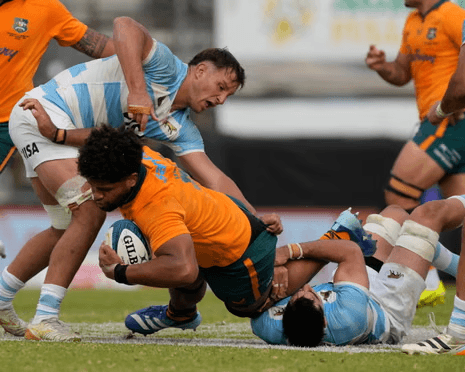
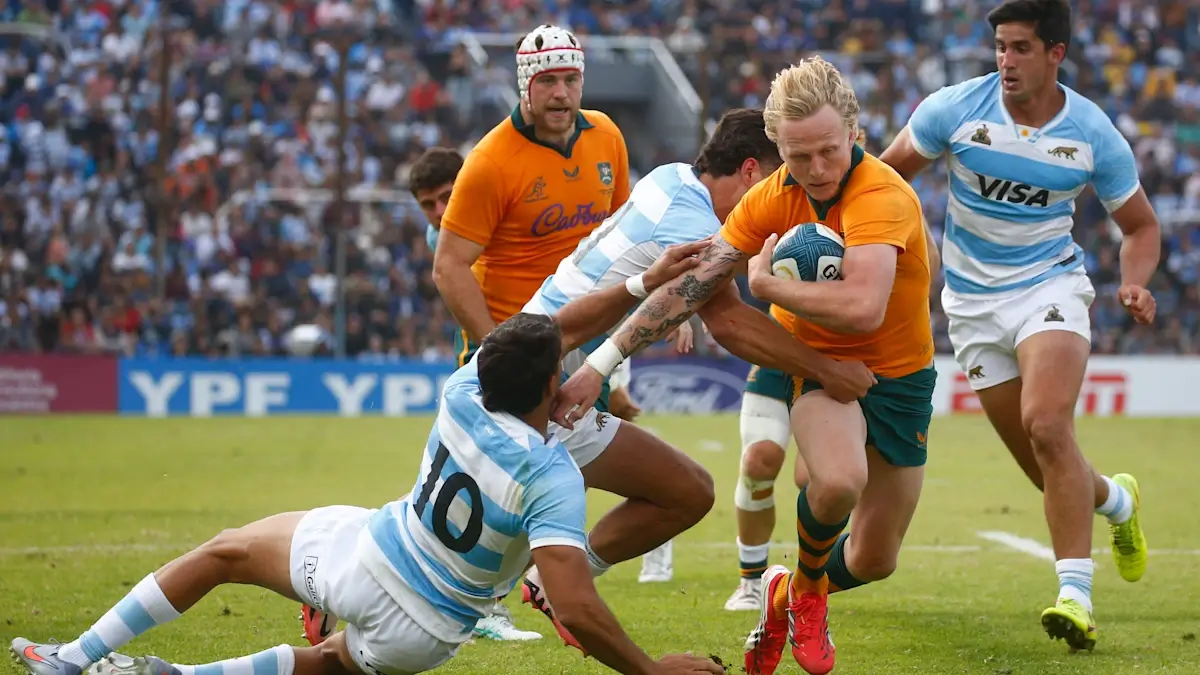
Wallabies get it done in the Argentine oven to pinch a dogged win over Los Pumas! Well, that was sweaty. The Wallabies have continued their encouraging start to the Les Kiss era, surviving heat, altitude, a hostile Argentine crowd and approximately 400 minutes of Los Pumas attack to grind out a 27-21 win in Jujuy. And make no mistake, this wasn’t one for the rugby highlight reels.
This was Test rugby. Proper Test rugby. The sort where you’re absolutely convinced your team has the game under control before spending the final 20 minutes sitting on the edge of your chair wondering why you ever believed such nonsense. Playing in the heat and altitude of northern Argentina at Estadio 23 de Agosto, the Wallabies got off to a flyer before spending much of the remaining 70 minutes being reminded that Los Pumas don’t tend to politely go away when asked.
A late Tom Hooper try proved the difference as Australia held their nerve to hand Argentina just their second-ever loss at the venue. More importantly, it gives Les Kiss another win to stick in the bank as the Wallabies continue to build something that is starting to resemble a competent international rugby team. Don’t get carried away, though. We’ve all been hurt before.
A flying start – After a tense opening few minutes, the Wallabies struck first through Brandon Paenga-Amosa. The try came after some lovely work from Josh Canham, who busted through the Argentine defence from deep before finding Jeremy Williams in support. Williams then produced the final pass for Paenga-Amosa, who crashed over.
It was exactly the sort of start the Wallabies needed. Eleven minutes in and they were at it again. Australia’s set piece was getting on top and, working the blindside, Carter Gordon found himself on the end of the attacking movement to score. Suddenly the Wallabies were up 12-0, and Australian supporters everywhere were beginning to wonder whether this might be one of those nice, relaxing afternoons.
Narrator: It was not.
Argentina hit back almost immediately through Gerónimo Priscinatelli, exposing a short Australian defensive line with their first meaningful attacking opportunity. But the Wallabies weren’t done yet. After more sustained forward pressure, Fraser McReight added Australia’s third try of the afternoon. In conditions that were already beginning to sap the energy from both sides, the game had somehow produced three Australian tries inside the opening period.
At that point, things were looking rather pleasant. Which is generally when the Wallabies start looking for ways to make things unnecessarily difficult. Enter the Pumas. Argentina began to build pressure and, with Harry Potter sent to the sin bin, the Wallabies found themselves defending their line with 14 men.
The Pumas attacked. And attacked. And attacked some more. To Australia’s credit, the defensive line held for several raids. Argentina found success through the aerial game and their work around the ruck, but the Wallabies refused to crack. Eventually, however, something had to give.
From a tap-and-go near the scrum, Joaquín Moro barged over to bring the home side back within five points. The momentum had swung. The crowd had found its voice. And every Australian rugby supporter watching had started doing the mental calculations about whether there was enough beer in the fridge to survive the second half.
Thankfully, the Wallabies had one final say before oranges. An Argentine offside penalty after the clock had gone red allowed Lonergan to knock over three points and stretch Australia’s lead to 22-14 at halftime. A handy buffer. As it turned out, they’d need every bit of it.
The second-half squeeze – Argentina came out after halftime looking like a side that had been told there was a free steak waiting for every player who could score a try. They nearly crossed twice early in the half through broken-field transitions before finally getting their reward. After a sustained period of pressure, Boris Wegner crossed in the 52nd minute.
Suddenly it was 22-21. One point. In Argentina. At altitude. In the heat. Against a Los Pumas side smelling blood. No worries.
The Wallabies needed someone to make something happen, and thankfully Hunter Paisami decided that would be him. Paisami broke the line and created the opportunity for Tom Hooper, who crossed five minutes later to restore Australia’s advantage. It wasn’t a spectacular try. It didn’t need to be. At that stage of proceedings, the Wallabies could have scored off someone’s backside, and nobody wearing gold would have complained.
The score moved to 27-21. And then began the longest 20 minutes of everyone’s lives. Hold the bloody line. Fatigue began to take over. Passes went astray. Breakdowns became messy. Possession changed hands. Players started looking like they’d spent the previous week running wind sprints up Mount Kosciuszko. The Wallabies had opportunities to finish the match off.
Jeremy Williams appeared to have scored after Australia earned a crucial attacking scrum, only for the TMO to spot a knock-on in the lead-up. Then Tate McDermott had another effort held up over the line. So instead of killing the game, the Wallabies had to go back to defending it. Because apparently winning comfortably is against the rules.
Los Pumas came again. And again. Australia attempted to pin them back and chew up the clock, while Argentina threw everything they had at the visitors. The ball changed hands at both ends of the field, and the game remained balanced on a knife edge. Finally, as the clock turned red, Matera knocked the ball on.
Tate McDermott needed no second invitation. The ball was booted into touch. Game over. Wallabies win. And somewhere across Australia, thousands of rugby supporters simultaneously unclenched. A win is a win. It wasn’t perfect. Far from it.
Les Kiss was understandably pleased with the result but acknowledged that the Wallabies had created some of their own problems by giving Argentina opportunities and field position. “Certainly happy with the win, for sure and nothing short of what we expected against a team that just kept on coming,” Kiss said. “Happy with certain elements of our game. However, we did put ourselves under pressure and offered too many opportunities at that time with some options that just gave them field position and gave them the ball freely.” And that’s probably the correct assessment.
The Wallabies showed enough attacking quality to establish a lead, enough defensive resilience to survive the inevitable Argentine onslaught, and enough composure to close out a match that could easily have slipped away. Winning away from home in Argentina has never been easy. Winning in Jujuy, in the heat and altitude, against a desperate Pumas side in front of a passionate home crowd?
That’s the sort of result you take, stick in your pocket and don’t spend too much time apologising for. Kiss was certainly not getting ahead of himself. “Yeah, we’re not going to lose the run of ourselves, but we’ll also accept that it’s Test rugby, and to get a win is very important on their home turf with the passion of their crowd; we’ll still enjoy what we got out of that game. A W is very important.”
Quite right too. There will be plenty to fix before next week. The Wallabies still gave away too much momentum at times and allowed Argentina back into a match they initially appeared capable of controlling. But this is Test rugby, not synchronised swimming. Sometimes you don’t win beautifully. Sometimes you win ugly.
Sometimes you spend the final 20 minutes desperately defending your own line while questioning every life decision that led you to supporting Australian rugby. And sometimes, you kick the ball into touch and take the four points. The series now moves to Mendoza, where the Wallabies have the opportunity to claim the Puma Trophy for the first time since 2022. One down. One very angry Puma to go.
Three things we learned
The Wallabies can win ugly – For years, the Wallabies have been accused of finding increasingly inventive ways to lose tight Test matches. This time they did the opposite. Australia got themselves into a winning position, lost momentum, absorbed pressure, made mistakes, survived more pressure and still found a way to get the job done. It wasn’t pretty, but neither is getting sunburnt while climbing a mountain in Argentina.
The important thing is the Wallabies found a way to win. Fraser McReight remains an absolute menace. At this point, opposition teams should probably just accept that Fraser McReight is going to be involved in everything. A try in the first half was the headline, but his work rate around the breakdown and defence continues to make him one of the Wallabies’ most important players. If you’re looking for the bloke wearing gold who is annoyingly close to the ball every five seconds, it’s probably McReight. Again.
Les Kiss is building something — but there’s still plenty of work to do. The Wallabies are winning games, and that’s a pretty decent starting point. But Kiss won’t be reaching for the champagne just yet. Australia’s ability to surrender field position and invite pressure remains an issue, particularly against sides as dangerous and unpredictable as Argentina. Still, winning away from home against Los Pumas is something previous Wallabies teams have struggled to do consistently. The signs are encouraging. The foundations are being laid. But let’s not start engraving the William Webb Ellis Trophy just yet. We’ve got another Test in Argentina first.
South Africa 33 Defeated New Zealand 26
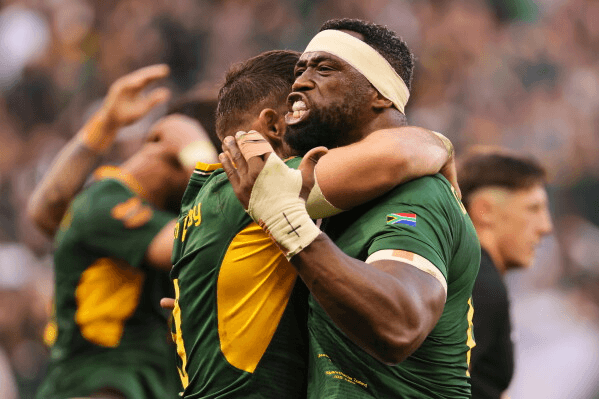
Springboks hold their nerve as All Blacks come roaring back in Cape Town! Well, well, well. Turns out the All Blacks aren’t the only team capable of bouncing back after a hiding. After being comfortably dealt with 33-16 in Johannesburg last week, the Springboks responded in Cape Town with a performance that was equal parts power, precision and sheer bloody-mindedness, holding off a furious late All Blacks comeback to win 33-26 and square the four-Test series at one-all. And if anyone thought the Rugby Championship was going to politely settle down after one week, they’ve clearly never watched these two go at each other. The Springboks were on from the opening whistle.
Fast starts and big hits – South Africa wasted absolutely no time getting into the contest, scoring from virtually their first meaningful attack. A successful lineout became a rolling assault; the Springboks marched upfield, and Jesse Kriel crossed in just the second minute. Welcome to Cape Town, lads.
But unlike some recent All Blacks performances where an early setback has led to panic stations, New Zealand responded well. Will Jordan broke down the right-hand side, creating chaos in the South African defensive line before Cam Roigard finished the movement. Game on.
The Springboks then showed one of the major differences between this performance and the first Test: when points were available, they bloody well took them. Rather than kicking for the corner and rolling the dice, Cheslin Kolbe knocked over a penalty to restore the lead. And then came Damian de Allende.
The big Springbok centre crossed in the 22nd minute as South Africa began to assert themselves physically and territorially. But again, the All Blacks refused to go quietly. Captain Ardie Savea exploded away from a lineout, proving once again that giving the bloke even half a metre of space is generally a poor life choice. His break eventually created the opportunity for Damian McKenzie to score. At that point, the game was finely balanced.
Then Rassie Erasmus did Rassie Erasmus things. The Bomb Squad gets a different address. In one of those selections designed specifically to make opposition coaches spend all week wondering what the hell is going on, Erasmus switched his front-row combinations. Wilco Louw, Malcolm Marx and Ox Nche were named on the bench.
Yep. The Bomb Squad was waiting. And when they entered the contest late in the first half, they immediately went to work. South Africa won a scrum five metres from the New Zealand line, earned a penalty, opted for another scrum and eventually watched Siya Kolisi crash over the line. Classic Springbok rugby.
Not particularly subtle. Very effective. The try gave South Africa a 24-14 halftime lead, and suddenly the All Blacks were staring down the barrel. Kolbe added two more penalties after the break, and the Springboks appeared to have things under control at 30-14. Appeared being the key word. The All Blacks refuse to go away.
Because you don’t put the All Blacks away simply by getting 16 points ahead. New Zealand began to find some attacking rhythm and, perhaps surprisingly, the Springbok scrum wasn’t enjoying the complete dominance many expected. The visitors began throwing the ball around, and suddenly the South African defence was having to work overtime.
Leroy Carter crossed. Ardie Savea crossed. And Cape Town Stadium suddenly got very, very nervous. The Springboks were clinging to their lead as the All Blacks threw everything at them. Kolbe added another penalty, giving South Africa some breathing room, but New Zealand continued to attack until the final whistle.
Four tries to three. That’s right. The All Blacks actually outscored the Springboks in tries but still lost the match. Welcome to Test rugby in South Africa. After the game, Kolisi was understandably pleased with the response from his side. “Last week we did not take our opportunities, and this week we did take them.” And that’s probably the simplest summary of the difference between the two Tests.
South Africa were clinical when the opportunities arrived. New Zealand were brave, dangerous and relentless, but once again found themselves playing catch-up after conceding early momentum. All Blacks skipper Ardie Savea was disappointed but proud of his team’s fight. “We let the Springboks get an early try and then I think we were just chasing the game.” And chase they did.
Unfortunately for the men in black, the scoreboard doesn’t award points for gallant comebacks. Savea also took time to acknowledge the milestones of Pieter-Steph du Toit, who brought up his 100th Test, and Ox Nche, who reached 50 caps. The result sets up a fascinating third Test next weekend, with the series locked at one-all. And just when things weren’t spicy enough, the teams now head to Soweto. No pressure, then.
Three Things We Learned
You don’t beat South Africa twice by turning up – The All Blacks were excellent in Johannesburg, but the Springboks were always going to respond. The Boks don’t tend to lose at home, shrug their shoulders and say, “Ah well, better luck next week.” Instead, they spend seven days plotting revenge. South Africa’s intensity from the opening whistle was vastly improved, and they made sure New Zealand knew this was going to be a very different Test match. The All Blacks now know that winning a four-Test series in South Africa is going to require more than one good performance.
The Bomb Squad remains terrifying, even when you know it’s coming – Everyone knew Malcolm Marx, Ox Nche and Wilco Louw were sitting on the bench. Everyone knew they were eventually going to come onto the field. And everyone knew what they were going to try and do. Stop the scrum. Good luck with that. The immediate impact of the replacement front row was enormous and directly led to Kolisi’s try before halftime. The Springboks may change the seating arrangements, but the Bomb Squad remains one of the most effective tactical weapons in world rugby.
The All Blacks are never, ever dead – For large periods of this match, South Africa looked in control. At 30-14, it appeared the game was done. Except nobody sent the memo to the All Blacks. New Zealand scored two late tries, outscored South Africa four tries to three and had the Springbok faithful nervously checking the clock during the closing stages. There are plenty of things for Scott Robertson and his coaching staff to fix, particularly around conceding early momentum and playing from behind. But the fight and attacking threat are undeniable. The scary thing for the Springboks? The All Blacks lost by seven and still probably believe they should have won. Which makes next weekend in Soweto absolutely enormous. One-all after two Tests. Two to go. And not a single person involved will be taking a backward step. Just the way we like it.
Anyway, that is enough for me. Two cracking test games reviewed, and I’d better pretend I am interested in Family things. Over to you, GAGRs! Have at it.
Stay in the loop with G&GR