
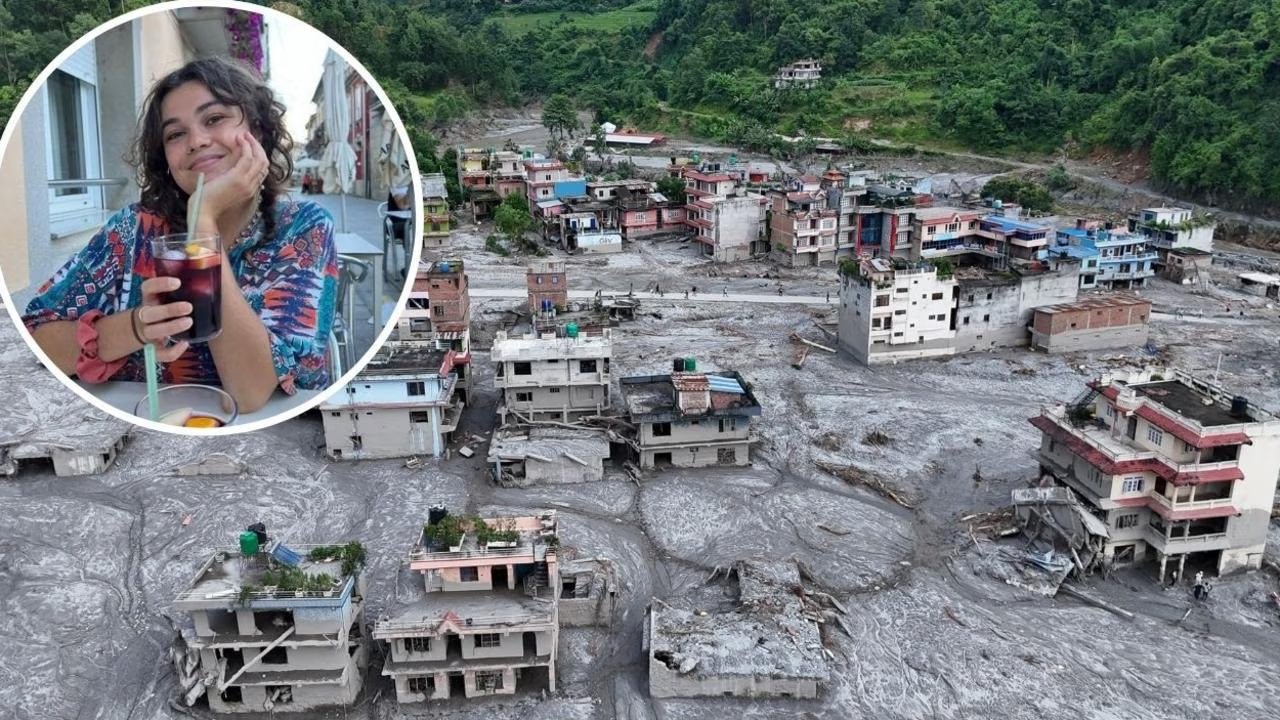
The parents of a young Australian woman who had been missing after the Nepal flooding catastrophe say they are “elated” after she was found safe and well, as the number of Australians unaccounted for grew to 42.
In a statement, Cara Severino’s parents Debbie and Frank thanked the Australian consul staff for finding her, while offering prayers for the thousands caught up in the disaster.
“Seeing Cara’s name appear on my message bank, hearing her voice and now seeing her photo and speaking with her has been the most miraculous gift,” they said in statement.
“We are incredibly thankful to the Australian Consular Response teams for locating her bringing her to safety and for the care they are giving her and all the amazing work they are doing to locate others.
“We are so grateful to her Nepalese hiking partners who saw her through a harrowing several days of hiking in very difficult terrain, so thankful that they have all made it to safety.
“The scale of this tragedy is staggering and amidst our personal joy we continue to stand in prayer with the many families here in Australia, in Nepal and around the world who have lost loved ones or are still waiting to hear from them, we know that the waiting is horrendous.”
They said the return of Cara had been a “miracle”.
“We are beyond relieved and so elated to have Cara safe and well and we can’t wait to hold her in our loving arms,” they said.
“This morning we are being enfolded in love by our church family who, along with so many of our family and friends, have been praying with us for this miracle. We thank Jesus for answering these prayers.
Aussie hiker survives
Ms Severino was among dozens of Australians caught up in the incident, and was unaccounted for several days before she was able to make contact with embassy officials on Saturday.
Ms Severino, who remains the only Australian to have been located, said she got out safely thanks to the “amazing people” she had been with at a national park when the disaster unfolded.
She recounted a devastating story of locals who were unable to escape the devastation.
“We passed a guy hiking up to Thulu Safru who lost his whole family when their whole town was destroyed. It’s just so devastating and undeserving,” she said.
“I feel for the families of those still missing, I know how much my family and friends went through.
“Blessed to be from Australia and have the embassy and Australian government giving so much support.”
Foreign Minister Penny Wong confirmed the news on Saturday afternoon.
“This is a rare piece of positive news amid a disaster that has brought immense loss and uncertainty,” Senator Wong said.
She said officials were transporting Ms Severino to a safe location and continue to monitor her condition.
Mr Thistlethwaite also welcomed the news and the efforts of Australian consular staff.
“So, it’s one of the, unfortunately few good news stories from this terrible tragedy,” he said
On Sunday morning, Nepalese officials said they were still monitoring a large dam which had formed along a segment of valley, creating potential for more flooding in the area.
Albanese mourns disaster in ‘awesome’ region
Anthony Albanese on Sunday took time during a speech to the Queensland state Labor conference to reflect on “the tragedy in Nepal that has resulted in such devastation and loss of life”, including potentially many Australians.
“Our thoughts and prayers are with their families and friends, with the people of Nepal, and with the citizens of every country caught up in this calamity,” the Prime Minister said.
“Our hope is that many of those missing are found alive.
“That something so devastating could occur in such an awesome and inspiring corner of the world during times of pilgrimage and holiday makes the blow seem even more heartbreaking.”
He said Australia was responding with significant consular, rescue and humanitarian aid, with the federal government announcing a further $3 million in humanitarian assistance as part of its ongoing response and recovery effort following the devastating floods along the Nepal-China border.
The additional funding brings Australia’s total humanitarian support for the disaster to $8 million.
42 Aussies still missing
Earlier on Sunday morning, Assistant Foreign Minister Matt Thistlethwaite confirmed the number of Aussies still missing had grown.
“So, it’s one of the, unfortunately few good news stories from this terrible tragedy,” he said, while confirming that 42 other Australians were now unaccounted for.
“Unfortunately, the number has risen to 42 today based on the advice from the Nepalese Tourism Board and our officials on the ground,” he said.
“We haven’t given up hope. Our officials are working around the clock to try and locate those missing Australians and hopefully return them home safely to their families.”
More than 2500 people are still missing, while the number of people confirmed dead now stands at 781.
Mr Thistlethwaite said the latest figures indicate a total of 6633 people had been rescued, including 261 foreigners.
“(It) is a remarkable effort and we haven’t given up hope, given that those figures rise every day,” he said.
“Yesterday it was 121 foreigners had been rescued. So, it’s more than doubled in the course of 24 hours.”
There are now 12 Australian response team personnel in Kathmandu, including crisis response staff, consular officers and Australian Federal Police, in addition to staff already on the ground.
The government said the extraordinary scale of the disaster, conditions on the ground and the remoteness of the affected region had created immense challenges for rescue and recovery efforts.
Communities in affected areas also faced heightened risks following the floods, while damage to roads and bridges had complicated the delivery of emergency assistance.
Nepal’s government has requested emergency supplies including hygiene kits and solar lighting solutions.
Australia’s additional assistance includes $2 million to provide those supplies and other humanitarian support, to be delivered by the Australian Defence Force.
The Royal Australian Air Force will transport the first of these supplies from Queensland in the coming days.
There has also been an overwhelming response from Australians to the Emergency Action Alliance appeal, which has reached $1.4 million in public donations.
In response, the federal government will provide a further $1 million to the appeal, bringing its contribution to $2 million.
The funds will support Australian NGO partners working with local organisations leading recovery and rehabilitation efforts in affected areas.
Glacier expert’s dire warning
University of Tasmania glaciologist Poul Christoffersen said “ice avalanches” like this one were becoming more frequent, even in mountainous terrain which is supposed to stay cold all year round.
“We see these ice avalanches more frequently now, even in mountainous terrain. Despite such high altitudes, it still gets warm in summer,” he said.
Professor Christoffersen said when the ice fell, it was pulverised, turning into “fragments and blocks of ice and dirt” which travelled down the valley and turned into “a destructive sludge”.
“This could have been triggered by a landslip underneath the glacier because it’s on such steep terrain and mountainous terrain, but it could have also been because the ice itself has warmed over time and not been able to stay attached in such steep terrain.”
Professor Christoffersen said Nepal wasn’t the only part of the world where ice falls from glaciers were becoming a genuine safety risk.
“There is real concern in mountain communities about these natural disasters which are associated with both ice and ice avalanches, but also rock slope instability and mountainsides becoming unstable,” he said.
“I have studied glaciers above the town of Chamonix in France, and some of the glacier sites where tourists used to go have now been sealed off. You can’t access them anymore because they have been deemed too dangerous.
“This is another example of a terrible incident where we need to reflect on what’s happening and the underlying causes.
“It’s easy to sometimes dispel climate change as not being significant when you hear that we are reaching up to 1.5 degrees above pre-industrial times, but this is what can happen.”
More to come