
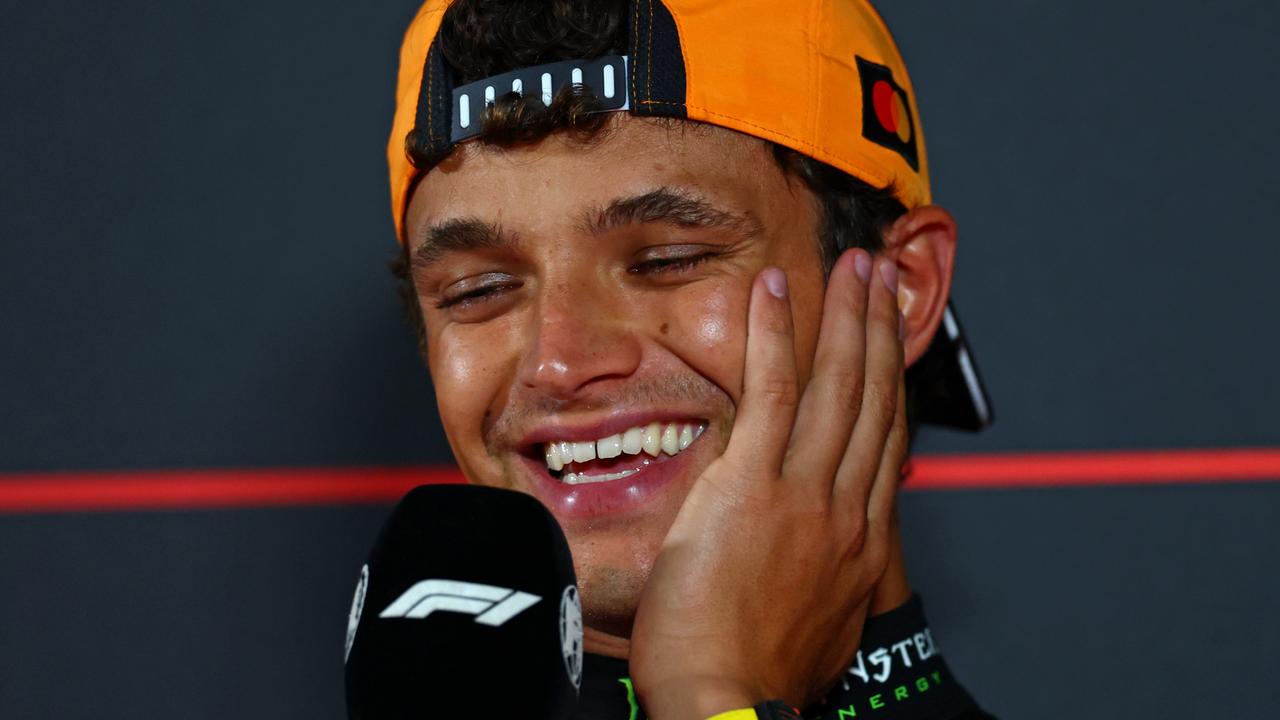
The announcement that Lando Norris has signed a long-term extension to his McLaren contract did not come as a surprise.
It’s not just that he’s the reigning champion — McLaren’s first since Lewis Hamilton — or that his British team has a habit of re-signing its drivers early to keep itself above the fray of the silly season.
It’s not even that Norris was a McLaren junior who has expressed a desire to be a one-team driver.

Fox Sports, available on Kayo Sports, is the only place to watch every practice, qualifying session and race in the 2026 FIA Formula One World Championship™ LIVE in 4K. New to Kayo? Join now and get your first month for just $1.
“There was some interest from elsewhere, but I don’t want to go anywhere,” he told the BBC. “I don’t want to be with another team. I don’t want to spend time with other people.
“That’s why it really was probably one of the easiest decisions I’ve made since being in Formula 1.”
It’s because a long-term contract is what the modern Formula 1 reality demands.
F1 has become a sport of franchise drivers locked into seemingly perpetual deals, their careers intertwined inextricably with their teams.
One part of that is because almost every team in the contemporary era has a well-developed, well-resourced junior driver program focused on finding and nurturing F1-calibre talent in the hope of cashing in on debut.
Seven of the eight drivers at the top four constructors either were developed by that team’s junior program or got their debut directly with the team.
PIT TALK PODCAST: Lando Norris wins the Dutch Grand Prix, his second victory on the bounce. Is the reigning champion back in the title fight? And after a big week of driver contract announcements, what’s next for the silly season? | Listen to Pit Talk now >
But another reason is that the stratification of Formula 1 has crystallised in recent years.
In Formula 1 today there’s a group of four teams with the potential to contend for wins and titles in any given year.
There’s then a big gap behind them, after which follows a vast group of midfielders — and sometimes one or two even more distant backmarkers — that scrap between themselves for a handful of points on all but the most exceptional of weekends.
The top teams expect loyalty from the drivers they’ve invested in bringing to Formula 1, but those drivers realistically have no interest in leaving the exclusive group of winners, creating a small, exclusive and largely static ecosystem.
Changing constructors is possible, but only in the most extraordinary of circumstances. Lewis Hamilton’s blockbuster switch from Mercedes to Ferrari was so spectacular precisely because it feels like the move of some long-forgotten age.
Hamilton’s stratospheric status made that possible, but consider how Max Verstappen, just a few years later, appeared unwilling to break down any doors at rival teams when his contract escape clause became active this year.
Driver churn has all but ceased, and the so-called silly season has become staid and conservative. Midfield drivers increasingly prefer to bide their time in place rather than move sideways, hoping a call from above will come one day.
But as Norris’s long-term deal proves, the opportunity for a frontrunning promotion is these days vanishingly thin.
Norris makes most of Max’s disaster | 02:45
WHAT’S THE STATE OF PLAY?
Red Bull Racing announced earlier this month that Verstappen had renewed terms until the end of 2030. That followed Charles Leclerc’s extension earlier this year for an undisclosed period, though the Monegasque’s deal will run until 2030 at the earliest.
Norris now joins them under lock and key until at least the end of the decade, and McLaren says there is a “multi-year option” to extend the deal beyond 2030.
Only Mercedes lacks a locked-in long-term driver line-up, but you can bet runaway title leader Andrea Kimi Antonelli will be offered extensive terms before the end of the year. It wouldn’t be surprising if it ran until the end of 2030.
Drivers under contract, frontrunners
Mercedes: George Russell (2027), Andrea Kimi Antonelli (2026)
Ferrari: Charles Leclerc (2030), Lewis Hamilton (2027)
McLaren: Lando Norris (2030), Oscar Piastri (2028)
Red Bull Racing: Max Verstappen (2030), Isack Hadjar (2026)
That would make four teams with one driver contracted to the end of the decade and the other out of contract in the next two years.
It wasn’t that long ago we were talking about these long-term drivers as ‘franchise’ signings — dependable top-level performers who reflect their teams as much as their teams reflect them.
But it’s clear these top teams want more than just one driver signed on these sorts of terms.
‘I had nothing, I don’t know why…’ | 00:51
Oscar Piastri is a good example. He wasn’t a McLaren junior, but he was a McLaren gamble, pinched from under the nose of Alpine and given a Formula 1 debut in 2023. Piastri and McLaren showed faith in each other at a time the former was unproven and the latter was still in a long and painful form slump.
He almost won the championship in just his third season, and though he’s struggling with the change of rules this year, on paper Norris and Piastri form “one of the strongest partnerships but also on one of the most united and close-knit teams in Formula 1,” according to team boss Andrea Stella. He was on a longer contract than Norris before this weekend.
George Russell is another clear example. The Englishman was a Mercedes junior and is managed by Mercedes boss Toto Wolff. He has title-winning potential, even if he too is struggling with the 2026 rules. His most recent contract, signed only around a year ago, was short to give him, not the team, flexibility in case Mercedes didn’t nail the new rules. This is not the identity of a throwaway second stringer.
Lewis Hamilton is different as a seven-time champion looking for a final legacy play — of which Ferrari also wants a part — but he’s clearly not there to be subservient to Charles Leclerc.
Only Verstappen is so large at his team that he deprives his teammates of oxygen. Perhaps that will change somewhat with Red Bull Racing under new management, but the way his more recent deal was announced suggests his status will remain unimpeachable for the rest of the decade.
But then again, the second Red Bull Racing seat is almost always given to a Red Bull junior, so the effect is the same.
Gone are the days that some teams would seek a dominant leader and a supportive second driver. That’s clearly not what’s happening at the frontrunners — or at least at three of the four of them.
And with such a large gap between the top four teams and the rest, no incumbent is motivated to risk their careers on a move into the midfield, no matter how enticing the project.
Carlos Sainz and Fernando Alonso are just two examples of race-winners — and in Alonso’s case, a two-time champion — who have been unable to return to the front through force of will alone.
That’s how we end up with a silly season that started with as many as 17 drivers either out of contract or with reported exit clauses on their side but end up with a maximum of two changes — only Esteban Ocon and, less likely, Liam Lawson could be at risk to Formula 2 drivers — but potentially no changes at all.
Lewis warns Oscar over ‘dangerous move’ | 01:15
WHERE DOES THIS LEAVE PIASTRI — AND OTHERS?
These teams don’t have number one-number two driver configurations. Even Red Bull Racing in theory doesn’t espouse that idea — the whole point of the Red Bull junior program is to find the next Verstappen, just as Daniel Ricciardo replaced Sebastian Vettel and just as Verstappen replaced Ricciardo.
But just because an explicit hierarchy doesn’t exist doesn’t mean the general shape of one doesn’t form on its own.
Norris’s long-term contract puts the spotlight on Piastri not because the Australian is under pressure to keep his seat but because of what it signifies for his future.
McLaren wants Piastri to succeed. He became McLaren’s gamble in 2023, and the quality line-ups at the front mean a team need two top performers to win the constructors championship.
It wants him back in title-winning form. Two competitive teammates can be a risk to team harmony, but they also inevitably push each other to find a higher level, which benefits everyone.
But history suggests the odds of Piastri — and any other driver, for that matter — beating Norris to the title are very low.
In 76 completed seasons of Formula 1, only four times has a driver won their maiden championship after having been beaten by their teammate to a championship in a previous year.
That’s a success rate of just 5.26 per cent.
It’s happened only twice in almost half a century.
Hamilton EXPLODES at Leclerc & Ferrari | 01:40
The most recent was Nico Rosberg, who was beaten by teammate Hamilton to the 2014 and 2015 championships but responded with an impressively disciplined campaign in 2016 to win his first world title. He promptly retired from the sport, recognising he had no more to give.
For the previous example, you need to go all the way back to 1985, when Alain Prost beat reigning world champion and his McLaren teammate Niki Lauda to the championship in their second season sharing a garage.
Before that?
Jack Brabham defeated Denny Hulme to the 1966 championship — his last of three — in his eponymous team. Hulme defeated the Australian in 1967 for his only world title.
The first of the four was in 1951, the second ever Formula 1 world championship, when Juan Manuel Fangio defeated inaugural champion and Alfa Romeo teammate Giuseppe Farina for the title.
This is the unlikely history Piastri is chasing by racing at McLaren alongside world champion Norris.
That doesn’t mean it can’t be done — evidently it can be — but with Norris signed up for the long term, Piastri’s route the championship must necessarily go through the Englishman in a way few other drivers have managed successfully.
It’s not just Piastri either. The same questions will be asked of Russell at Mercedes should Antonelli seal the championship this year — and they’ll be even more searing for the 28-year-old given the age gap between himself and the Italian, who turned 20 just last week.
It also sets up a fascinating contest at Ferrari, where Hamilton is the most likely title contender this year should the Scuderia mount a real challenge.
The stakes are always high in a championship battle, but the current Formula 1 set-up, with so few winning teams and such long-term contracts, means history weighs that little bit more heavily on the driver who comes off second best.
Norris’s contract extension wasn’t a surprise, but it was a further baking in of a system that locks a growing number of drivers out of race-winning seats and, for better or worse, disincentivises those already at the front from breaking free.