
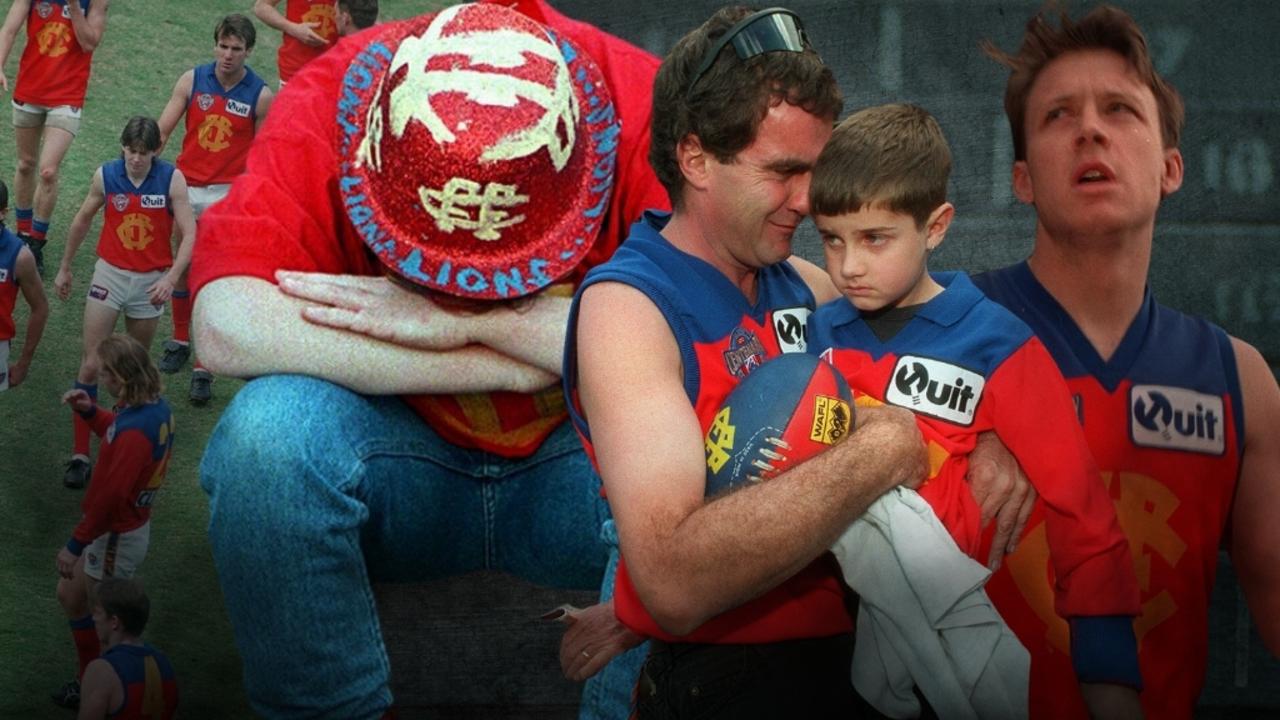
By the end, the final game of Fitzroy’s 100 years in the VFL/AFL was a relief to captain Brad Boyd.
“It was very, very clear that there was no path forward for Fitzroy in its own entity,” he said.
That’s not to say that it was an easy time for Boyd.
He had led his ailing club loyally through the difficult final years, fronting the media as the fate of the Lions became daily news fodder throughout 1996, culminating in being shunted across the country for one final go-around under the FFC monogram against Fremantle at Subiaco.
“It was weird to finish over in WA… I don’t know who came up with that plan. In this day and age, I think there’d be a lot of questions asked. It was a different time.”
Two weeks earlier, via a quirk in the AFL fixture, the Lions were set to take on their newly minted merger partners, the Brisbane Bears.
What made it uncomfortable for Boyd was that he already had a verbal agreement to be one of just eight players from the Fitzroy list chosen to join the Brisbane Lions in 1997.
“The merged venture had already approached me, so it made that game very strange,” Boyd remembers 30 years on.
Interim coach Alan McConnell remembers the press coverage going into overdrive in the leadup to that game.
“It was written up at the time as an opportunity for a dress rehearsal or a job interview for the players. But by that stage, the bulk of the players who were going to go to Brisbane were already pretty clear about where they were heading.
McConnell was the Roys reserves coach who had filled in with the senior side in mid-1995, and was also called on to take the reins for the final eight games of ’96 after SANFL legend Mick Nunan quit once the merger was announced.
“Game day was like attending a wake, you know, a state funeral every weekend for about eight weeks in a row at the end,” McConnell said.
The mourners were lifelong Fitzroy supporters who felt dudded by the end of their beloved club.
And while the AFL and then-CEO Ross Oakley received plenty of vitriol, the only public faces left at the club – in Boyd and McConnell – were on the receiving end of some of that anger too.
“I’ve got a couple of letters holding me accountable for trashing their family’s relationship with the club”, McConnell admits.
“I guess from where they sat you become representative of what they see on a weekly basis of what the club looks like.
“So, you just have to roll with the punches and take it on the chin because, you know, they need to express how they feel about it.”
Boyd was also fully aware of what the club meant to fans and their need to express their pain.
“The Fitzroy supporters were always so loyal, and followed through thick and thin, and it was a very, historical, special club for a number of reasons, so I was fully aware of the history of the club.”
But on the flipside, this wasn’t the Fitzroy which had won eight premierships and eight Brownlow medals and featured names like Smallhorn and Bunton, Murray, Quinlan and Roos.
“I also saw the demise, what it was in that last 24 months, where we got locked out of facilities and weren’t getting paid…it obviously couldn’t continue like that.”
Fitzroy played its final game in Melbourne in front of almost 50 thousand against Richmond at the MCG.
It was a match that ended as expected – with a 151-point drubbing at the hands of the rampant Tigers – but one that came with added emotional baggage as every one of the Lions five goals were cheered as if it were a Grand Final.
And once the final siren rang?
“The worst bit by a long way was postgame when the players were expected to do a lap of honour,” remembers McConnell.
“The players just wanted to get off, but the jumpers needed to go around the boundary line as a sign of respect for the history of the club.”
Boyd remembers it as an empty feeling.
“I remember just being depleted,” he said.
“We’d been absolutely smashed on that day … I just remember an empty and unknown sort of feeling about what was happening.”
If there was a shining light for the Lions in those dark days it was the performance of a host of emerging kids – Matthew Primus, John Barker, Jarrod Molloy and Chris Johnson who, within the next seven years would become a triple premiership player for the merged Brisbane side.
Another who took the opportunity was 19-year-old Marty Warry who broke into the side late in 1996 and finished on a high with 12 goals in the final three games, including four at Subiaco.
Warry, a lifelong Fitzroy fan, was drafted to the club at the start of 1995, so didn’t know any different than the chaos and disruption of those days.
“It was pretty tough,” he remembers of those two teenage years.
“I only played 8 games – three in my first year, and then the last five in my second year, and it was probably a tough initiation for a young fella.”
While McConnell and Boyd were dealing with everything that the merger had thrown at the club, Warry was proof that there were young players who had no real idea of the enormity of what was facing the club.
“Part of it was just being rapt to be playing although we didn’t know what our future held.
“It was a strange time, but I didn’t know any different. You sort of took each day as it happened.”
Having to fly to Perth for one last game after such an emotionally draining experience at the MCG almost seemed unfair for Fitzroy who showed heart but went down to Fremantle by 86 points on that day 30 years ago.
Boyd: “I think the players were stuffed, everybody was just exhausted after the final game at the MCG, and then to sort of get ourselves back up and, and do it again was almost impossible.”
McConnell describes that post-match as a very empty experience.
“What do you say to a group of players in that situation? I can’t remember what I did say, but there was a sense of helplessness in terms of what I could or should say to the players in the rooms after that game.
And, after a haunting rendition of Auld Lang Syne accompanied the Fitzroy jumper down the race for the last time, and a couple of beers at the unfortunately named Brisbane Hotel in Perth, that was that for Fitzroy after 100 years at the top level.
With there no longer being a Fitzroy Football Club – at least for the time being – the players quickly went their separate ways.
Warry remembers flying back into Melbourne after midnight.
“That was pretty much it. I can’t remember what happened after that. I think it was just gone.”
It is a feeling remembered by McConnell and Boyd as well with thoughts quickly shifting to what comes next.
Warry would find a home in 1997 at Collingwood but never played at AFL level again, and while Boyd was one of the eight Fitzroy players to join the new Brisbane Lions, injury limited him to just 15 games over three seasons.
McConnell would go on to a long career as an assistant at Geelong and working with the AFL academy as well as being the inaugural coach of GWS in the AFLW.
Boyd and Warry remain diehard fans of the Brisbane Lions, having jumped on board along with a lot of old Fitzroy supporters thanks in large part to five premierships over the past 25 years and the work done by Brisbane to include Melbourne based fans.
“I go to all of their home games and I still bump into people who recognise me in the crowd,” Warry says with a laugh.
“And even though the times were hard, I enjoyed it and I loved it and they were, they were good times.
“And I wouldn’t swap it for anything.”
Originally published as 30 years on from the sad final days of the Fitzroy Lions in 1996 before merging with Brisbane