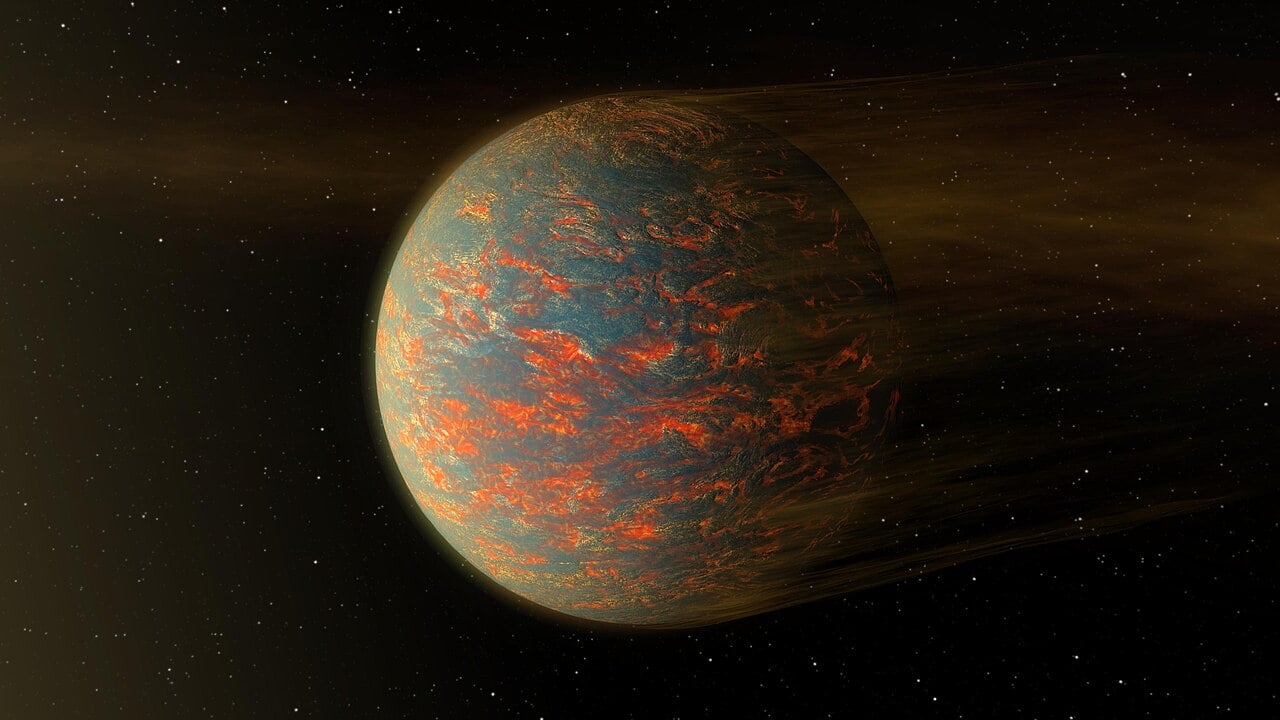
 Artistic rendition of 55 Cancri e and its host star, 55 Cancri A or Copernicus. Credit: NASA
Worlds like 55 Cancri e seem almost designed to destroy an atmosphere.
The rocky super-Earth orbits so close to its star that its year lasts less than 18 hours. Its surface is hot enough for rock to melt, likely forming vast seas of lava. The planet sits roughly 20 times closer to its star than Mercury does to the Sun.
You might expect any gas around such a world to have been blasted into space long ago. Instead, in 2024, the James Webb Space Telescope found evidence for a substantial atmosphere around 55 Cancri e, probably rich in carbon dioxide or carbon monoxide.
And it may not be a freak.
Astronomers are beginning to find other intensely hot rocky planets that appear to have atmospheres despite living in places where stellar radiation should strip them bare. A new study offers a counterintuitive explanation: the very heat that turns these planets into lava worlds may also help them keep their air.
The researchers argue that atmospheric survival does not simply get harder and harder as a planet moves closer to its star. A rocky world may first lose its atmosphere as the heat increases, only for the trend to reverse at the most extreme temperatures. Get hot enough to keep much of the planet molten, and an enormous reservoir of gas dissolved in the magma can help sustain an atmosphere for billions of years.
The Magma Ocean
The idea builds on the “cosmic shoreline,” proposed in 2017 by Kevin Zahnle and David Catling. The basic idea is that the more stellar radiation a rocky planet receives, the harder it should be for its gravity to hold onto an atmosphere. That relationship seemed to draw a rough dividing line between worlds with atmospheres and those stripped bare.
But 55 Cancri e sits far beyond where this simplified picture says an atmosphere should last.
×
Thank you! One more thing…
Please check your inbox and confirm your subscription.
“These lava worlds have pointed to something being wrong with the cosmic shoreline boundary, but we’ve found a way for them to preserve their atmospheres by proposing a new regime beyond it,” Barron Nguyen, a graduate student in Earth and planetary sciences at Stanford University and lead author of the study, said in a statement.
Nguyen and his colleagues modeled atmospheric escape together with the cooling and solidification of a planet’s interior. Their results turn the single shoreline into a three-part landscape: the familiar cosmic shoreline, an intermediate “airless valley,” and, on the intensely irradiated inner side, a new atmosphere-bearing region they call the “cosmic sandbar.”
 Artistic rendition of 55 Cancri e. Credit: NASA
The key is molten rock.
Molten rock can act like a huge storage tank for gases. Instead of putting all of its water and other volatiles into the atmosphere at once, a lava world can keep much of them dissolved in its magma.
In one simulation, an Earth-mass planet with only a very thin layer of water vapor above the surface held about 400 times more water hidden in its molten interior. So even though a star can strip gas from the atmosphere, the magma holds most of the planet’s volatile supply in reserve.
But as a planet solidifies, molten rock becomes less able to store volatiles. Some gases are expelled into the atmosphere, where radiation can remove them, while others become locked in the solid mantle. In that moment, replenishment can no longer keep pace with loss.
Hotter Can Sometimes Mean More Air
For a rocky planet about twice Earth’s mass, the model predicts a surprising pattern. At temperatures above roughly 600 to 700 kelvins (about 330° to 430° Celsius), a planet can enter the “airless valley,” where its atmosphere is stripped away faster than the interior can replace it. But push the temperature much higher — to around 2,100 kelvins (1,800° Celsius) from starlight alone — and the picture changes again. The surface can stay molten, allowing the magma ocean to keep supplying gas and sustain an atmosphere. Tidal heating can lower that threshold to about 1,900 kelvins.
This is not a simple rule that any planet would regain its atmosphere by drifting closer to its star. Whether a lava world keeps its atmosphere also depends on its mass, how much gas-forming material it started with, how active its star is, and how much extra heat tides generate inside the planet.
JWST is nevertheless finding objects in the right neighborhood. In addition to 55 Cancri e, observations of TOI-561 b published in 2025 found that the scorchy planet’s dayside was inconsistent with bare rock and instead favored a thick volatile atmosphere.
The broader stakes extend beyond lava worlds. These scorched planets are not plausible homes for life as we know it, but they provide unusually stark tests of how rocky planets gain, lose, and recycle atmospheres.
Before astronomers ask whether a distant rocky world has oceans or biology, they first have to figure out whether it keeps any air at all.
The study was published in The Astrophysical Journal Letters.