
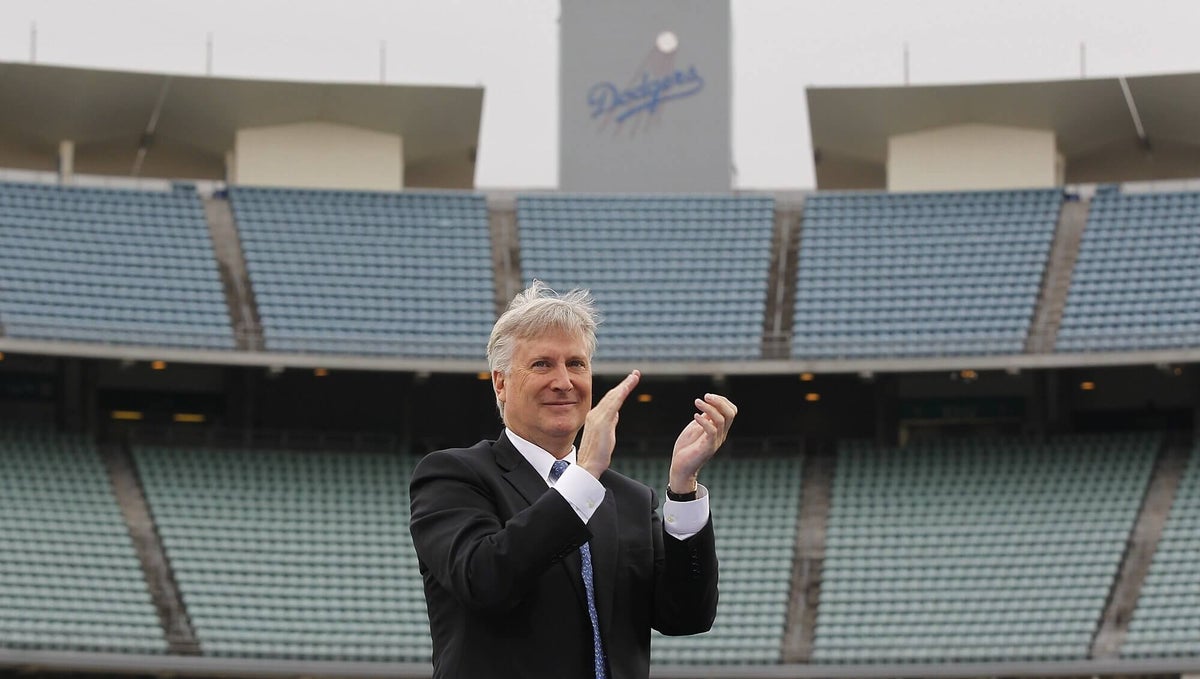
The biggest prize in baseball drew a crowd in 2012.
Billionaires searching for their next trophy. Corporate titans eager to break into Major League Baseball’s exclusive ownership club. And investors betting the distressed Los Angeles Dodgers were an asset too valuable to pass up.
The sale of the storied franchise in a court-run bankruptcy process stunned the baseball world with its stratospheric price and laid the foundation for a little-known Chicago financier named Mark Walter to become a sports mogul.
Now, 14 years later, federal investigations into other companies in Walter’s empire and his surprising decision to sell his majority stake in the NBA’s Los Angeles Lakers have brought renewed attention to his initial entry into the sports world.
When he bought the Dodgers, some powerful figures in MLB ownership circles had questions about how Walter, CEO of Guggenheim Partners, planned to fund the purchase. But they also reveled in what his record-shattering $2.15 billion bid would mean for their own teams’ valuations.
Some MLB owners privately questioned Walter’s use of insurance money in financing the team’s purchase, according to contemporaneous news reports and recent interviews conducted by The Athletic. But during the sale, MLB’s central office and the league’s other franchise owners didn’t have the full control they normally wield. A federal bankruptcy judge oversaw the process.
Marc Ganis, president of the Chicago-based sports business consultancy SportsCorp, said the bankruptcy left MLB with little room to object.
“If left to their own devices, I think it would have been very unlikely that Major League Baseball would have approved this source of capital,” Ganis said. “But, because it happened through a bankruptcy process, baseball’s hands were tied.”
Just how much control MLB surrendered during the bankruptcy — and whether the league ultimately would have approved Walter’s ownership group without the court’s involvement — is unclear.
Two people briefed on ownership matters who were not authorized to speak publicly told The Athletic that Walter’s bid likely would have been rejected through the league’s typical process.
In an Aug. 26 statement, Walter’s holding company TWG Global said, “The Dodgers transaction was subject to significant scrutiny and complied with all rules and regulations that govern the purchase of Major League Baseball teams.”
That scrutiny included “a full investigation conducted by an outside law firm on behalf of insurance regulators from multiple states, which identified no irregularities and resulted in no further action,” the company said.
TWG Global also said that “attacks” have falsely claimed the purchase was improper and that the company is “looting” insurance funds. The company did not respond to a request for additional comment to The Athletic.
MLB and the Dodgers declined to comment for this story.
Today, federal authorities are probing whether loans from Walter’s insurance companies to other businesses in his portfolio were properly disclosed. Insurance regulators want Walter to remove billions of dollars of loans to businesses he owns or controls from his insurers’ books by the end of the year.
Meanwhile, Walter agreed to sell the Los Angeles Lakers for $12.5 billion – at a 25 percent premium compared to when he bought the team about a year ago. He is also reportedly looking to offload his share of the English soccer team Chelsea FC.
TWG Global has said the Dodgers are “not being sold and no sale process has been initiated.”
The company added that “as responsible owners and investors, they consider all legitimate offers when they are received” for the company’s sports assets.
Dodgers fans credit Walter with ushering in a golden era that included high spending and two consecutive World Series titles. But, intense public scrutiny has thrust the private 66-year-old and his companies into an unwanted spotlight.
For the Dodgers faithful and MLB’s central office alike, Walter’s group was supposed to provide an escape from turmoil.
The team’s previous owner, real estate developer Frank McCourt, placed the Dodgers in bankruptcy in 2011 amid a bitter divorce and ongoing feud with MLB.
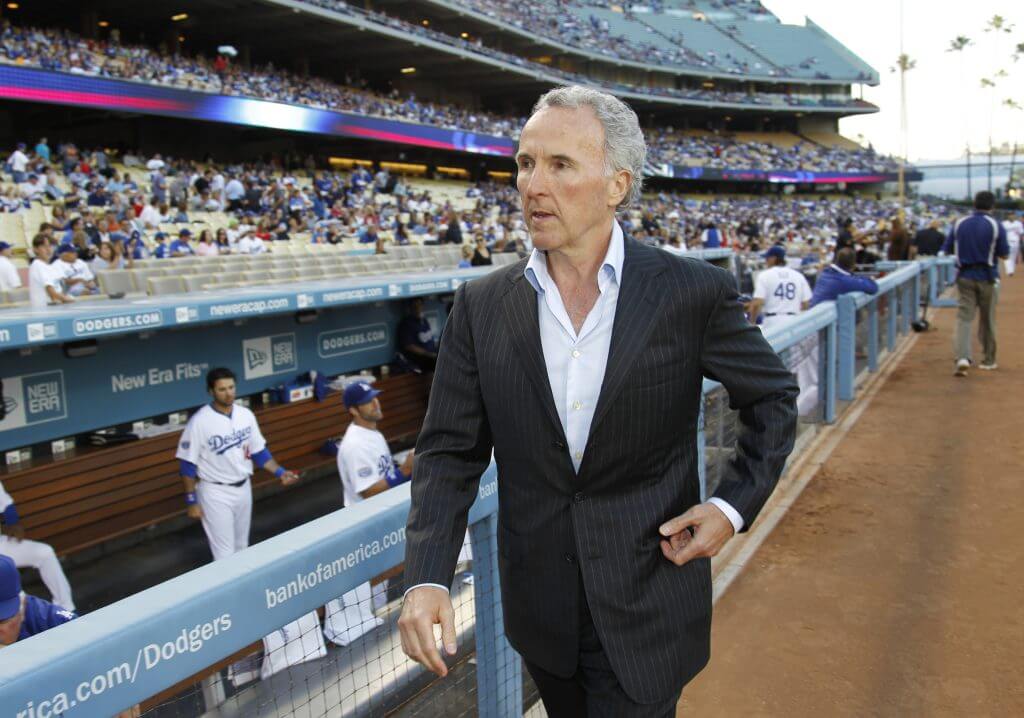
Frank McCourt walks past the Dodgers dugout in 2011. Danny Moloshok / Associated Press
The league had approved McCourt as an owner in 2004, despite concerns about his ability to finance the club. McCourt purchased the Dodgers for $421 million “entirely with borrowed funds,” according to MLB court filings in the Dodgers’ bankruptcy case.
His purchase of the team was allowed, MLB’s lawyers wrote, because McCourt agreed to provide an additional $30 million in liquid equity within three years by selling some of his real estate assets or securing equity investors.
“Mr. McCourt failed to satisfy this obligation,” the league told the court in June 2011.
The league also accused McCourt of siphoning off well over $100 million in club revenues and being “unable to properly distinguish between his personal interests and those of the club.”
McCourt did not respond to calls seeking comment. At the time, McCourt and the Dodgers called the league’s accusations inflammatory and not supported by evidence.
MLB said McCourt had created a “complex network of corporate entities” to leverage the club and its assets to generate revenue. As tensions rose, MLB installed a monitor to oversee McCourt’s handling of the team’s finances. Months later, McCourt filed for bankruptcy.
Matthew Pace, a New York sports lawyer and partner at Rimon Law, said McCourt’s purchase of the team using debt should have been a red flag for MLB. The result was a bankruptcy sale in which the league’s best interest was not the sole priority.
“In a bankruptcy sale there are considerations, like the rights of creditors, that do not come into play in a private sale that does not involve a bankruptcy,” Pace said.
An investment bank ran the court-supervised sale of the team, assembling a list of more than 100 prospective buyers. Thirty signed non-disclosure agreements and sat for highly confidential presentations detailing the team’s immense value.
As the contenders narrowed, Walter seemed to come out of nowhere.
Much of the news coverage around his group’s bid focused on his co-owner Magic Johnson, a retired Los Angeles basketball star, rather than on Walter himself.
However, some team owners were skeptical of Walter’s sudden arrival as the money man behind the group. A pair of fellow Chicagoans, White Sox owner Jerry Reinsdorf and the late Atlanta Braves executive Bill Bartholomay, both remarked back then they did not know who Walter was, according to one of the people briefed on ownership talks at the time who was not authorized to speak publicly. Bartholomay was a veteran of Walter’s world, the insurance industry.
Reinsdorf declined to comment when reached by phone.
Then-MLB commissioner Bud Selig told The Athletic in an interview last week that he did not try to stand in the way of Walter’s purchase and did not recall whether he was concerned about the use of insurance money to finance the sale.
MLB apparently did not ask court-appointed mediator Joseph Farnan to reject Walter’s group from the pool of eligible bidders — a step the league took with others.
Late in the process, the league rejected four consortiums from the bidding, including one with now-President Donald Trump’s son-in-law, Jared Kushner, the Los Angeles Times reported in 2012. Kushner’s brother is part of the ownership group buying the Lakers from Walter.
Even if MLB had sought to remove Walter, the league had no guarantee of success. In at least one instance, Farnan overruled MLB and reinstated a group the owners wanted out, the L.A. Times reported.
“The mistake was allowing the team to go into bankruptcy in the first place — almost forcing McCourt to go into bankruptcy at one point,” said Ganis, the sports business consultant. “They kind of jumped the gun and McCourt immediately filed for bankruptcy protection and that took a lot of the latitude away from Major League Baseball.”
Asked whether the league’s authority was muffled during the bankruptcy process and if he could have rejected Walter’s bid, Selig, 92, said “bankruptcy was a complicating factor. That’s as much as I can tell you.”
The bidding unfolded over the course of two months, with the field narrowing to three as the offers climbed.
MLB’s owners approved Walter as a bidder on March 26, 2012, and expected an auction would take place shortly afterward, a lawyer for the league said in court.
But then Walter’s group, operating under the name Guggenheim Baseball Management, swooped in with an eye-popping offer that left MLB both elated and perturbed.
“What happened, instead, was shortly after the league vote, we were informed that Guggenheim made a very high bid and that Mr. McCourt had determined to accept that bid,” Thomas Lauria, an attorney for the league, said in April 2012, according to court transcripts. “And that was announced publicly. We were, in fact, told that the purchase agreement had been executed.”
Because there had been no league signoff on the deal or on the announcement, Lauria said they were in direct violation of MLB rules.
“This caused some problems on our side of the table,” he said. “As exciting as it was to see the price that had come in, we still have a league to manage and we have 29 other owners who have certain expectations about how things are going to be handled.”
On the day judge Kevin Gross would confirm McCourt’s plan to sell to Walter, MLB’s lawyer suggested the league was being blindsided with the new owner present in the courtroom.
“Some of our issues go to what we perceive as being significant deviations from what was submitted to the owners for their approval and what the deal is today,” Lauria said.
But as frustrated as MLB was by the process, the league — and its owners — benefited from the price tag. The $2.15 billion sale instantly raised team values across the league.
In his 2019 memoir, “For the Good of the Game,” Selig wrote that when McCourt told him what he was getting for the team, the former commissioner “almost dropped the phone.”
“I may have asked Frank to repeat the price,” Selig penned. “He didn’t just become the first owner to sell a baseball team for a billion dollars. He went straight to two billion dollars, partly on the strength of their local television rights.”
Behind the record price was a confidential concession.
The Dodgers’ TV rights were a major reason Walter offered such a gargantuan bid, and the league agreed to an extraordinary step that enhanced its value.
McCourt and MLB agreed in the bankruptcy proceeding to confidential “special terms” for the sale of the team, “the most important terms of the settlement agreement,” Bruce Bennett, a lawyer for McCourt’s Dodgers, said in court.
A key element was that the buyer would be permitted to share less of the Dodgers’ local TV rights fees with other teams than the league’s revenue sharing system typically requires. Prospective buyers designed their bids with that in mind, Bennett said.
David Samson, who was president of the Marlins in 2012, said the result was Walter’s group placing a significantly higher value on the Dodgers.
“They were able to say, of course, I can put an extra $400, $500, $600 million on the price of the team, and I’ll get it paid back on the life of this cable deal,” Samson said.
Exactly how much TV money Walter would be able to shield from revenue sharing was not settled at the time Walter took over in 2012.
“I recall being told, ‘Look at the whole deal, don’t focus solely on the revenue sharing break they’re getting,’” Samson said. “The reality is that there is going to be a team sold for over $2 billion. There is a number on the books, and that will increase the value of every franchise.”
In January 2013, Walter agreed to a massive TV contract with Time Warner Cable, a 25-year deal worth $8.35 billion, according to the Los Angeles Times — more than double what had been anticipated upon approval of the special revenue-sharing carve-out.
MLB and Walter agreed that in the first year of the TV contract, the deal would be valued at $130 million for revenue sharing purposes and would increase every year, the Times reported. Prior to the Time Warner deal, the first year was appraised at about $84 million.
But the revised special terms were still a major windfall for Walter: The TV deal pays an average of $334 million annually. The Dodgers have received an estimated tens of millions annually that they do not have to share as other teams do.
The Financial Times reported that by bundling the TV contract into a multibillion-dollar debt security and selling pieces to banks and insurers — including some within Guggenheim’s own network — the deal pulled in more money than the purchase price of the team itself. It also provided new cash to buy more insurance companies, FT reported.
Over the past decade, Walter has stood quietly at the helm of the franchise he helped build into a high-priced, Shohei Ohtani-led winning machine. According to a person briefed on the team’s finances, the team generates annual revenues between $900 million and $1 billion.
That money has helped them grow their payroll to the highest in the majors. Including luxury tax penalties, the team is projected to spend more than $500 million on players this season as it vies for a third straight World Series championship.
The team, TWG Global insists, remains on firm financial footing.
“The Dodgers have the highest revenue in baseball, and it significantly exceeds the team’s obligations to its players,” TWG Global said in a statement.