
When Formula 1 opened its doors to Netflix’s cameras for the docuseries “Drive to Survive,” few could have predicted the impact it would have on the sport.
The series, which debuted in 2019, was one of the most important factors in F1’s subsequent boom in popularity. It took motor racing to a whole new audience on streaming services. And F1 races are now sold-out events with a much younger and more diverse fanbase than a decade ago.
But the ripple effect from “Drive to Survive” extended elsewhere in motorsport. In the World Endurance Championship sports car series, a similar shift has occurred.
“For me, it’s clear. Six or seven years ago that we started to see more and more young people. At the time, I heard so many times, ’motorsport is for old people.’ This is (now) completely the opposite,” Frederic Lequien, the WEC CEO, told The Athletic in an interview.
“We need to be smart and to get the right analysis: (it’s) thanks to the Netflix series.”
The modern WEC was established in 2012, forming a full season of races around the 24 Hours of Le Mans — the world’s most iconic sports car event. With a shortest race distance of six hours, three drivers sharing duties per car, and multiple classes of cars racing on track at the same time — a normal WEC race has Hypercar (for prototype models) and GT3 (for grand tourers) — the format is very different to F1.
Yet there is a degree of familiarity for fans who, after having their interest piqued by “Drive to Survive,” look to other forms of motorsport.
Many recent ex-F1 drivers, including Kevin Magnussen and Logan Sargeant, now race in WEC. Car brands active in F1, such as Ferrari and Cadillac, are also on the WEC grid. Five of the eight tracks on the current WEC calendar have also hosted F1 grands prix this year.
According to data supplied to The Athletic by WEC, 28 percent of fans surveyed who attended a race in 2025 did so for the first time, and 30 percent of attendees were 35 or younger.
The series still has a largely male fan demographic (86 percent of surveyed attendees were men) but the number of women fans was higher among those identified as ‘casual’ or ‘opportunist’ fans, pointing to the growth in this area.
Lequien said that fans being introduced to WEC would quickly come to appreciate the close, competitive racing on display. At this year’s 24 Hours of Le Mans, won by Toyota, the top four cars were separated by just 32 seconds after a full day of racing.
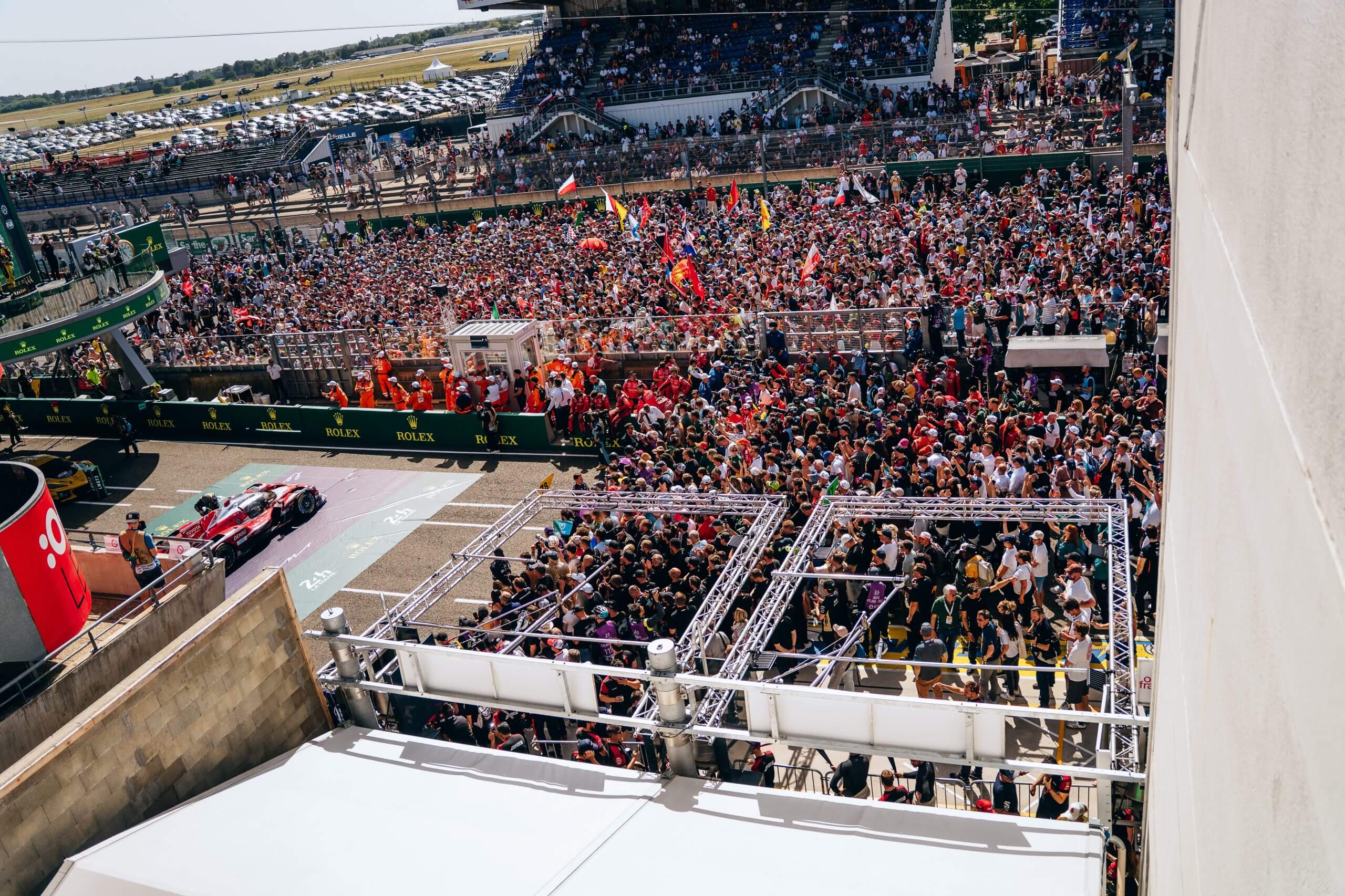
Crowds gather under the podium after the 2026 Le Mans 25 Hours (Ivan Couturier / Hans Lucas / AFP / Getty Images)
The quality of the racing in the series has also proved appealing to many top racing drivers. Fernando Alonso, the two-time F1 world champion, has already hinted he would like to return to Le Mans after winning the race twice for Toyota in 2018 and 2019. Charles Leclerc has expressed an eagerness to enter the famous race for Ferrari one day.
For drivers looking for next steps outside of F1, WEC has become a popular landing spot, with their fans often happy to follow.
This weekend’s Lone Star Le Mans WEC race at the Circuit of The Americas in Austin, Texas, will provide Sargeant (below), who raced in F1 for Williams in 2023 and 2024, a chance to race in front of his home fans once again.
He is part of the Proton Competition line-up in the GT3 class, racing a Ford Mustang, ahead of joining Ford’s new Hypercar team in the top WEC category from 2027.
“I still have a lot of support from some of my fans in F1, and that’s nice to see,” Sargeant told The Athletic in an interview.
“A lot of people are happy to see me with Ford now, and it’s honestly been great. So, hopefully, I can just keep doing well for them. I’m sure I’ll see a bunch more at COTA, being in America.”
But even drivers without an F1 background have felt the impact of growing crowd numbers at WEC races in recent years. More than 350,000 fans attended Le Mans this year, marking a new event record, while the season’s opening two rounds at Imola in Italy and Spa in Belgium also drew their biggest-ever crowds.
“The amount of manufacturers involved now and the level of competition, I think in itself, before you take any big-name start from F1, was attracting people,” Phil Hanson, who won Le Mans in 2025 for AF Corse Ferrari, told The Athletic in an interview.
“It’s such a huge fan base, and that’s growing year on year on year, regardless of which F1 driver says they might want to race in WEC.
“The sport is in a really healthy space. Even in other categories and other areas where there’s not as much F1 attention, you still see the same sort of level of attention picking up year to year, which is just positive everyone.”

Ex-Williams F1 driver Logan Sargeant at the 2026 Le Mans 24 Hours (Ker Robertson / Getty Images)
For Lequien, a big selling point for WEC is its accessibility. Fans can purchase tickets that give them access to the paddock — the area behind the pits, where only those working at F1 races and VIPs are allowed — and a chance to get close to the cars and drivers.
“They can almost touch the cars,” Lequien said. “It’s a good deal.” He said for the Spa race in May, tickets cost an average of $64. “You can go inside the paddock, you can go in any grandstand. You have a super big fanzone with a lot of activations and so on.”
For this week’s race in Austin, a three-day general admission ticket costs $89.50, with an equivalent ticket for the F1 weekend later this year retailing for $450.
WEC has experienced significant changes over the past decade, placing a new focus on cost control in the top class to make the top tier of global sports car racing sustainable for manufacturers. The championship is also eager to be a “laboratory” for car companies, according to Lequien, with hydrogen-powered engines remaining an area of interest for many in sports car racing.
As well as balancing the technical and financial demands of the series to deliver a compelling on-track product, Lequien made it clear that WEC had to keep its fans, both old and new, top of mind.
“Maybe at the beginning, (the rise in popularity was) thanks to F1 and ‘Drive to Survive,’” added Lequien. “But it’s true sport. WEC is extreme. It’s pure motorsport.
“This is something maybe we should not forget. We must deliver something to the fans: beautiful cars, super design, pure sound. It’s what they want.”