
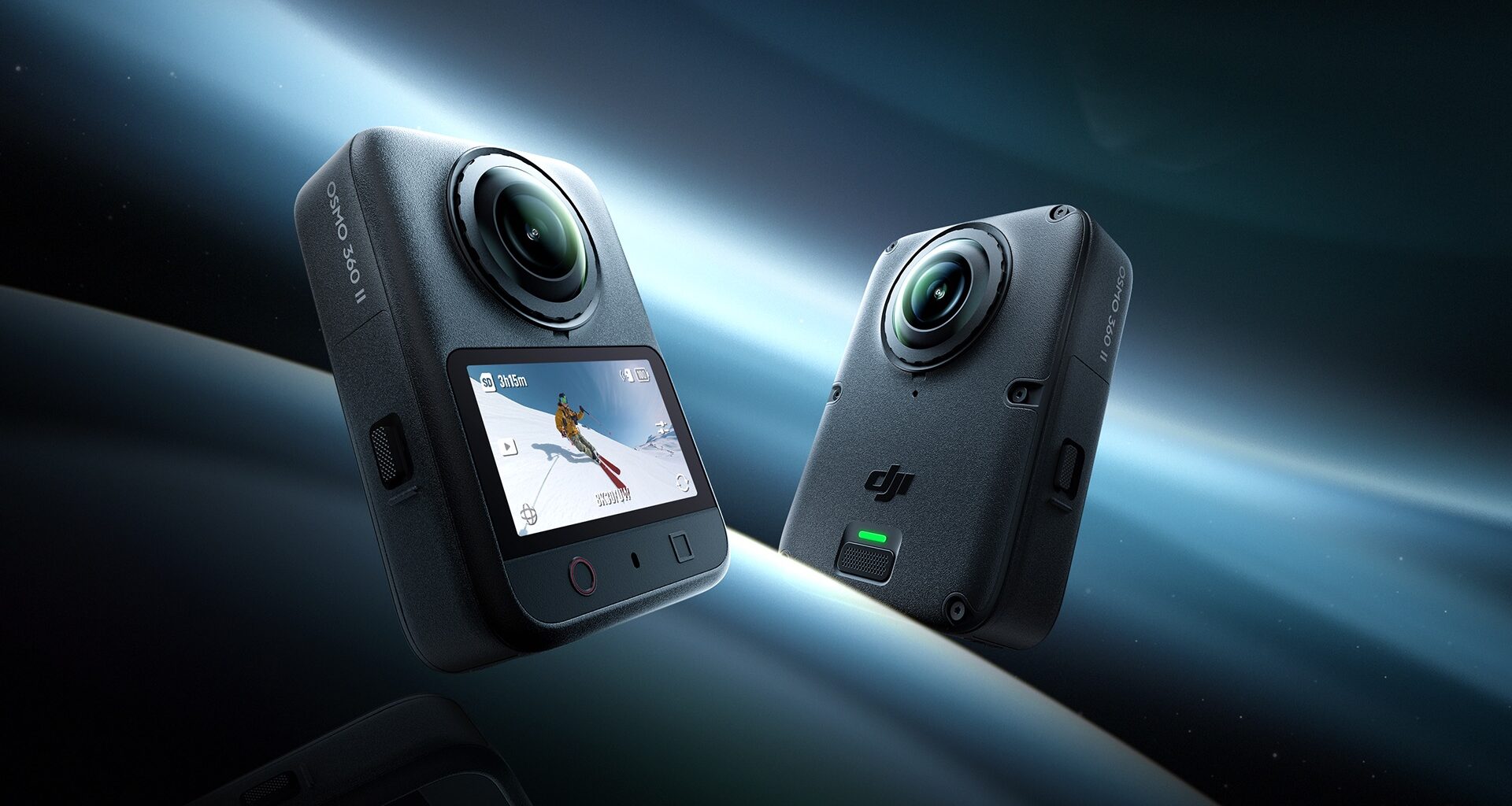
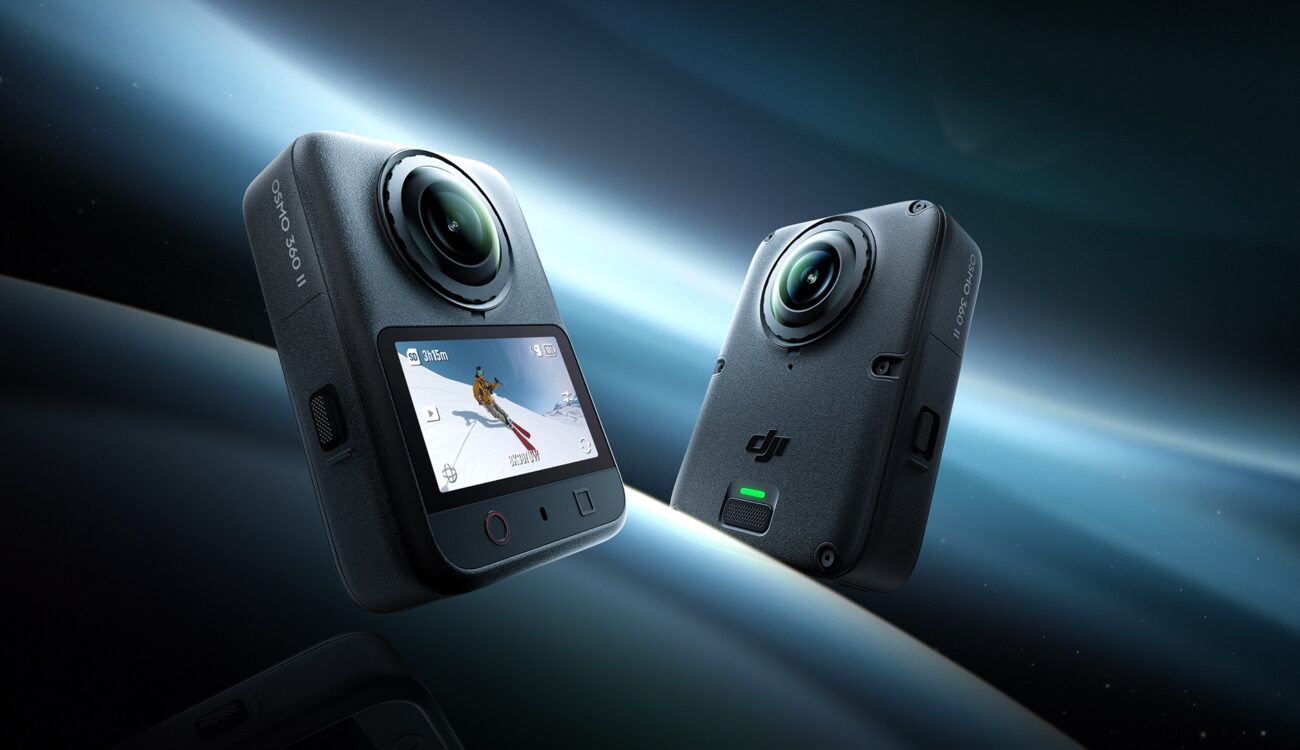
So here it is, the second-generation DJI Osmo 360, and it is arriving globally today with a presence at IFA in Berlin from tomorrow. The headline changes are native 8K 360° video at 60fps (up from 50), user-replaceable lenses with a harder coating, a claimed 14.5 stops of dynamic range, a new AI SuperNight 2.0 low-light mode, and a tap-to-connect NFC area. The sensors, the body weight, and the internal storage are unchanged, so the interesting question is whether the upgrades land where the first camera actually hurt.
Let me get the numbers out of the way first. The Osmo 360 II keeps the dual 1/1.1-inch square CMOS sensors with 2.4μm pixels and f/1.9 lenses that DJI introduced on the original Osmo 360 a little over a year ago. Panoramic video now runs at 7680×3840 up to 60fps and 6000×3000 up to 60fps, panoramic slow motion reaches 4K at 240fps (the first camera stopped at 100fps), and stills remain at 120MP but gain HDR capture. ISO covers 100 to 51200, the maximum bitrate is 170Mbps, all formats record 10-bit with D-Log M available, and stabilization is handled by RockSteady 3.0 and HorizonSteady. The body measures 61 x 36.3 x 81mm (2.4 x 1.4 x 3.2in), weighs 183g (6.5oz), is waterproof to 10m (33ft) without a case and 50m (164ft) with the new Osmo 360 Waterproof Case, and carries 128GB of internal storage with 105GB usable, plus a microSD slot for cards up to 1TB.
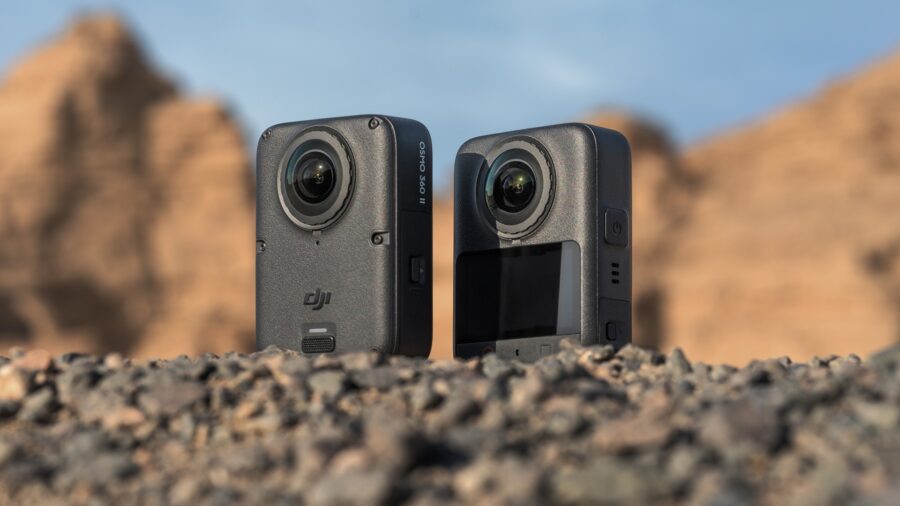 Osmo 360 II from both sides. Image credit: DJISame sensors, more frames, and a dynamic range number to read carefully
DJI is not pretending this is a new imaging pipeline. The press material calls the sensors “the industry’s first advanced 1-inch square HDR image sensor,” and the accompanying spec sheet lists them as dual 1/1.1-inch square CMOS, which is exactly what the first Osmo 360 used. The “1-inch” framing comes from DJI’s argument that a square 1/1.1-inch sensor covers the same 360° image field as a rectangular 1-inch type sensor, since the round image circle of a 180°-plus lens wastes the corners of a 4:3 sensor anyway. DJI quotes 25% higher sensor utilization from the square layout and lower power draw as a result. That is a fair engineering point, but the sensor is a 1/1.1-inch part, and when you shoot in single-lens mode you are working with one of them.
The generational gain is in the processing. 8K60 panoramic capture is the one spec that a working shooter will feel immediately if you shoot with a 30/60 fps timebase (or if you are in a region that has the remnants of NTSC as a standard). DJI credits a new high-performance chip for the extra frames, and the same chip is presumably what enables the 4K240 panoramic slow motion and the 8K120 Vortex mode, which is designed to be used with the Osmo Vortex Rotating Handle for wraparound slow-motion transitions.
Then there is the dynamic range figure. DJI claims 14.5 stops for 360° video, up from 13.5 stops on the first camera, and describes this as “doubling the brightness range.”
One additional stop is by definition a doubling of light, so the math is right and the phrasing is marketing. It is also the exact figure Insta360 claims for the X6, which tells you something about how these two companies are watching each other.
As always, this is a manufacturer claim and not a measured result, and our lab has published enough small-sensor tests to show how far the two can diverge; the Insta360 Luna Ultra lab test is the most recent example, while the DJI Osmo Pocket 4P went the other way and topped our database. In other words, the number on the box tells you very little until we measure it. (Caveat here: We really can’t measure the DR of 360 cameras properly!)
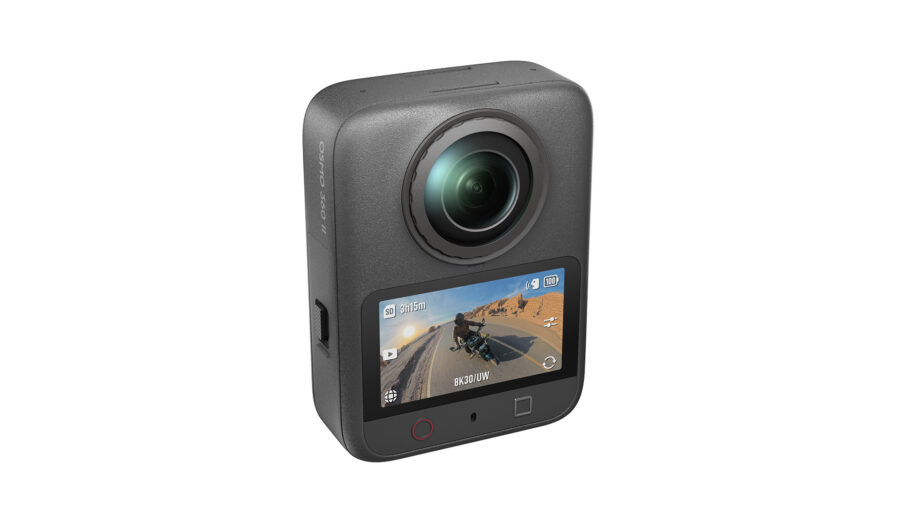 Osmo 360 II. Image credit: DJIAI SuperNight 2.0, and the 5K single-lens mode that quietly disappeared
AI SuperNight 2.0 is a new noise-reduction algorithm that DJI says delivers cleaner, brighter low-light 360° footage. There is no technical detail in the press material on how it works, what resolutions and frame rates it is available at, or how much temporal smearing it introduces, so for now it is a feature to evaluate on real footage, with no spec attached that you could compare. Given that both lenses sit at f/1.9 behind 2.4μm pixels, any real low-light gain here is coming from processing, not optics.
The single-lens side of the spec sheet has moved in two directions. The Boost Video mode with its 170° field of view survives at 4K and 2.7K up to 120fps, so the camera still works as a conventional high-frame-rate action camera when you do not need the full sphere. What has gone is the 5K 4:3 and 5K 16:9 single-lens option that the original offered at up to 60fps; standard single-lens video on the II now tops out at 4K (4:3 or 16:9) at 60fps. For most people Boost Video was the mode that mattered, and that one is intact, but if you were using the first camera’s 5K flat output to reframe in post, that headroom is no longer there.
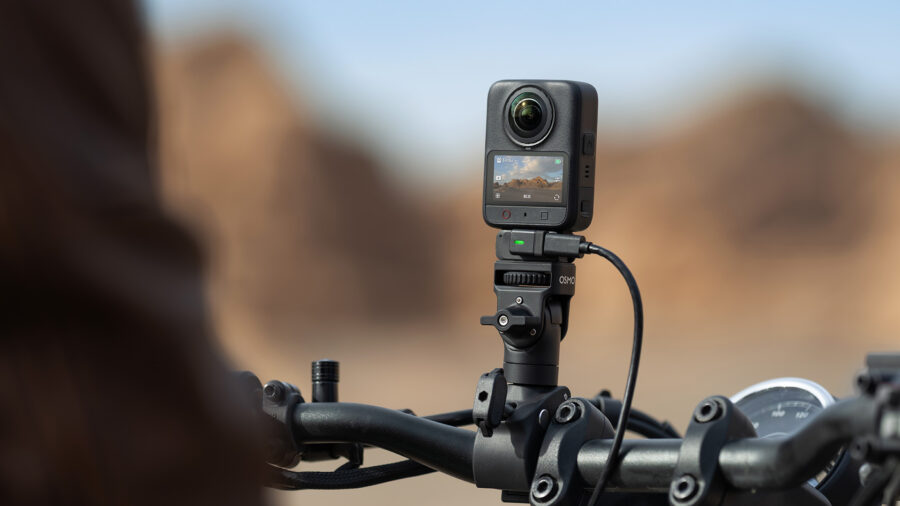 Osmo 360 II mounted on a motorcycle. Image credit: DJIThe replaceable lenses are the fix owners were waiting for
When we reviewed the DJI Avata 360 earlier this year, Jakub wrote that I expected its at-home lens replacement kit to carry over to a second-generation Osmo 360, because protruding fisheye elements on an action camera get scratched no matter how careful you are. That is exactly what has happened. The Osmo 360 II uses an all-new replaceable lens design, and both lenses carry what DJI calls an ultra-hard optical film for better scratch and wear resistance. If a lens does get damaged, you swap it and keep shooting. An Osmo 360 II Lens Kit ships to reviewers alongside the camera, and the separate Osmo 360 Lens Protectors remain an option for anyone who wants a sacrificial layer on top.
This closes the most obvious gap against the Insta360 X5, which introduced user-swappable lenses last year, and it is the single upgrade that changes the ownership economics of the camera. A scratched lens on the first Osmo 360 meant a service trip. On the II it means a few euros and a few minutes.
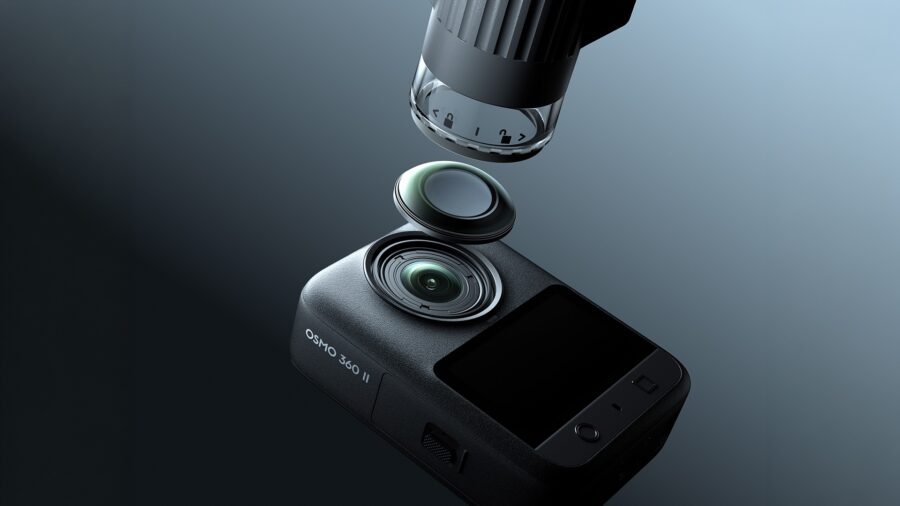 Finally, the Osmo 360 II comes with an all-new replaceable lens design. Image credit: DJIBattery, storage, and runtime
The included battery is the new Osmo Extreme Battery Plus at 2150mAh, up from 1950mAh, and DJI rates it for 100 minutes of continuous 8K30 panoramic recording with fast charging to 80% in 22 minutes. That 100-minute figure matches what DJI quoted for the original camera at the same resolution, so my guess is that the bigger cell is paying for the faster processor and the extra frames, with nothing left over for longer runtime. The Osmo 360 II Battery Extension Rod adds a further 180 minutes and doubles as a magnetically attached grip.
Storage is unchanged at 128GB internal with 105GB available. On our bikepacking trip through Kyrgyzstan with the first camera, five days off-grid made the internal storage one of the most useful features for Mascha on the spec sheet, and the microSD slot now accepts cards up to 1TB. Operating temperature goes down to -20°C (-4°F), which DJI illustrates with skiing, where a double twist of the selfie stick starts recording.
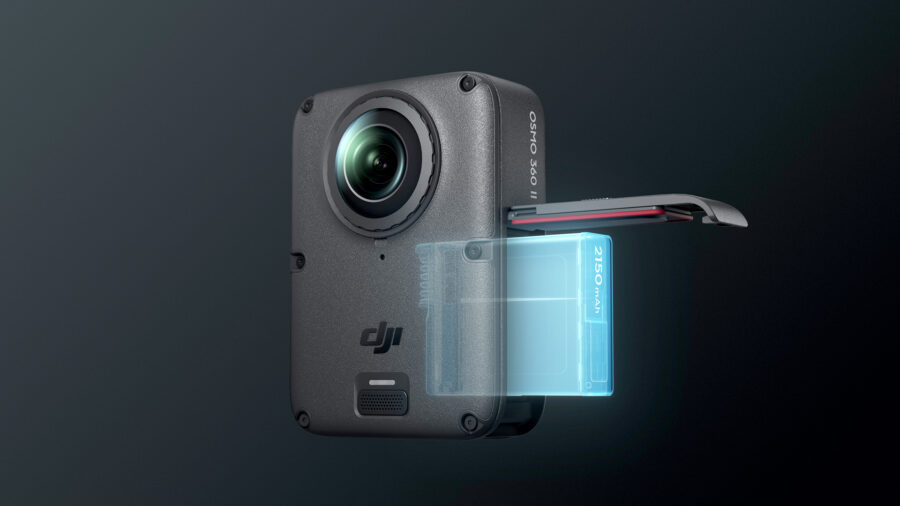 The new Osmo Extreme Battery Plus with 2150mAh is included. Image credit: DJISpotlight Follow, NFC, and the DaVinci Resolve plugin
The software side is where DJI has put most of the workflow effort. Spotlight Follow lets you select a subject and keeps it centered in the final reframed output regardless of how the camera rotates, with the flat export handled in the DJI Mimo app or DJI Studio. The series comparison lists Spotlight Follow output at up to 4K30, so this is a delivery tool for social and quick turnarounds; your 8K60 masters still get reframed the manual way. Dual Recording generates a front-facing view and a selfie view from the same 360° file, and AI High-Precision Smart Stitching is meant to reduce close-range misalignment on fine textures such as railings, tiles, and coral, which is where every 360° camera I have used shows its seams.
The new NFC area lets you tap a phone to the camera to connect to Mimo, transfer footage, or jump straight to the editing page. The first camera required searching and pairing through the app each time. For desktop work, DJI Studio exports 360° files that can be imported directly into DaVinci Resolve via a plugin, which is a welcome step for anyone whose finishing lives in Resolve rather than in a phone app. DJI also mentions 64x panoramic slow motion in post through DJI Studio’s AI frame interpolation, describing it as equivalent to a cropped 8K480. That is interpolated motion, not captured frames, and it should be judged as such.
Audio comes from a four-microphone array with a wind noise reduction design, and OsmoAudio Direct Microphone Connection supports the DJI Mic 3, Mic 2, Mic Mini 2S, Mic Mini 2, and Mic Mini without a receiver. Mounting moves to a dual-direction quick-release design, so the magnetic mount now attaches on both sides of the camera, and there is a standard 1/4-inch thread for conventional grip.
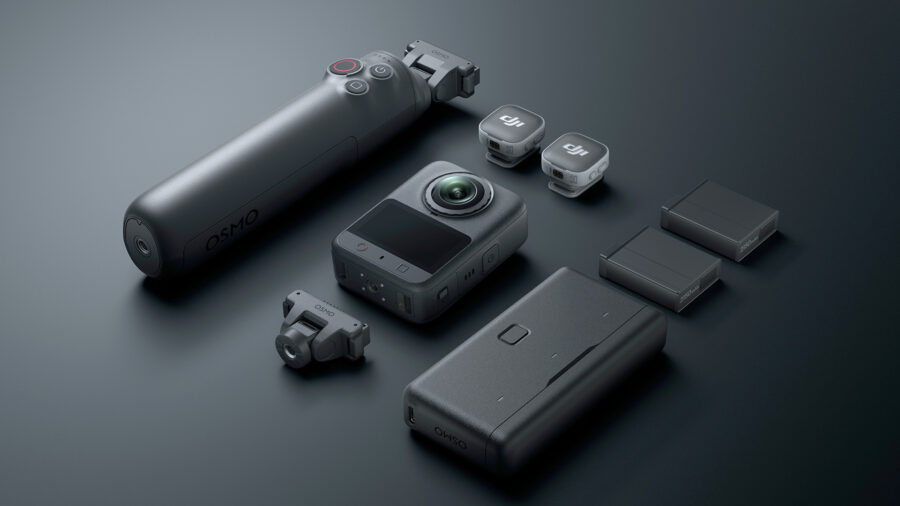 This is what DJI calls their “all-scenario ecosystem”, including 2 DJI Mic 3. Image credit: DJIOsmo 360 vs. Osmo 360 II at a glance
Here is the generational delta in one place, drawn from DJI’s own series comparison and spec sheets. Rows marked “claimed” are manufacturer figures.
FeaturesOsmo 360Osmo 360 IISensorsDual 1/1.1-inch square CMOS, 2.4μm pixelsDual 1/1.1-inch square CMOS, 2.4μm pixelsLensesf/1.9, non-replaceablef/1.9, user-replaceable, hardened optical filmDynamic range (claimed)13.5 stops14.5 stopsMax 360° video8K (7680×3840) at 50fps8K (7680×3840) at 60fps360° slow motionUp to 4K at 100fpsUp to 4K at 240fpsSingle-lens videoUp to 5K 4:3 30fps, 4K 4:3 120fpsUp to 4K (4:3 or 16:9) at 60fps, per the supplied spec sheet360° photo120MP (15520×7760)120MP (15520×7760), HDR supportedTimelapse8K 360°16K 360°Low-light processingSuperNightAI SuperNight 2.0Spotlight FollowNot availableYes, output up to 4K30Color10-bit, D-Log M10-bit, D-Log MMax bitrate170Mbps170MbpsStabilizationRockSteady 3.0, HorizonSteadyRockSteady 3.0, HorizonSteadyBatteryOsmo Action Extreme Battery Plus, 1950mAhOsmo Extreme Battery Plus, 2150mAhRuntime at 8K30 (claimed)100 minutes100 minutesFast charge50% in 12 minutes80% in 22 minutesInternal storage128GB (105GB usable)128GB (105GB usable)Waterproofing10m bare, 50m with case10m bare, 50m with caseMountingMagnetic quick-release, one sideDual-direction magnetic quick-release, both sidesMimo connectionSearch and pair in appTap to connect via NFCWeight183g (6.5oz)183g (6.5oz)
Read down the right-hand column and the pattern is clear: sensors, optics, storage, weight, and codec ceiling are carried over, and the money went into the processor, the lens mount, and the software.
Combos, availability, and the pricing gap
Various combos are available. The Standard Combo includes the camera, one Osmo Extreme Battery Plus, a protective pouch, a lens cloth, a USB-C 3.1 PD cable, and the Osmo 360 Silicone Lens Cap 2. The Adventure Combo adds two more batteries for three in total, the Osmo Multifunctional Battery Case 3, the Osmo Adjustable Dual-Direction Quick-Release Adapter Mount, and the 1.2m (3.9ft) Osmo Invisible Selfie Stick. New accessories announced alongside the camera are the Osmo 360 Waterproof Case and the Osmo 360 Heavy Duty Clamp Kit, with the existing 2.5m (8.2ft) Extended Carbon Fiber Selfie Stick, Hanging Neck Mount Max, and Vortex Rotating Handle carried over.
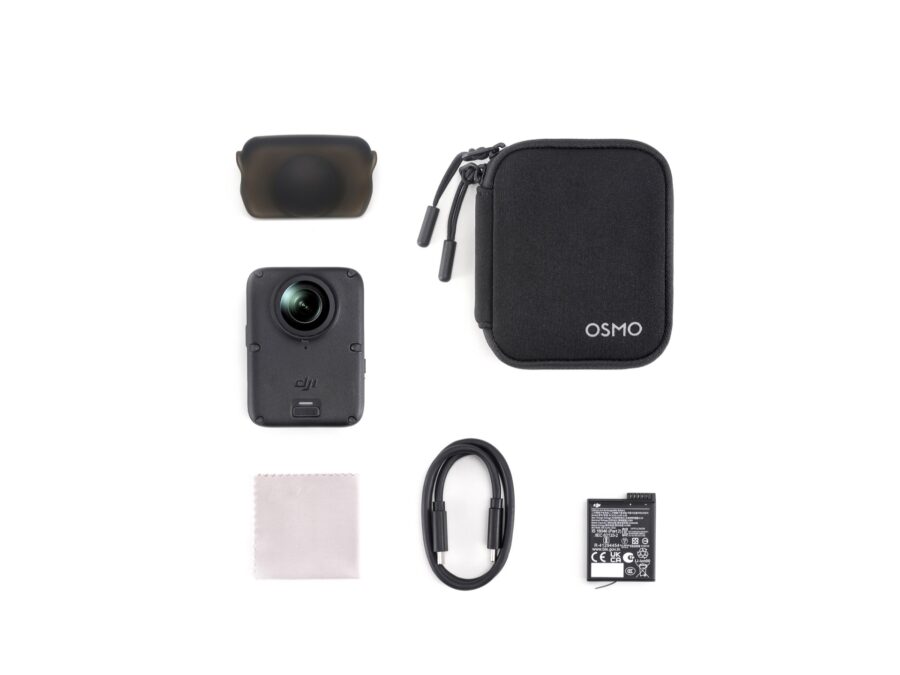 Osmo 360 II Standard Combo. Image credit: DJI
The first hands-on opportunity with Osmo 360 II will happen at IFA 2026 in Berlin, Hall 20, Booth H20-129, which is starting tomorrow, September 4, and running until September 8.
While the original Osmo 360 launched at €479.99 for the Standard Combo in Europe, the new Osmo 360 II Standard Combo launches at €589, which seems like a rather significant price increase. Like most other DJI products lately, it will not be available in the US at launch, “application still pending”.
Is 8K60 plus a replaceable lens enough to move you off a first-generation Osmo 360 or an Insta360 X5, or is 360° still a niche tool for you? Let me know what you think in the comments below.