

The experiment was carried out at Ben-Gurion University using clouds of rubidium atoms cooled to just above absolute zero and manipulated close to the surface of a specially designed atom chip.
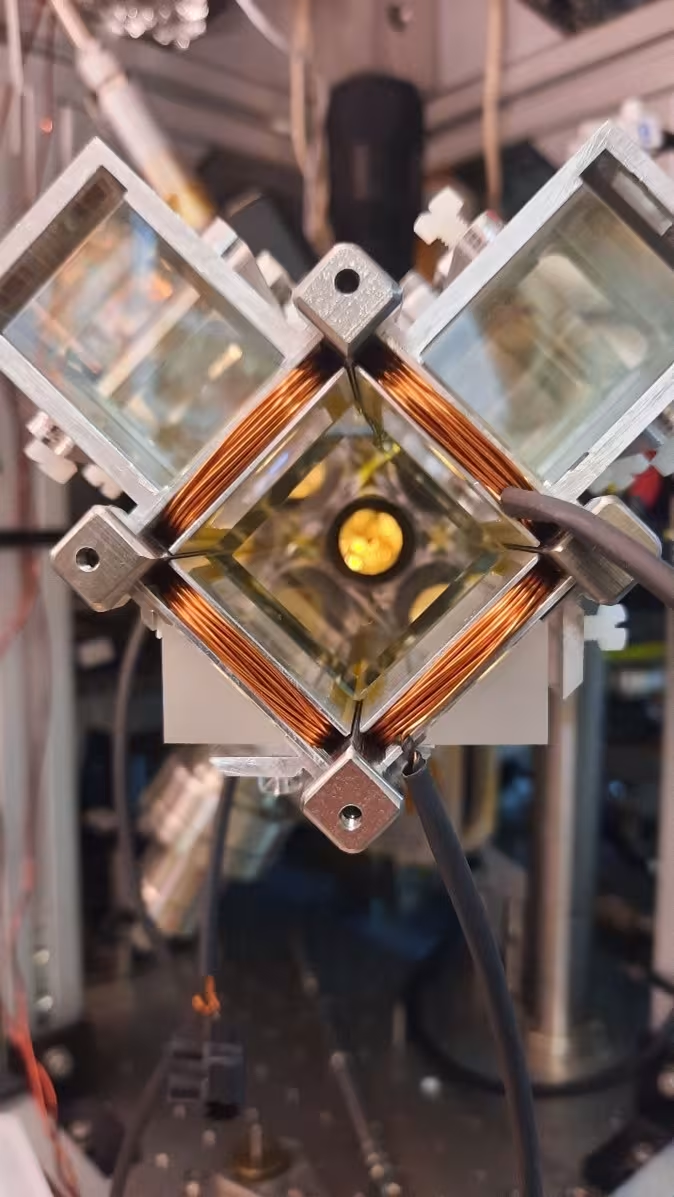 The 2D MOT apparatus which feeds the science chamber with cold atoms. Credit: Or Dobkowski.
The experimental team, including PhD student Or Dobkowski, first used microwave pulses to put the ultracold atoms into a quantum superposition, effectively allowing each atom to travel along two different paths at once. They then used tiny electrical wires on the chip to generate precisely controlled magnetic fields. One part of the atomic wave responded to this magnetic field, allowing the researchers to apply an upward force that exactly counteracted the downward pull of gravity. In effect, this part was held stationary relative to the laboratory and the Earth.
The other part was pushed upwards with a precisely controlled magnetic pulse, then switched into a state almost unaffected by the magnetic field so that it could fall freely under gravity – following a ballistic trajectory, similar to a ball thrown into the air.
At the end of the fall, the researchers used another precisely controlled magnetic pulse to bring the two parts back together. When the two waves were reunited, they interfered with each other. That interference allowed the researchers to measure the tiny difference in quantum phase accumulated while one was falling and the other was held still.
The phase measured in the new experiment is the same as the one predicted when Einstein’s principle is applied to such a quantum wave. The result therefore provides an experimental connection between quantum physics and Einstein’s theory of gravity.
Although previous experiments have used quantum particles to measure gravity, the researchers say this is the first direct measurement of the predicted quantum phase of a freely falling object.
Lead author Professor Ron Folman (Ben-Gurion University of the Negev) said: ‘This is a unique paper, in the sense that it combines a hard experiment with a far-reaching theoretical interpretation, about one of the most fundamental questions in physics: How can gravity (described by Einstein’s theory of relativity) and quantum theory, be unified into one understanding of the universe? These two pillars of modern physics have so far eluded all attempts at a unified theoretical framework, but this complex experiment gives more hints as to how such a unification may be achieved.’