
In 2008, two physicists proposed that something strange should happen when graphene is bent almost as sharply as atoms allow. The bend, they argued, could nudge electrons out of balance, producing electrical polarization from shape alone.
If they were right, that meant that wonder material — graphene has amazing strength, conductivity, flexibility, and lightness — could be turned into highly sophisticated ultrathin electronic devices without the need for adding additional material.
But would it actually work? The sharp deformation occurs across distances approaching the scale of individual atoms, where even powerful microscopes struggle to determine exactly how sharply a material curves.
Now researchers in the US and UK say tiny wrinkles in graphene may have provided the experimental evidence they were looking for. In a new study, the team reports that extremely sharp bends changed graphene’s local electrical potential in ways that closely matched atomic-scale theoretical calculations.
The researchers add they’ve now seen flexoelectricity in graphene, meaning uneven bending creates a separation of electrical charge. In one-atom-thick graphene, however, the researchers argue that the extreme bend does something more unusual. It changes how electron orbitals overlap, redistributing electrons around the wrinkle.
That makes this a case of what the researchers call quantum orbital flexoelectricity. It might not mean anything to you yet, but read on and we’ll get to it in a moment.
Right All Along
 Tiny bends in graphene can change the material’s electrical properties—depending on the angle. Schematic exaggerated for illustrative purposes. Credit: ZME Science
The path to discovery was not initially straightforward.
Sathvik Ajay Iyengar, then a doctoral student at Rice University, was revisiting measurements he had collected with researcher Manoj Tripathi when he noticed unusual electrical signals around the sharpest graphene wrinkles. He took the results to Vincent Meunier, who had helped advise his doctoral work and is also the author of a 2008 study, which first introduced the idea of “electronic flexoelectricity” in low-dimensional systems like graphene.
×
Thank you! One more thing…
Please check your inbox and confirm your subscription.
“When Sathvik showed me the measurements he and Manoj had collected, we realized that the unusual signals could provide an experimental connection to an idea we had predicted many years earlier,” Meunier said in a Rice University statement. “Bringing the experiments and atomic-scale calculations together allowed us to test that connection directly.”
The wrinkles formed where graphene rested on molybdenum disulfide, another atomically thin material. Because the two materials respond differently to mechanical stress, graphene buckled into narrow standing ridges without researchers having to push on it with a microscope tip.
Previously, a 2021 experiment with graphene nanobubbles, for example, reported flexoelectric behavior after researchers created the bubbles using an electric field from a microscope probe. The new wrinkles are naturally formed, giving the team a comparatively clean way to examine extreme curvature.
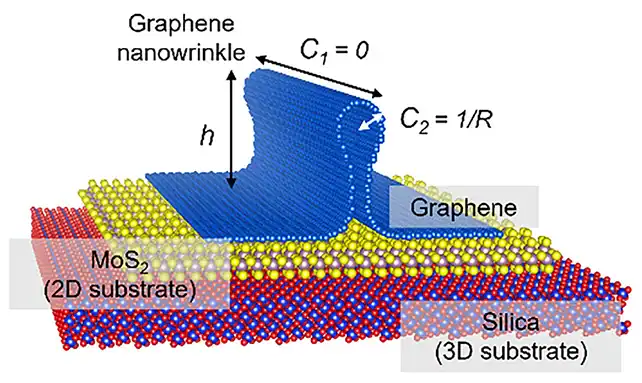 Schematic of the graphene wrinkle used in the experiment. The blue graphene sheet bends sharply where it rests on a layer of molybdenum disulfide (yellow), which sits on silica (red). Credit: Advanced Materials
The Sharper Bend
The team also found that how sharply the graphene bent mattered much more than how tall the wrinkle was. At the sharpest tips, the electrical behavior changed noticeably, while taller but less sharply curved wrinkles behaved much the same as shorter ones.
“The sharpness of the wrinkle turned out to be much more important than its overall size,” said Iyengar. “That tells us we can potentially tune electrical behavior by carefully controlling curvature at the nanoscale.”
The effect was surprisingly strong. At the sharpest bends, electrons shifted enough to create a pronounced electrical imbalance, with one side becoming relatively negative and the other relatively positive. The researchers estimated this polarization to be 100,000 to 10 million times stronger than in much larger flexoelectric systems.
Iyengar likens the two sides to the opposite ends of a tiny battery, but without actually storing and delivering energy like one.
The broader promise is that engineers may one day control the behavior of atomically thin electronics simply by deciding where and how sharply the material bends. All sorts of interesting and useful properties could arise this way, although other currently known useful graphene properties could diminish too. A 2012 study of graphene wrinkles showed that wrinkles can make it harder for electrons to move through graphene, changing its electrical resistance depending on the wrinkle’s shape and direction. Moreover, a 2021 Nature Nanotechnology study showed that unevenly bending molybdenum disulfide could help it generate an electric current when exposed to light.
However, the new result comes with caveats. Researchers cannot yet accurately measure the smallest bends atom by atom, and some key quantities rely on models and order-of-magnitude estimates. Nor has anyone built a practical device around the effect.
The study was published in the journal Advanced Materials.