
AI-generated
By Alex Lennane
4 September 2026
In the second of a two-part interview with WiseTech CEO Zubin Appoo, The Loadstar examines WiseTech’s plans to turn CargoWise into an AI ‘system of execution’ – and what that could mean for the future of the TMS. Yesterday: DSV’s evolving relationship with CargoWise, the impact of its new pricing model, and the regulatory and operational challenges it faces
For more than two decades, CargoWise has been the place where freight forwarders record and manage their operations. WiseTech Global now wants it to become the software that increasingly does the work itself.
CEO Zubin Appoo told The Loadstar the company was increasingly moving away from describing CargoWise simply as a “system of record”, as artificial intelligence and automated workflows begin taking over tasks previously performed by forwarding staff.
“Over the past six months or so, we have been talking much more about CargoWise Next being a system of execution or a system of intelligence,” he said.
If software can decide what needs to happen next in a shipment, and then execute that decision, the valuable part of the technology could shift from the system in which transactions are recorded, to the layer making those decisions.
WiseTech’s answer appears to be to put that layer inside CargoWise itself.
Mr Appoo said this would combine data held by customers, industry datasets WiseTech had accumulated and refined over more than 30 years, AI agents, and automated workflows.
“This is a system that our customers run their businesses on day in, day out,” he added.
Some of what that means operationally is beginning to emerge.
WiseTech had four agentic AI capabilities available when it introduced CargoWise Value Packs, has since added another two, with two further capabilities described by Mr Appoo as “imminent”.
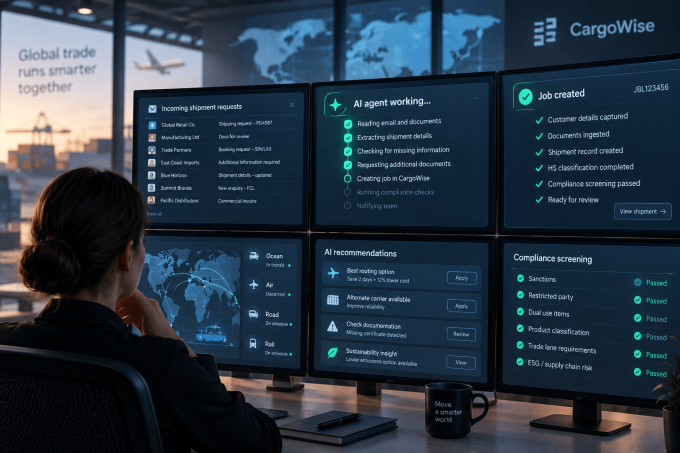
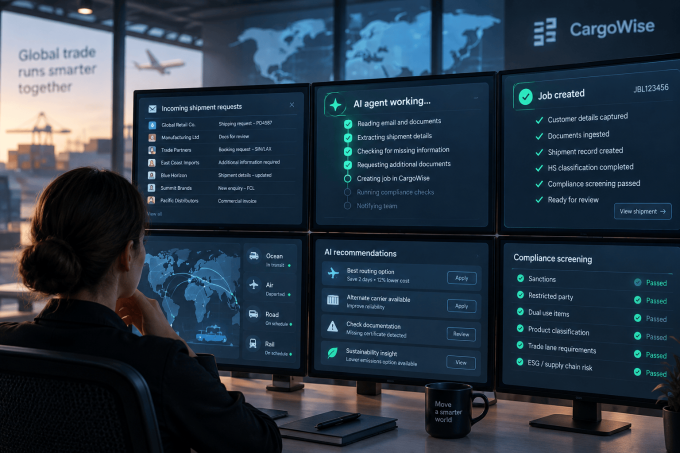
One is SARA, its Smart Auto Request Agent, designed to take over the often labour-intensive exchange of information between forwarders and their customers.
It can examine an email and accompanying documents, identify missing or illegible information, request additional documents or clarification from the importer or exporter, and return the completed information to the operator.
“The smart auto request agent takes humans out of that process entirely,” said Mr Appoo.
That will be followed by an auto job creation agent. Once the necessary information has been gathered, it can automatically register the job in CargoWise Next, ingest electronic documents and commercial invoice lines, and initiate other processes, including AI-assisted classification and compliance checks.
By the time an operator gets involved, much of the administrative work will already have been completed.
WiseTech is targeting up to 50% labour cost savings for logistics service providers through AI, automation, and its other capabilities – although Mr Appoo declined to reveal how much of that saving customers could achieve today.
“We have made solid progress on that since we’ve built our agents,” he said.
Whether forwarders ultimately cut staff, redeploy them, or use the productivity gains to process more freight was for individual customers to decide, he added.
And WiseTech also intends to capture some of the economic value created.
As part of its explanation of how CargoWise could achieve forecast revenue growth of 12%-20% in FY27, Mr Appoo pointed to increasing efficiency savings delivered through AI and other features and, specifically, “monetising agentic AI capability”.
That helps explain the strategic importance of CargoWise’s shift from seat-based licensing towards its Value Pack model, under which pricing is increasingly linked to transactions and the value WiseTech says its technology delivers.
But there are limits to how autonomous WiseTech believes freight operations can become, particularly where regulatory risk is involved.
Asked who would carry the liability if a CargoWise AI agent made an incorrect operational or compliance decision, Mr Appoo was clear.
“It is ultimately the forwarder or the broker,” he said.
That is why WiseTech describes its classification product as an AI “assistant”, he explained. The intention is for AI to perform much of the legwork, while an experienced operator reviews the audit trail and ultimately approves or corrects its decisions.
The heavily regulated nature of logistics also means WiseTech is being cautious about releasing agents simply to increase their number, he added.
“It’s not just about saying to the market we’ve now got 18 agents or 29 agents. That’s meaningless if the agents don’t actually do their job very well.”
The emergence of increasingly capable AI software has also prompted questions over whether the barriers to building alternatives to established TMS platforms, such as CargoWise, are beginning to fall.
Mr Appoo disagrees. He said CargoWise’s biggest competitor remained the in-house legacy systems operated by some of the world’s largest forwarders, rather than a new generation of AI-native challengers.
“I don’t subscribe to the view that AI is a threat to us. I say AI is an accelerant to us, because it’s not like you can vibe code CargoWise.”
He argued that the platform’s competitive advantage went considerably beyond its software code, pointing to integrations with some 400 airlines, 160 shipping lines, and Class I North American railroads and customs authorities around the world.
“That’s not source code. That’s sort of commercial relationships, deep domain expertise, and none of that can be replicated by AI.”
But WiseTech itself is also becoming considerably more than simply CargoWise.
The $2.1bn acquisition of e2open last year expanded the company’s reach beyond its traditional forwarder customers into manufacturers, retailers, importers, exporters, and beneficial cargo owners.
WiseTech’s FY26 results describe an ambition to build a “mission-critical operating system” spanning five markets: logistics and transport, through CargoWise; connected supply chain orchestration, through e2open; trade finance and banking; customs and government; and verified identity, trust and data, through VerifyWise.
Mr Appoo rejected the suggestion that expanding into the shipper market could ultimately put WiseTech in competition with the forwarders on which CargoWise was built, insisting the strategy was not intended to bypass them.
“That’s not because there’s any view about disintermediating freight forwarders,” he said.
He argued that, while around half of ocean freight went through forwarders, the remainder included large manufacturers dealing directly with shipping lines – a market CargoWise had not traditionally captured.
“E2open is a market or a TAM expansion for us, but it doesn’t change our very deep and very loyal, I think, focus on logistics service providers.”
And acquisitions will remain part of that expansion.
WiseTech acquired supply chain risk and compliance intelligence provider FRDM.ai in July for up to $24.3m, with its technology being used as a building block for VerifyWise. The product maps and verifies multi-tier supply chains against increasingly demanding requirements, covering areas including modern slavery, forced labour, sanctions, and other compliance obligations.
Mr Appoo said there was plenty of work still to do integrating e2open, a process WiseTech expects to span several years, but ruled out any move away from acquisitions.
“M&A has, for many years, been part of our strategy and we’ll continue to use M&A where there’s an opportunity for us to expand our reach in the supply chain and deliver more value to our customers.”
The result is a WiseTech proposition that is no longer simply a TMS.
Its stated ambition is now to become the “operating system for global trade and logistics”, connecting not only forwarders but carriers, shippers, manufacturers, banks, and governments.
And if AI does shift the value in forwarding software away from recording transactions and towards deciding and executing what happens next, Mr Appoo appears determined that CargoWise should own that layer too.
“What we are doing is essentially making CargoWise into an AI system of execution.”
So, is AI killing the TMS – or is the TMS simply becoming the AI?
Part one of this interview: DSV weighs early CargoWise move as WiseTech tackles pricing and ACCC scrutiny