
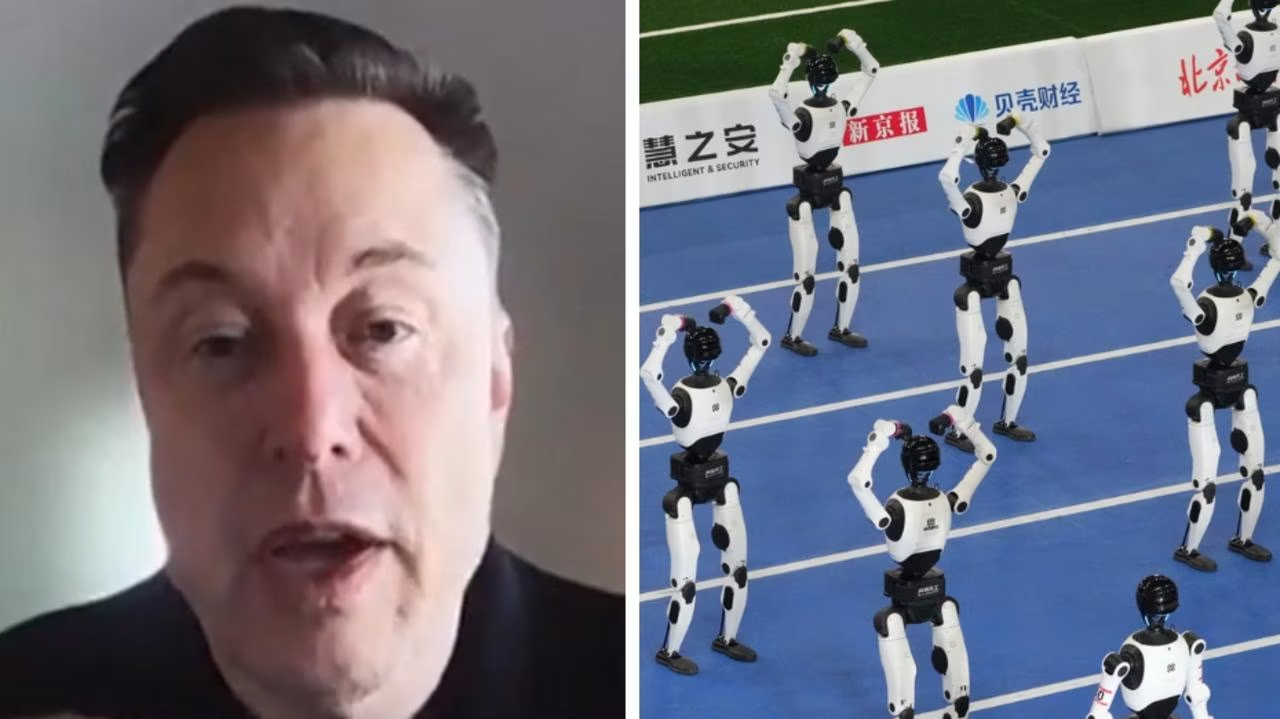
Elon Musk has predicted there will be at least one billion humanoid robots within the next decade that will be more productive than “all humans combined”.
The world’s richest person predicts the productivity of a single humanoid robot will be at least five times that of an ordinary human. Robots are then predicted to start manufacturing other robots, creating a “recursive effect”.
“So it starts off very slowly but then grows at an explosive rate,” the SpaceX and Tesla CEO told the 2026 G20 summit in North Carolina via video link.
“10 years from now, I would say there are well over a billion humanoid robots. The productivity per robot will be probably five times that of a human.”

Mr Musk said he believes this to be a “conservative estimate” and said he would be “willing to put serious money betting on that there will be at least a billion robots in 10 years, and those robots will be at least five times the output of a human”.
“Meaning that the billion humanoid robots will be more productive than all humans combined,” he said.
Mr Musk said he believes the usefulness of robots will depend on three factors: how good the AI software is, how good the AI chip in the robot is, and how good the electromechanical dexterity of the robot is, particularly the hands.
“All three of those things are improving exponentially. The usefulness of the robot is those three things multiplied by each other,” he said.
Global humanoid robot shipments totalled roughly 19,100 units in the first half of 2026, more than triple the 5,100 units shipped in the same period last year, according to data from Smart Analytics Global.
The research firm expects shipments will rise to around 60,000 units this year and hit half a million by 2030.
Chinese humanoid robot makers made up more than 97 per cent of global shipments, with Shanghai-based Agibot claiming the top market share with 8,400 of global shipments, followed by Hangzhou-based Unitree Robotics at 5,900 units.
Tesla is launching its own humanoid robot, Optimus, which has been pitched as an all-purpose humanoid robot designed to perform unsafe, repetitive or boring tasks.
It’s aiming to produce one million of the robots per year, with Mr Musk previously saying Optimus could eventually account for about 80 per cent of Tesla’s value.
It comes after Chinese humanoid robots smashed records set by humans at the World Humanoid Robot Games in Beijing this month.
The five-day games saw two robots run faster than Usain Bolt’s 9.58-second world record in the 100 metres sprint.
Tiangong Ultra, developed by the Beijing Humanoid Robot Innovation Centre, ran 100 metres in 9.39 seconds, while Honor’s Lightning finished in 9.47 seconds.
The results marked an improvement from last year’s inaugural games, where Tiangong Ultra won the 100m race in 21.50 seconds.

AI to boost global economy by up to $30 trillion, Musk says
Speaking at the G20 summit, Mr Musk said humanoid robotics would mark an “incredible change”.
“I think AI will probably increase the global economy by 20 to 30 per cent, that’s my rough estimate. Meaning in the order of $20 to $30 trillion per year,” he said.
“AI will be able to do anything digital, anything that does not require shaping of atoms by hand, probably by the end of next year.”
Mr Musk said AI was already incredibly good at software and it was getting to the point where AI would be “Stockfish-level good”, a chess program that can beat the world’s best chess players easily.
“At this point, you could run Stockfish on your phone and beat Magnus Carlsen at chess,” he said
“At some point next year is my prediction, AI software will be so good that it will be Stockfish-level good, meaning that it is impossible for a human to compete in writing software with AI. AI will just crush all humans at software.”
Mr Musk expects AI will be “extremely good, possibly Stockfish-level” at anything digital in 12 to 18 months.
Read related topics:Elon Musk