
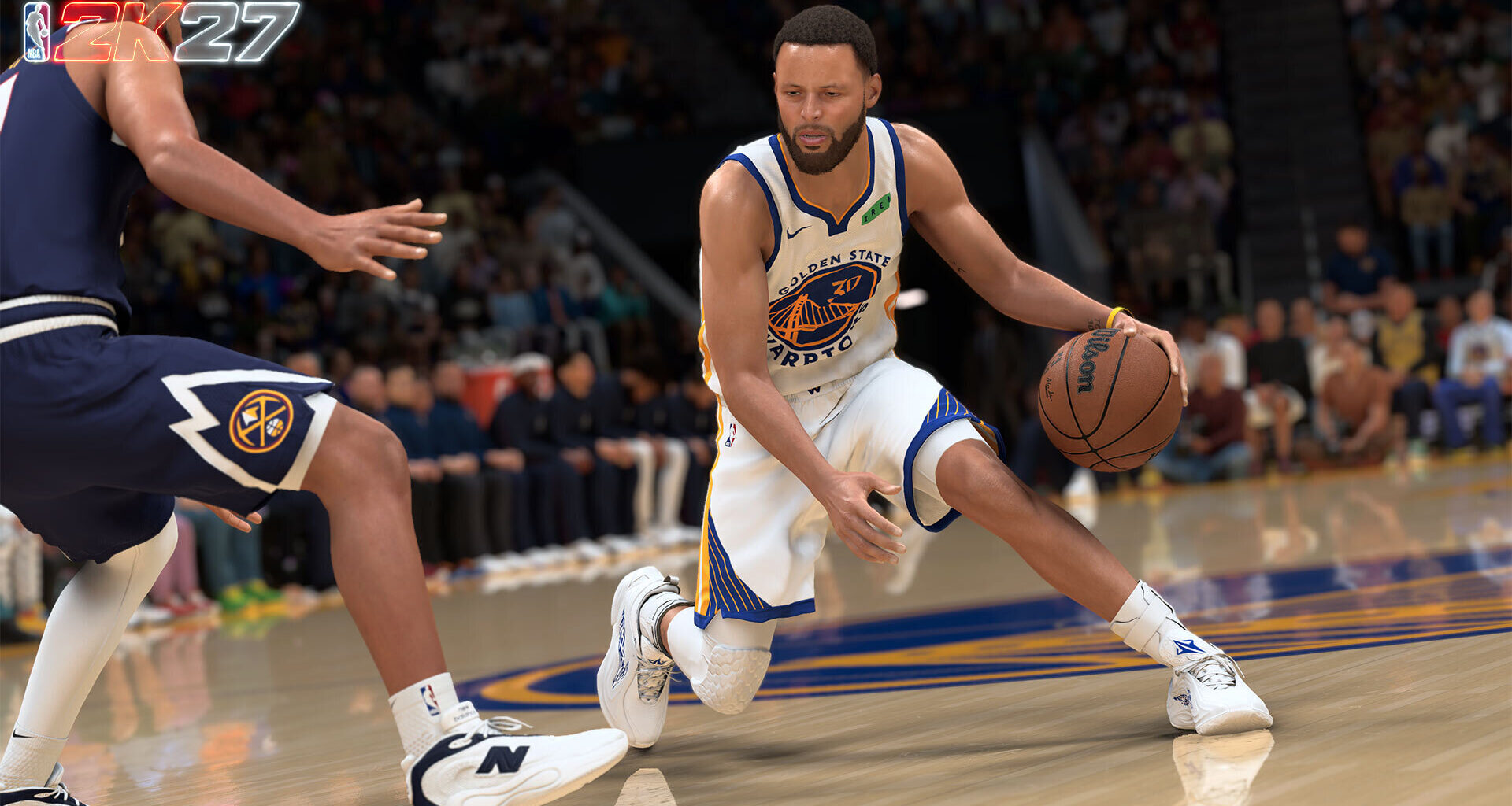
I really do think the NBA 2K series has stepped up its game in recent years and is now among the very best when it comes to gameplay. NBA 2K27 leaves me with somewhat mixed feelings, however, as whilst it’s still really good on the court, problems arise in other areas.
Let me start with what is, and always should be, the most important aspect of a sports game. This is, of course, the gameplay and how it feels to play a real sport in a virtual world. Fortunately, as I said, this is where NBA 2K shines, and this year is no exception. I generally think it simulates real basketball well, and although the changes are minor from year-to-year, it’s still a step forward.
This year, according to the developers themselves, they’ve added over 7,000 new animations. It’s obviously difficult to verify whether this is the case, but I’ll have to take their word for it. This is powered by ProPlay, a technology converting real match footage into in-game animations. Most of the improvements are on the offensive side, with new logic-based dunks that produce more realistic results all the way to the basket, a lay-up engine that adjusts players’ movements in mid-air, and new dribbling moves.
 Is this one of the last years we’ll have the chance to play as Steph?
This is an ad:
To round off the offensive side, shooting has become slightly more difficult, at least initially before I became used to it. I’ve also seen feedback online from players who’ve halved their percentage from behind the three-point line, which I think is good as it’s not realistic to face players online who make 80 per cent of their three-pointers, since that would be far too easy. The so-called “rhythm shooting”, where you use one of the joysticks to time your shot with the player’s movements, now requires you to hit the green zone on the shot meter. This means that shots taken slightly too early or too late will miss every time. However, this is something you can exploit if you’re really good at it, as the green zone gets bigger the better you get at finding that perfect timing. The flip side is the zone gets smaller if your timing is off. So-called “button shooting” – where you use a single button press to try and hit the green area – is much easier to use, especially for beginners, as it only requires one button press instead of two movements (down and then up) to try and get the perfect rhythm.
One thing that has a major impact on your shots is not just how good you are at hitting green areas within a gauge, but also how the defenders affect you. A hand in your face obviously makes it much harder to sink a ball compared to an open shot the size of a motorway in Texas. This year, defenders have improved defensive mechanics when they raise their arms to better disrupt shooters. Hold down your right stick to play aggressively with your arms, causing the defender to automatically challenge shot attempts. Alternatively, hold the control stick down to play more cautiously and challenge without taking major risks if, for example, you’re in foul danger.
Manual block attempts can still be used. There’s now also colour-coded feedback to show the quality of the defensive attempt. Perhaps the biggest difference, however, is a new ball-collision system. This system compares the different attributes of both players to see whether contact from, for example, a steal is sufficient to dislodge the ball, which rewards physical, well-timed defence, whilst still giving the ball-handler a chance to keep the ball under control. It also means that tall players, especially the towering Victor Wembanyama, has a better chance of blocking shots, and it’s bloody impossible to even attempt a shot when the Frenchman is nearby.
 Wemby put in an unusually passive defensive performance. Feedback on how well you’ve defended a shot is now shown in colour on the ground (in this case, red for a failure).
This is an ad:
All in all, the basketball is excellent. So is the Career Mode, where you create a player and follow their career. Whilst other sports games have completely done away with any sort of narrative – such as “The Journey” in FIFA 17-19, “Longshot” in Madden NFL 18 and 19, and the now-defunct Fight Night series – it’s pleasing NBA 2K keeps this alive. Admittedly, it’s no longer the extreme sort where the player’s friends die in storylines created by Spike Lee, but it still gives your player a sense of personality. Last year, the focus was on basketball in Europe, and in 2K27 it’s all about the G League. In a nutshell, your player is a top-ranked prospect at school and has a deal with one of the very best university teams. However, an accident puts a stop to it all, and two years later he’s fighting to make a comeback and get drafted. This time, the route goes via the G League, which these days can be summed up as a feeder league for the NBA. You can choose between two different teams and then fight your way to draft day. If you can’t be bothered or don’t want to play through the rather long story, you can instead jump straight into the NBA.
I like MyCareer and always have, but a few years ago, 2K made one of the daftest decisions in the history of sports games. Now, the character you create to play the offline Career Mode is completely tied to the online mode, MyCity. This means you use the same player in both modes and can only upgrade your attributes using the game’s virtual currency. Not at all interested in playing online? That’s a shame. You’ll still have to spend the same currency used to compete against others online. And it’s not exactly a small amount required to max out a player. If you only have the base version of the game, there’s a high chance you’ll be forced to use a player with very low attributes against Jokic, LeBron, Wemby, and others.
This year, the developers have found an extra way to be a bit greedy. They’ve introduced MyCareer Eras, which lets you take your custom-created player and throw him into different eras (Magic vs. Bird 1984, Jordan 1991, Kobe 2003, LeBron 2010, and Steph 2016) to see how he’d have fared against those teams. Each era has its own rules, team line-ups, arenas, and so on. Sounds brilliant, doesn’t it? And it is… basically. Want to use the player you’ve just spent X number of hours developing in the story mode? Forget it. If you want to play in one of these eras, you actually have to create a completely new player. If you want to play in all five, you’ll need to create five different, new players. You’ll obviously need to upgrade these as well, unless you want to play with a player with a total attribute rating of 65, which requires virtual currency. It’s unbelievable that you can’t play as the player I’ve already created and developed.
MyCareer does, however, have two nice additions. One is that you can now play the Career Mode in co-op, where one player takes on the role of radar partner Trace Miller. The other is that you can create female players, however, these can only be used in MyCity.
 Fortunately, the game is at its best on the court.
MyCity… the social online hub that people have mixed feelings about. As a hub for online gaming, it’s the best in the world of sports games. You can play anything you could dream of, with features such as The REC, Theatre, Street Kings, Park, Proving Grounds, Ante-Up, Starting 5, Crew HQ, Casual Corner, seasonal areas, Rucker Park, Daily Rivals, and more. Describing every game mode would turn this review into a lengthy book, so I’ll skip that, however, there’s something for every player. Casual Corner is a lovely new addition where you can simply jump in and play 3v3 or 5v5 against players of a similar skill level to yourself, where the better you play, the better the others will be. This is intended as an introduction for new players who might be a bit nervous about starting to play against others online. Then there’s the dark side, where everyone plays for themselves; an incredible amount of money is spent on maximising attributes that won’t matter in a year’s time; gatekeeping, where you have to build your player in specific ways to be able to compete; and more. And I haven’t even mentioned that the starting area is basically a shopping centre, surrounded by shops selling items to customise your player’s appearance, where the shoes, caps, balls, bags, and other items aren’t exactly cheap.
It’s not cheap either if you want to compete in MyTeam, the 2K series’ Ultimate Team mode. I’ve said it before and I’ll say it again: NBA 2K has the most greedy Ultimate Team mode of all the (major) sports games. There are very few players to unlock for free, and most things have to be bought via various card packs. The difference is huge compared to, for example, MLB The Show, which gives you enough free cards to drown in. I returned to that game a week or so ago after not having played it since May, and after just a few hours I’d unlocked a very strong team who could compete online simply by completing various challenges and programmes. MyTeam hasn’t really seen any major changes (why tinker with a cash cow?) apart from the fact that players now earn XP after matches, which can be used to improve some of their attributes.
 MyTeam is back for all card collectors.
MyNBA, which is the game mode where you can take charge of a club or a current player, has received a whole host of updates this year, which is good to see. This is often the sort of game mode developers neglect in favour of focusing on what brings in extra cash. There are over 20 changes from last year, and some of the biggest include an improved free agency system where the best available players consider various factors before deciding which team to sign for. These might include bonuses, demands to get rid of a rival, or signing a teammate. Another feature is that, as a GM, you now have a trust rating of up to 100. The higher it is, the greater the chance players will want to play for you. Low trust means players don’t trust your contract promises, and you may have to overspend to sign a player. There’s also the option to make trades involving four teams simultaneously.
The main attraction this year, however, is MyNBA Legacy, which is a sort of combination of the GM mode and the player mode, as it quite simply lets you do both. You choose a player and can start either as their rookie version or at their current ability level, whilst simultaneously managing the team as GM for up to 100 years. After 25 years, the player retires and you take over as their son, which is a fun addition for anyone who wants to do a bit of everything.

NBA 2K27 is a sports game that gets almost everything right when it comes to the basketball itself, but there are a few issues. Visually, the game hasn’t progressed in a few years, and whilst it isn’t ugly by any means, it feels like an upgrade is needed soon. There’s also still a sense this is the most money-grabbing of the major sports games, with currency dominating several game modes. Although there are some pleasant additions, particularly in the MyNBA Franchise mode, it unfortunately feels as though the series has lost a bit of its momentum and has fallen into a sort of lull.