
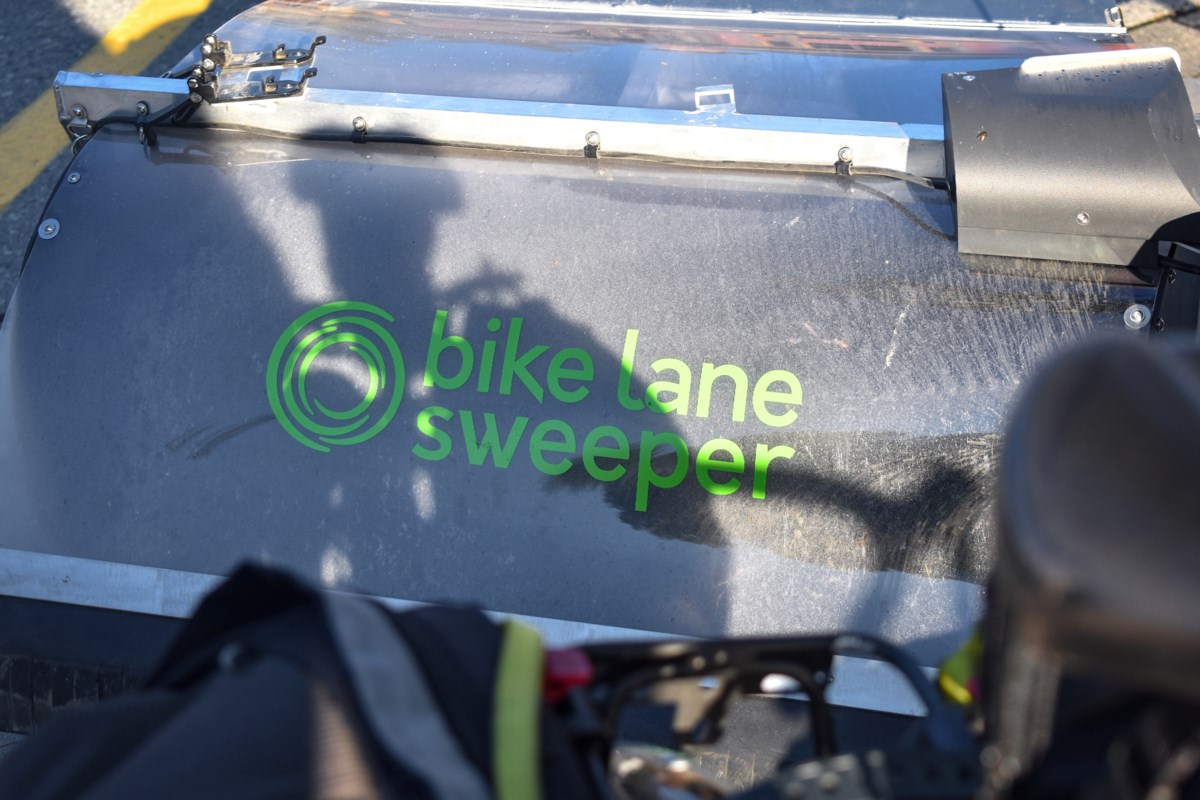
The club is exploring whether the machine could help keep Highway 99 shoulders cleaner and safer for cyclists
On a clear Sept. 1 morning, locals travelling between Function Junction and Nita Lake may have spotted an unusual vehicle making its way down Highway 99.
Shortly after 8:30 a.m., Whistler Cycling Club (WCC) board member—and 2025 GranFondo Whistler winner—Tyler Eardley was pedalling south along the shoulder with a metal contraption in tow. Beneath the device, a battery-powered brush spun across the pavement, collecting accumulated gravel and debris into two bins at the back of the device.
For Eardley and the WCC, the test was the latest attempt to tackle a problem the club has already spent years raising with the province: highway shoulders that are often wide enough to ride are frequently littered with winter grit and other debris that make riding uncomfortable or downright unsafe.
“I think more people would ride the road if it was better,” Eardley told Pique shortly before the test ride. “I feel like once [the province’s sweepers] get to the fog line, they just forget that that’s also the road.
“But there’s also users [on the] shoulder, and there’s more every year. Not just because of e-bikes, but road cycling’s booming [and] gravel bikes are coming into trend. So there’s way more people riding who would like to use this space, partly to not take up the Valley Trail.”
Now, the club is considering whether part of the solution could fit behind a bicycle.
From advocacy to a possible hands-on solution
In a Jan. 23 letter to the provincial Ministry of Transportation, the WCC laid out findings from its 2025 assessment of cycling infrastructure between Pemberton and Squamish. Among its chief concerns was sweeping frequency.
The club found most Whistler highway shoulders received an initial sweep in April 2025, but narrower sections beside concrete barriers and around the Mons overpass were not cleared until June, while some tight sections remained unswept until July. According to the WCC, those conditions can force riders out of the shoulder and into live traffic.
Eardley said the existing large-scale highway sweeping schedule leaves too much time for debris to build back up. He said the problem is particularly frustrating because much of the highway’s basic cycling infrastructure is already there.
“The shoulder is pretty good. It’s wide,” Eardley said. “And the roads are pretty quiet once you start going north—just have to pick the right times.”
He noted that the problem doesn’t end at the highway. Tight turns in hilly neighbourhoods around the resort municipality can make for dangerous conditions for riders, regardless of their age or experience levels.
A Sunshine Coast-built sweeper
The machine being tested Tuesday was developed on B.C.’s Sunshine Coast by mechanical engineer Cedric Eveleigh in collaboration with California inventor Pierre Lermant.
The design can operate in two configurations. On open roadside shoulders, the rotating brush pushes grit and debris off the riding surface. Where curbs, barriers or other obstacles prevent that, a rear collection system can capture material to be emptied later.
Eveleigh has said the idea grew out of volunteering with Transportation Choices Sunshine Coast, where locals manually sweep road shoulders with brooms.
“It was while sweeping debris with a broom that I got thinking about better ways to sweep bike lanes,” Eveleigh told Bicycle Broker in an interview published earlier this year.
Eardley said the machines sell for about $6,500 to municipalities and for-profit operators, or roughly $4,500 to individuals and non-profits.
The battery powers the brush, rather than propelling the sweeper itself. Eardley said Eveleigh recommends towing it at roughly 10 to 15 kilometres per hour, with about three hours of battery life.
“You can pedal it,” Eardley said. But for a community program, “you would get a bike and a machine together in one grant, and then it would be a ready-to-go system that anyone can jump on, because it kind of needs an e-bike.”
A low-maintenance belt-drive e-bike could cost another roughly $3,000, he estimated.
What happens next
The machine being tested is on loan from Eveleigh. The WCC has not yet decided how a permanent program would work.
Grant funding is one possibility. Another is finding a local business willing to buy or sponsor the machine in exchange for advertising space on its large rear panel.
Eardley said Eveleigh has also demonstrated another possible model on the Sunshine Coast, where cyclists and other supporters contribute small recurring payments through Patreon that have raised enough to pay for a regular sweeper.
He estimated sweeping once a month could ultimately be enough, though Tuesday’s ride was partly about learning what the machine can do and how often it would realistically be needed.
Eardley said better shoulder maintenance could also help make the corridor more appealing to road cyclists.
“Whistler already attracts people who bring their road bikes here and want to ride,” Eardley said. “If the shoulders were cleaner and better maintained, I think you’d see even more people using the highway, [and] more [potential for] the Sea to Sky as a road-cycling destination.”