

Encore a never to be repeated opportunity for a new owner
by Richard Gladwell, Sail-World.com/nz 6 Sep 01:41 PDT
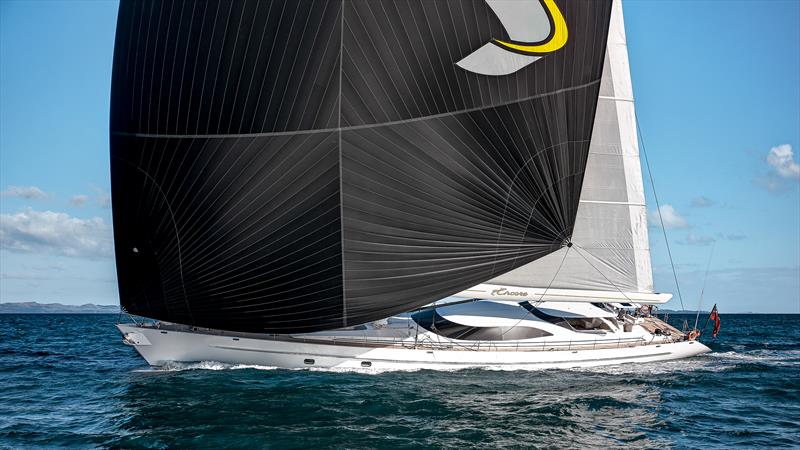
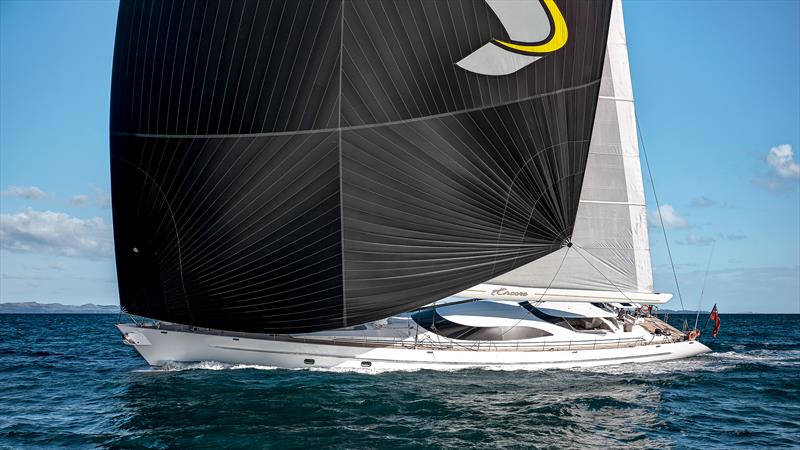
Encore – designed by DuBois – built by Alloy Yachts © McD Yachts
When Encore slipped into Henderson Creek in April 2013, it marked the end of New Zealand’s golden era of custom yacht building.
The 44-meter Dubois-designed sloop was the last sloop built by the highly respected Alloy Yachts, and one of the last before the yard closed.
Skipper Jono Wishart, who’d already been with the owner for 20 years, skippering Eclipse (formerly Esprit). After deciding a bigger yacht was required, they put their combined experience into Encore’s design and build – working alongside the highly respected naval architect, the late Ed Dubois.
Wishart has been with Encore from her build to the present day, including a recent exhaustive ABS survey refit.
“You have Perini owners, and you have Royal Huisman owners,” Wishart reflects. “Then you have Alloy Yachts owners. Once you see how this boat is engineered, there’s simply no going back. You cannot buy another one like her. Alloy Yachts is gone, and the guys who built her represent a level of metalwork and shipwright craft that the world may never see again.”
Born of 300,000 sea miles
To understand Encore, one must understand the vessel that came before her.
For over twenty years, the same owner, along with Wishart, logged more than 300,000 nautical miles aboard their previous yacht, Eclipse. Built in 1991 as Alloy Yachts build number AY8, she was the legendary 33-meter Dubois design originally commissioned for Neville Crichton – featuring the first carbon rig built by Southern Spars for an Alloy build.
Eclipse took them to the far corners of the planet: remote anchorages across Papua New Guinea, passages through Fiji, and blue-water crossings far beyond the standard cruising routes of the Mediterranean and Caribbean.
When the time arrived to build a successor, the owner had zero interest in chasing fleeting design fads. There would be no fragile fold-down balconies, no delicate electric shell doors hanging inches above salt spray, and no unproven gadgets.
The brief delivered to Ed Dubois was clear: build a larger ocean-going passage-maker that offers greater autonomy and bulletproof operational logic, preserving everything that made Eclipse an indestructible world cruiser.
Because the team knew precisely what they needed, the design period for Encore was clean and decisive. Under the guidance of Wishart and Alloy Yachts project manager Greg Yeo, the build went through with a staggering total of only 42 variations across the entire project —a figure almost incomprehensible for a custom 44-metre superyacht involving 478,000 build hours.
Architectural integrity and the sea-going transom
While contemporary trends lean toward heavy, hydraulic “whale-tail” transoms that fold down flat into the sea, Encore was deliberately engineered with an ocean-tested, full-beam open-stepped transom configuration.
“Those massive fold-down stern platforms submerge hydraulic rams, micro-switches, and seals directly into raw seawater,” explains Wishart. “They corrode, they fail, and they rattle under way. Our transom opens at standing height. It serves as a secure, dry staging area for diving and fishing, while the custom two-stage stainless ladder drops deep into clean water.”
The transom design features a clever exhaust-diversion system. When guests are swimming or gearing up for a dive, generator exhaust can be redirected away from the stern and discharged through the hull side, ensuring the swimming area remains free of fumes and surface sheen.
At night, high-output underwater lights wash the waters astern in a brilliant glow, frequently drawing in pelagic life. “We’ve sat at anchor in the islands with the lights on, swimming right off the back steps with manta rays gliding around underneath us,” recalls Wishart.
Beyond the boarding gates lies the lazarette—a massive, impeccably organised space for machinery and gear. Finished to the standard of an engine room, it houses:
A custom Alloy Yachts four-stage stainless-steel hydraulic passerelle.
The captive winches for the reacher.
A dedicated 40 kVA shore-power frequency converter.
Complete backup steering apparatus, dive compressor, and scuba banks.
Dedicated racks for water toys, lines, and safety apparatus.
The Floating Interior: Gentlemen’s club elegance
Crossing the threshold from the cockpit into the upper saloon reveals the understated elegance of Encore’s interior.
The owner’s brief rejected the sterile, ultra-minimalist white lacquer typical of modern speculative builds, favouring instead the warm ambience of a classic gentleman’s club.
American walnut joinery anchors the interior, crafted completely in-house by Alloy Yachts’ master cabinetmakers. The upholstery and soft goods are classic Ralph Lauren fabrics, chosen by the owner’s wife, paired with tailored, deep leather accents and bespoke crocodile-pattern leather Venetian blinds.
What makes this interior truly extraordinary is what lies out of sight. The entire guest interior is a floating structure. Every sole, bulkhead, and joinery unit is mounted on Sylomer elastomeric vibration isolators, completely separating living quarters from the aluminium hull structure. Combined with advanced acoustic sound-damping materials applied throughout the hull plating, vibration and machinery rumble are virtually eliminated under way or under generator power.
The climate control system meets rigorous commercial hotel standards. Fresh air is introduced via dedicated make-up air units, scrubbed, dehumidified, and fed through air handlers, executing eight complete, quiet air changes every hour. Every door features concealed drop-seal brushes integrated into the jambs; when a door latches into its 316-grade stainless SOSS hinges, pins drive the brushes down onto the threshold, ensuring light-tight, acoustically dead seals between cabins.
The master stateroom sits aft, separated from the machinery space by a full-beam, en-suite bathroom. The bathroom features twin vanities, custom Planus sanitary ware hooked into an IMO MARPOL-compliant Tecnicomar sewage plant, and walk-in showers finished in slab granite and marble. To eliminate excess top weight without sacrificing durability, Alloy sliced the stone into thin veneers and vacuum-bonded them to 25-millimetre aluminium Nomex honeycomb panels.
Outside the master stateroom lies a dedicated, private sitting room and study. This space serves as an executive office, equipped with an integrated desk, private refrigeration, a custom bar, and an entertainment screen.
Forward through the central lobby, beneath a sweeping curved staircase that descends from the pilothouse, a concealed floor hatch reveals an expansive sub-sole storage room (although often used for wine storage, the aft guest bilge is not temperature controlled)
Two double guest staterooms and one twin cabin branch outward, each with a private marble-lined en-suite. With clever Pullman berths integrated into the twin and starboard suites, Encore comfortably accommodates ten guests overnight, cared for by a full crew of six housed in three forward en-suite cabins.
Ascending to the main deckhouse, overhead illumination pours through an extraordinary structural feature: the lower saloon’s clear glass ceiling. Composed of 50-millimetre thick, eight-layer laminated armour glass, it provides complete structural integrity without requiring cumbersome storm shutters.
Guests seated at the formal dining table below can glance directly upward along the mast toward the stars. In a stroke of brilliant naval engineering, this glass roof doubles as the deck soft-patch; should the main engine ever require overhaul or replacement, the central panel lifts clear, providing a straight crane pick directly into the machinery room below.
The machine beneath the luxury
Separated from the galley and laundry by a dedicated soundproof door lies the ship’s control room. While most Dubois designs run ship switchgear and automation directly through the bridge or upper saloon, Encore isolates all primary command hardware down below. The main electrical switchboards, automation racks, generator synchronisation systems, and network servers are mounted in this air-conditioned office space. Engineers can inspect systems and run full diagnostic monitoring at a spacious leather desk without once intruding on guest privacy.
A core design priority was re-engineering Dubois’ typical engine room layout. “On many builds of this size, designers plant the mast step straight down inside the forward end of the engine room, while the propeller shaft seal is buried in an aft bilge passage,” explains Wishart. “A hollow carbon mast will always bring rainwater down into the boat. We isolated the mast step in its own dry forward-drainage box and brought the Hundested propeller shaft seal inside the engine room, where it belongs. The result is an engine room with perfectly bone-dry bilges.”
Power is delivered by an underrated Caterpillar C18 turbo-diesel engine showing just over 5,000 original hours. Turning a four-blade Hundested variable-pitch propeller, the yacht settles into long-range cruise profiles burning clean and quiet. Auxiliary power is produced by twin 67 kW Northern Lights generator sets, both fully rebuilt, synchronised to run in parallel under varying house and sailing loads.
The ship’s automation runs on Alloy’s renowned SeaTouch PLC monitoring system. Designed with Kiwi-Aussie operational logic, every relay, alarm, tank sensor, and breaker is clear, serviceable, and fully documented in plain-English schematics. During her recent refit, Attest Marine the original electrical engineers behind Alloy’s PLC systems—completed a total hardware and code upgrade, finessing Encore’s automation.
Network infrastructure is equally cutting-edge. Originally launched as the first Alloy build to feature an end-to-end fibre-optic backbone to future-proof shipboard data, the vessel easily integrated a commercial-grade Ruckus Wi-Fi network and a triple Starlink satellite array. High-speed streaming, secure data transfer, and global communications run seamlessly across high-latitude ocean crossings.
Deck layout, rig, and ultimate seakeeping
On deck, Encore displays the clean lines that made Ed Dubois a legend. The hull is finished in Matterhorn White Awlgrip, meticulously resprayed by the master painters Aquatic Spraycoating who finished her when she was launched. Her quarter-sawn teak decks, laid at a full 25 millimetres when new, were freshly recut, reseamed, and planed down to a robust 18 millimetres during her refit, and still looking immaculate.
Every piece of stainless deck hardware—from the mooring bollards and spring cleats to the lifeline stanchions and cowl vents—was shaped, ground, and mirror-polished entirely by hand inside Alloy’s fabrication facility.
Twin helm stations anchor the working cockpit aft, mirroring navigation displays, thruster joysticks, and sail controls. Hydraulic winches, captive drums, and furlers react instantly through dedicated proportional Danfoss valves and Rexroth hydraulic pumps. Hard-drawn 316-grade stainless hydraulic lines run through the ship’s framework with no flexible rubber hose run exceeding one single meter, eliminating system pressure drop, heat buildup, and fluid leaks.
Under sail, Encore delivers astonishing speed and control.
Her three-headsail cutter Doyle Sails rig provides a flexible, easily managed sail plan for any sea state:
The Reacher: A massive 130% reaching genoa set on an outer furler
The Blade: A high-aspect working jib sheeted tightly inside the shrouds directly alongside the coachroof, featuring vertical carbon battens that keep the leech flat when driving hard to windward.
The Staysail: An inner heavy-weather storm sail.
“I’ve driven her through forty-knot squalls on a passage to Hawaii under two reefs in the mainsail and the staysail alone,” says Wishart. “We achieve 300+nm days effortlessly, and in great comfort.”
The turnkey opportunity
Greg Yeo, her build project manager, returned to the Encore project to oversee the all-encompassing, 181-day yard period at Orams Marine in Auckland.
Yeo’s intimate understanding of Encore put him in good stead to manage the ABS classification process, and the long-term crew’s active involvement in each project resulted in Encore being in arguably better mechanical and cosmetic condition than when she first launched in 2013.
Every hull valve was stripped and rebuilt. Fuel, water, and waste tanks were opened, blasted, inspected, and resealed. The Caterpillar main engine and Hundested driveline were pulled down, inspected, fitted with new bearings, and dialled in to micro-tolerances.
The mast and EC6 rigging underwent complete non-destructive testing; the PLC control architecture was brought to modern standards. The hull plating was fully inspected using ultrasound under the direct supervision of an ABS surveyor. She was handed back to her crew with her classification fully up to date, ready to circumnavigate.
Wishart has spent over thirty uninterrupted years with the same owner across two vessels and is the longest-serving Captain of an Alloy Yachts vessel. Both Eclipse and Encore have been used only for cruising with family and friends and have been maintained continuously by a very tight-knit crew.
Lying at the Southport Yacht Club on Australia’s Gold Coast, Encore is turnkey ready for an owner who appreciates genuine provenance. She is a modern classic: a true, ocean-proven high-performance cruising sloop from the pinnacle of New Zealand boatbuilding.
For the sailor who demands absolute autonomy, outstanding materials, workmanship and engineering, ready to grace any ocean on earth, the stage is set.
All that is missing is her next owner.
To see the full specification of Encore: mcdyachts.com/encore
Like to know more? Contact McD Yachts
Contact: Paul MacDonald
Ph/WhatsApp: +64 27 5133 524
Email:
Web: mcdyachts.com/encore
Additional Images: