
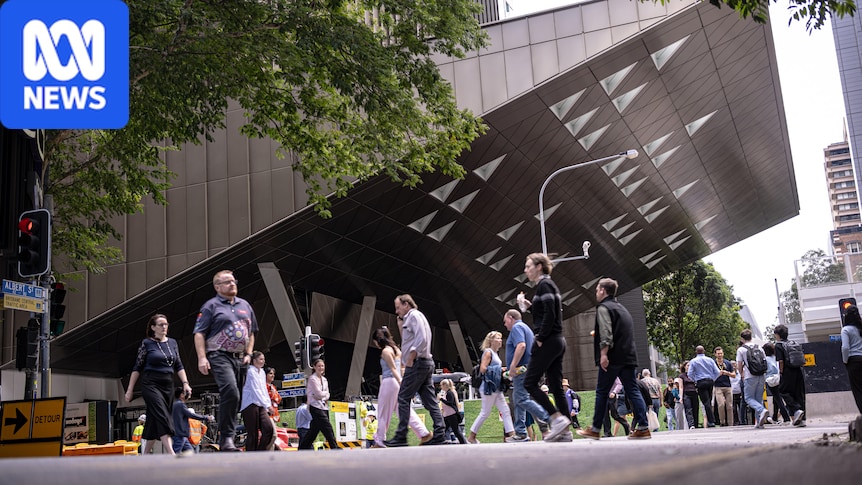
Engineers have completed an 80-tonne mechanical contraption named “The Esky Lid” designed to protect Brisbane’s new underground tunnels from flooding.
The Esky Lid was unveiled today at Albert Street Station, which will be part of Brisbane’s Cross River Rail underground train network.
Loading…
The 22-metre by 10-metre barrier will be able to descend from the ceiling over the station’s main entrance, sealing it shut from floodwaters.
Sliding panels allow the barrier’s modules to click into place, blending in with the station ceiling when not in use.
During intense flooding, shutters will also close off the entrance to the northern side of Albert Street Station.
Albert Street Station will be the most important line of defence, since it will be the deepest point of the 10-kilometre Cross River Rail network.
The station itself is in a low-lying, flood-prone area of Brisbane’s CBD.
The lid will keep the station flood-proof up to about 10.3 metres above street level, which is rated as a 1-in-10,000-year probability.
Cross River Rail Delivery Authority program director Jeremy Kruger said they called it The Esky Lid because it could close like the lid of an esky.
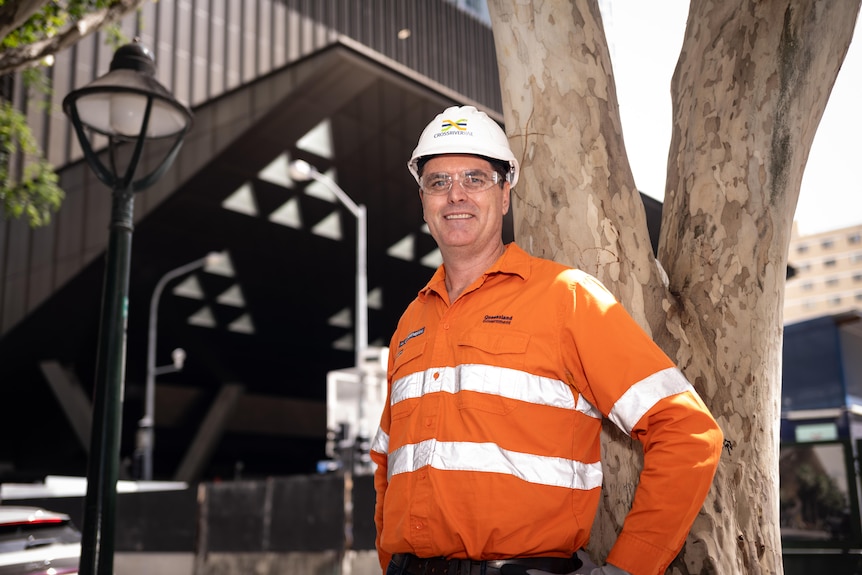
Jeremy Kruger says it is unlikely that the company Esky will try to sue them over the name. (612 ABC Brisbane: Kenji Sato)
Mr Kruger said passengers would be evacuated before the esky lid came down in the event of an extreme flood.
However, Mr Kruger said there was a good chance that people alive today would never see this “ingenious” feat of engineering in action.
“This will be a nice, open amenity 99.999 per cent of the time,” Mr Kruger said.
“For that 0.001 per cent flood, it can come down, seal, deploy, and protect the station.”
A history of blowouts
Mr Kruger said construction work would finish in early 2027, with safety tests to follow afterwards.
However, he said passenger services were not due to begin until 2029.
Cross River Rail was originally due to open in 2024 at a budget of $5.4 billion, but the project has suffered repeated blowouts over the years.
Mr Kruger said the project was now expected to cost around $19 billion, almost four times the original estimate.
It will be Queensland’s single largest and most expensive infrastructure project in history.