
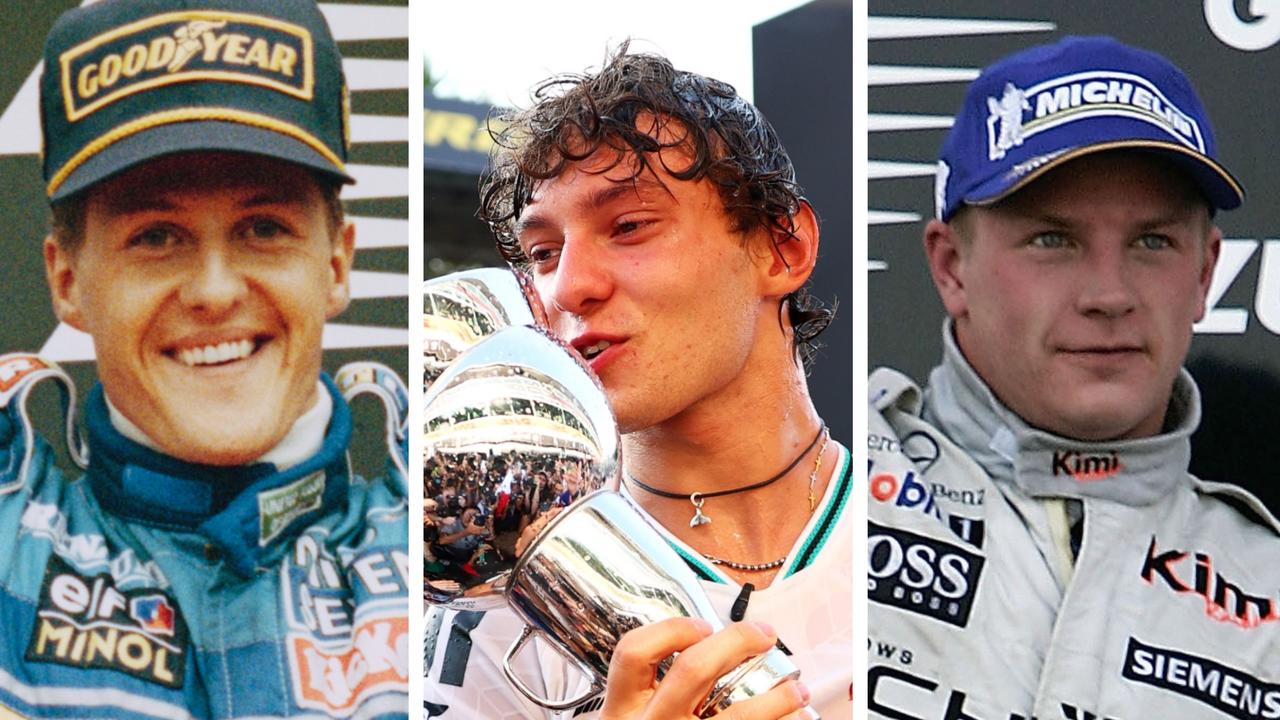
Title leader Andrea Kimi Antonelli’s stunning 19th-to-first victory at the Italian Grand Prix did more that just deal his title rivals a crushing blow.
It did more than just break Italy’s six-decade wait for a home winner too.
When Antonelli took the chequered flag 3.9s ahead of teammate George Russell, he wrote himself indelibly into the history books for executing one of the greatest comebacks in world championship grand prix history.

Fox Sports, available on Kayo Sports, is the only place to watch every practice, qualifying session and race in the 2026 FIA Formula One World Championship™ LIVE in 4K. New to Kayo? Join now and get your first month for just $1.
Prior to Sunday, only eight drivers had won a Formula 1 world championship grand prix from 15th or lower on the grid.
Only one driver has done it from further back than Antonelli.
Note that there is one statistical quirk here.
Between 1950 and 1960 the Indianapolis 500 was included in the drivers world championship despite being neither a grand prix nor run to the same regulations as every other race on the schedule.
Few Formula 1 drivers entered these events — ironically it wasn’t until after the race was dropped from the world championship that F1 stars began crossing the Atlantic to compete at the Brickyard — but every driver who did race is considered to have had a Formula 1 start.
One of them is Bill Vukovich, who won the 1954 Indianapolis 500 from 19th on the 33-car grid — an impressive feat, no doubt, to claim his second win at the famous race, but only the equal 11th biggest comeback in Indy 500 history.
It would be the equal second biggest comeback in Formula 1 but has been excluded from the breakdown below.
Antonelli ends 60-year Monza wait | 00:41
1. John Watson wins the 1983 United States Grand Prix from 22nd
John Watson’s remarkable 1983 feat will surely stand peerless on this list for all time. Not only is a comeback of such scale improbable, but in many of the intervening years there haven’t been 22 cars on the grid in the first place.
The foundation of Watson’s comeback was his McLaren’s dreadful one-lap pace, in part due to its uneasiness on the qualifying tyre and the unvarnished Long Beach track.
His race pace, though, was sensational, and allied to an extremely high attrition rate — half the 26 starters weren’t classified, two more failed to finish, and Watson was one of only three drivers to see the flag on the lead lap — he rose through the field.
It wouldn’t fair to say he walked it, though. He started ahead of teammate Niki Lauda, but the Austrian jumped him at the start and led the way through the field. Watson, though, got back ahead as the race approached half distance and thumped the then two-time champion by almost half a minute.
2. Andrea Kimi Antonelli wins the 2026 Italian Grand Prix from 19th
Antonelli didn’t start from the back on pure pace; instead it was a penalty for taking a new engine that had him line up 19th on the grid. Knowing in advance that he’d be starting down the field meant he spent practice focusing on race pace — even still, his speed in qualifying, when there was nothing for him on the line, was impressive, hinting at something special.
He unleashed that pace with a race performance team boss Toto Wolff described as “walking on water”.
His first lap — and the restart lap following the red flag — was an exercise in disciplined aggression, the Italian picking off drivers with the perfect balance of risk. He was eighth on lap 6, fifth on lap 10 and into the top three on lap 13. By lap 18 he’d passed Russell for the lead.
Strategy, though, seemed sure to work against him — he was on the medium rather than the hard, which meant he’d have to stop again. Luckily enough, a virtual safety car came out at just the right time, saving him around eight seconds in pit lane. He dropped to sixth, but within 21 laps he’d reeled in and overtaken Russell a second time.
Could he have won without the virtual safety car?
Almost as if pre-empting that question, Antonelli set the fastest lap of the race on the final lap. It was 0.738s quicker than anyone else and almost 0.9s quicker than Russell’s best. There was clearly much more in the tank — enough to think Antonelli could have won the race from anywhere on the grid.
Andrea Kimi Antonelli won his home race from 19th. (Photo by Clive Rose/Getty Images)Source: Getty Images
3. Rubens Barrichello wins the 2000 German Grand Prix from 18th
A disastrous qualifying for Rubens Barrichello left him ahead of only four drivers on the grid, but he woke up on Sunday as a man on a mission.
Fuelled light for a two-stop strategy to capitalise on his Ferrari’s good pace and to make the most of old Hockenheim’s long straights, he made strong progress early, and by lap 5 he was remarkably up to sixth.
On lap 25 he got a stroke of luck when a disgruntled Mercedes employee invaded the track. His dangerous protest, running in front of cars to gain attention, brought out the safety car, bringing the leaders back into range.
But the decisive moment came later, on lap 32, when rain began to fall. Mika Häkkinen pitted from the lead for wets, but Barrichello stayed out on slicks. It was the right call, and Barrichello claimed a remarkable maiden victory.
Ruben Barrichello claims his first victory from 19th. (AFP Photo / Patrick Hertzog)Source: AFP
4. John Watson wins the 1982 Detroit Prix from 17th
The first running of the Detroit Grand Prix was beset by serious organisational issues that left the schedule compressed onto just two days. Watson was one of the losers from the mess, qualifying deep in the field.
Attrition aided him, with 13 of 24 drivers failing to finish. Similar to Antonelli, he also got the benefit of a second restart following a crash, which he took 13th.
But counting too was an astute call to use hard tyres in much warmer conditions than those that had prevailed for practice and qualifying.
A clumsy crash between Niki Lauda and Keke Rosberg while battling for the lead moved Watson up to first after 40 laps, from where he cruised to a comfortable victory.
5. Kimi Räikkönen wins the 2005 Japanese Grand Prix from 17th
The era of one-lap qualifying tended to throw up some curve balls, and the 2005 Japanese Grand Prix ranks among the most famous. The track started wet and kept getting wetter, which meant the top finishers of the previous grand prix, who were last in the queue, got the circuit at its worst. Kimi Räikkönen was the penultimate car on track and qualified 17th.
What followed was a drive for the ages. Räikkönen picked up five places on the first lap and continued surging forward, helped by an alternative refuelling strategy that saw him gain and then consolidate ground in the middle of the race.
After the final pit stops, Räikkönen was running second behind Giancarlo Fisichella with eight laps remaining. Lap by lap he reeled him in, the McLaren forcing the Renault into a desperate late defence to hold top spot.
The move came on the final lap.
Fisichella took a tight defensive line into the chicane at the end of the penultimate lap, but he ended up compromising his line. Räikkönen got a great exit onto the main straight and slipstreamed his way alongside his rival towards the breaking zone.
They sized each other up and almost touched, but Räikkönen, on the racing line, had the upper hand. He sensationally swept around the outside of the first turn to take the lead. Victory was his.
Kimi Raikkonen won one of F1’s greatest races from 17th in Suzuka. (Motor Racing A/CT)Source: AFP
6. Max Verstappen wins the 2024 Sao Paulo Grand Prix from 17th*
Rain was so heavy on Saturday in Sao Paulo that qualifying had to be postponed to Sunday, but conditions were only marginally better when cars hit the track to set the grid.
A big crash for Lance Stroll in the final minutes of Q2 prevented Max Verstappen from setting a time to make it into the top 10. He was eliminated 12th, and a five-place engine penalty dropped him to 17th on the grid.
*However, a bizarre start to the race meant only 14 drivers started ahead of him, with Stroll and also Alex Albon failing to take the start of the treacherously wet race.
His pace was such that his official starting position is only a technicality. Hie was up to 11th on the first lap and up to sixth by lap 11.
A decision not to pit during a virtual safety car for a Nico Hülkenberg crash shuffled him to second place, which paid big dividends when a Franco Colapinto crash triggered a red flag.
The free tyre change during the suspension locked Verstappen into second, and he made easy work of Ocon’s slower Alpine at the resumption to set up an eventually cruisy 19.2s victory.
Max Verstappen made it look easy winning in Brazil in 2024. (Photo by Clive Mason/Getty Images)Source: Getty Images
7. Jackie Stewart wins the 1973 South African Grand Prix from 16th
Jackie Stewart’s weekend at Kyalami couldn’t have started much worse, with a brake failure causing a terrifying crash in practice. The car was so damaged that he had to commandeer teammate François Cevert’s car for qualifying, but even then he could manage only 16th on a grid of 25 cars.
It took him only seven laps to retake the lead, albeit in some alarming circumstances. Clay Regazzoni was involved in a crash that turned his car into a fireball, and it was only thanks to the heroics of Mike Hailwood, one of three other drivers taken out of the race by the incident, that the Swiss was extricated from the flaming wreckage with his life.
These were the days before the safety car and before races were routinely red flagged, so the race continued with just local yellow flags. It took three laps for the crash to be cleared, and by the time racing resumed, Stewart had picked his way into the lead, from where he charged to a 24.5s victory.
McLaren accused him of overtaking drivers under yellows, but the stewards ultimately decided against penalising the Scotsman, allowing him to keep one of what would be five victories that delivered him his third and final championship.
Jackie Stewart charged to a superb but controversial victory from 16th in South Africa in 1973 (CD#0776-3301-3813-123)Source: Supplied
8. Michael Schumacher wins the 1995 Belgian Grand Prix from 16th
Mixed weather in qualifying left title leader Michael Schumacher an unfancied 16th on the Spa-Francorchamps grid, but the weather that cursed him over a single lap would save him on race day — and in spectacular if not controversial style.
Schumacher rose through the order, but it was the arrival of rain that got him the lead. While the leaders stopped for wet-weather tyres, Schumacher and his Benetton team gambled on staying out on slicks and hoping that the weather would subside.
Backing the logic of the gamble was that the rain was heavy enough to wet only certain parts of the track, while other sections were still good enough for slicks. The German had to keep his lines tight and precise through the wet sections but could create some breathing space elsewhere.
He moved into top spot, but defending champion Damon Hill quickly caught him on wets. What followed was lap after lap of defensive artistry, with Schumacher daring to be as late on the brakes as Hill even when the standing water suggested it shouldn’t have been possible.
Not all his moves were so lauded, though, with Hill complaining that he was dangerously blocked at some of the track’s fastest corners, at times even being forced off track. Post race the stewards would agree, but only enough to issue Schumacher a suspended one-race ban.
Hill’s better tyres eventually got him ahead anyway, though by then he’d lost as much as 15s behind the German — and then the track dried out. Schumacher passed him back, and Hill was forced into another pit stop that undid his race, leaving him a distant 19.4s runner-up at the flag.
Michael Schumacher outduelled Damon Hill to win the 1995 Belgian Grand Prix from 16th on the grid (LAT Photographic/Williams F1)Source: Supplied
9. Fernando Alonso wins* the 2008 Singapore Grand Prix from 15th
A result with one of Formula 1’s most infamous asterisks, Alonso improbably won the race only after his Renault team had fixed the result in Formula 1’s biggest cheating scandal.
Renault had entered a steep decline following its 2005–06 title doubles with Alonso, and there were rumours that the auto giant was considering withdrawing from the sport. It was figured a victory in a season that had delivered just one podium so far might change minds.
It wasn’t going to come naturally in Singapore, however, where a fuel pump problem left Alonso 15th, one place ahead of teammate Nelson Piquet Junior.
But the team, led by Flavio Briatore and Pat Symonds, hatched a plan. Piquet was instructed to crash his car deliberately to cause a safety car. Alonso, who had already made an unusually early pit stop for a full tank of fuel, was promoted to fourth — and all three drivers ahead of him still needed to pit. Once they did, Alonso moved into a lead he’d never relinquish.
It looked extremely fortuitous at the time, but it wasn’t until a year later that Piquet went public after being sacked by the team. Alonso was exonerated, but Briatore and Symonds were banned from the sport, though both later had their exclusions overturned in court.
Renault withdrew from the sport in disgrace.