
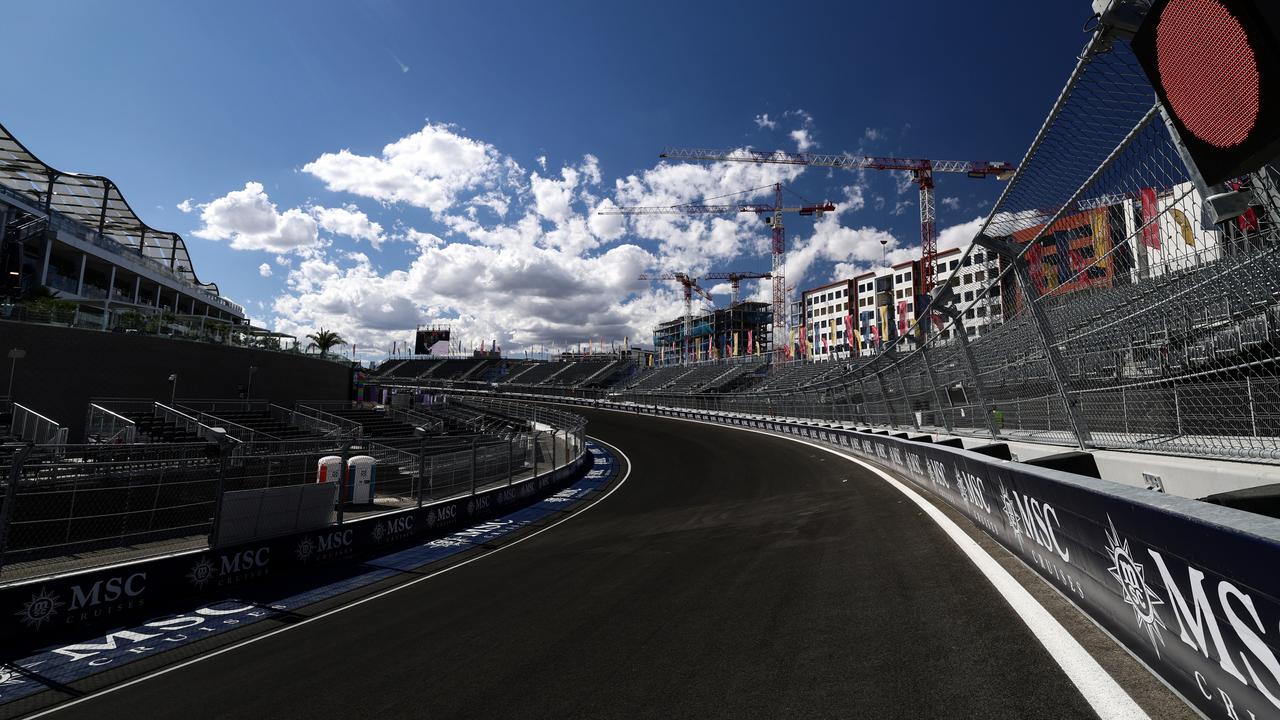
In the final stages of construction, organisers of the new Spanish Grand Prix realised they needed to break in their Madring circuit with some real racing cars.
They got Formula 3 on the phone, and the field of 20 junior cars turned up for a two-day test on 24–25 August.
They left with three broken chassis and countless other broken parts. There was so much carnage that red flags were flown a remarkable 19 times — more than one suspension for every hour of track running.

Fox Sports, available on Kayo Sports, is the only place to watch every practice, qualifying session and race in the 2026 FIA Formula One World Championship™ LIVE in 4K. New to Kayo? Join now and get your first month for just $1.
“Okay, they’re Formula 3 drivers, but it’s a track that kills cars,” recounted James Vowles, boss of the Williams team that has a junior driver in the F3 field.
The signs of carnage are still visible today, with locked-up tyre marks still pockmarking the track and leading directly into the omnipresent barriers that received the errant cars.
It was a baptism of fire, then, for the Madring — and it’ll be the only warm-up it gets before Formula 1 action starts this Friday.
Formula 1’s newest circuit already has quite the reputation.
Norris & Piastri’s clash under scrutiny | 01:42
WHAT WILL IT BE LIKE TO DRIVE?
The Madring was dreamt up as an extreme street circuit in a similar form to Jeddah, host of the Saudi Arabian Grand Prix. Jeddah’s basic outline took the shape of public roads that existed before the race, but the venue is essentially permanent, with the track closed to traffic during the year.
Madrid’s answer to Jeddah is a semi-street circuit. It comprises some upgraded public roads around the city’s convention centre, but other parts of it are purpose-built and permanent.
Watch an on-board video and you’ll understand why.
Not content to offer the usual flat, 90-degree street track experience, Madrid organisers have built considerable elevation — and considerable banking — into a circuit they expect to be fast and flowing.
It’s perhaps thought of as a combination of Jeddah’s permanent sweeps, Azerbaijan’s short, fast corners, and Zandvoort’s inclined loops.
The centrepiece is La Monumental — a name that really needs no translation.
Measuring 550 metres and lasting around six seconds, it’s the longest single corner on the Formula 1 calendar, rotating cars 270 degrees.
Its 24 per cent incline — compared to the Indianapolis Motor Speedway’s 15.8 per cent banking — will ensure the corner will be fast and difficult to get right.
Grandstands on both sides of the road — for a capacity of 45,000 spectators — will give the entire complex an amphitheatre feeling that will make this section of circuit instantly identifiable on the calendar.
“It’s a very, very special corner,” Charles Leclerc said after Ferrari used one of its filming days to send a 2026 car around the track while it was still in the final stages of construction.
“It’s a corner where I feel in qualifying we’ll have to be very brave because it’s going to be on the limit.
“I do believe it can become one of the most iconic corners of the season, especially with the grandstand. That will add to the experience of that corner. One thing is for sure, and that’s that you will have to have full commitment.
“It’s just a very, very cool corner, and I can only imagine the way it will be during the race weekend. It will be very much on the limit.”
To get there, though, drivers will have to make it through a complex and technical series of corners that claimed several F3 cars last month.
The lap starts with a left-right chicane sure to cause carnage on the first lap. A long right-hander follows, opening up onto the circuit’s longest straight.
Another chicane follows, but the approach to this one is much faster, at up to 340km/h. It’s an overtaking zone but also an error generator, with high kerbs prepared to punish drivers who get their trajectory wrong.
From there the track begins to climb, and a jink to the left makes the tighter turn 8 right-hander blind, signalling the transition from public roads to the permanent section of circuit.
Another chicane — this one open and flowing and unlikely to be a passing opportunity — leading into La Monumental, where there are expectations drivers will be able to take different lines that could promote overtaking.
A big downhill braking zone follows for a tight left-hander that opens into a section of high-speed sweeps leading to some more traditional 90-degree corners — slow enough to have very little run-off area — that take cars back to the main straight.
The mixed layout will make finding a qualifying rhythm extremely challenging, especially given the high likelihood of crash-caused disruptions. The lack of extensive run-off will mean any incident, even minor, will likely cause a suspension — or, in the race, a safety car at least.
Norris edges Piastri on final lap | 01:37
WHAT WILL IT BE LIKE TO RACE?
It’s always difficult to simulate a race at a brand-new track. Not much was thought of the Azerbaijan Grand Prix layout originally. The junior series put on some chaotic racing, yet the first Formula 1 race was a bore. It wasn’t until the second season that teams and drivers found their groove and the Baku track became a favourite stop on the calendar.
It’s additionally complicated by the 2026 hybrid power units, which have altered expectations for the way races are run.
We can say with relative certainty that at least this won’t be an energy-starved circuit — that is, we shouldn’t be talking much about drivers running out of power around the lap. There are enough corners to keep the battery topped up, which means all the best bits of the track — including La Monumental — will be limited by grip, which is where the drivers earn their money.
It is, however, inescapable that even the permanent part of the circuit is designed to offer a street-style challenge that will make overtaking difficult
Some overtaking sections have been built in — reliable big stops after long straights, for example, and there’s hope for different lines through La Monumental — but in most sections the risk of pulling of a move will be a race-ending crash with the barriers.
Strategy will be unpredictable, particularly given the track will evolve considerably in grip as the weekend goes on. That’ll combine with warm daytime temperatures in the low 30s that could make this a tyre killer as well as a car killer.
But making more than one pit stop will be discouraged by the long pit lane, reportedly at least 550m at 80km/h. That will mean a minimum of 25s lost in pit lane.
If overtaking is difficult, losing positions to an extra pit stop could be extremely costly to overall race time — but if degradation is very high, the advantage of new rubber could be significant. It might be the sort of race that changes suddenly from a strategy perspective.
That will be the case especially if the number of interruptions is high — as many expect it to be.
But we’ll only know on Sunday what sort of action this circuit produces — and keeping the example of Baku in mind, the track may need more than a season to live up to the hype.
Lando calls out Oscar ‘dangerous’ move | 00:41
WHO WILL IT SUIT?
It’s the question everyone wants an answer to, but the mixed assortment of corners makes it difficult to know.
Mercedes will of course feature in the mix, but its engine advantage will be less significant here given the plentiful charging opportunities — this certainly won’t be a Monza repeat.
McLaren should be strong in the parts of the circuit reflective of Zandvoort and Budapest, tracks at which it dominated, but team boss Andrea Stella thinks the car will be weak at many other parts of the track. Though there are some long, fast corners for McLaren to do well in, there are also plenty of slower, shorter ones that will leave it vulnerable.
Requiring relatively high downforce, Ferrari should be competitive here — but then again, it’s managed to sensationally fumble every good chance it’s had for the last three weekends, so betting on the Italian team is a risk. It will have derived only limited benefit from its filming day given the track was a dusty construction site at the time and given the various restrictions on tyres and running imposed on those sorts of de facto shakedown tests.
Red Bull Racing has been difficult to read all season. Whether or not it does well will depend on whether it can find the balance sweet spot. Verstappen was an unlikely second in Hungary, for example, but then crashed out in Zandvoort after an anonymous qualifying — only to do well again in Monza.
The form guide hasn’t yet settled this year, and at a brand-new circuit, it’s even less certain than usual.
Ferrari in chaos as Kimi seals comeback | 02:46
WHAT HAPPENED TO THE OTHER SPANISH GRAND PRIX?
Madrid will be the sixth venue to host the Spanish Grand Prix and the seventh Spanish circuit — along with the unloved Valencia Street Circuit, the five-time European Grand Prix host — to hold a world championship race.
Barcelona is the longest-tenured, having hosted the national race every year since 1991, but understanding how it got the race helps explain how it lost it.
Barcelona hosted Spain’s first championship races in 1951 and 1954 before disappearing from the schedule.
Madrid then took the initiative with the permanent Circuito del Jarama, in 1968, following a non-championship race the previous year.
Barcelona wasn’t going to cop that lying down, so in 1969 it drew F1 to the famous — and famously dangerous — Montjuïc street track in the coastal hills to the south. The championship alternated between Barcelona and Madrid until 1975, when four people — two photographers, a fireman and a spectator — were killed in one of the race’s many crashes.
Jarama became the race’s sole host until 1981, and after a three-year spell off the calendar, Jerez, near Seville, enjoyed a five-year stint as host before Barcelona won back the race with the brand-new, purpose-built Circuit de Barcelona-Catalunya.
Barcelona-Catalunya is a well-loved, heavily used circuit, but by the end of 2010 was beginning to show its age. Initially reluctant to invest in upgrades, Madrid saw a chance to snatch back the race.
The Madring was its bold pitch: a purpose-built semi-street track just 10km northeast of the city centre.
It satisfied F1’s desire to race closer to destination cities at venues serviced by public transport — Barcelona-Catalunya is an arduous and heavily congested 32km road trip with limited public transport access — to help give the event more of a festival atmosphere.
The reportedly almost doubled race hosting fee undoubtedly helped too.
Barcelona-Catalunya has since invested in new infrastructure to rescue its place on the calendar. It will alternate with the Belgian Grand Prix until 2032, with it set to drop off the calendar next season.
Madrid, however, takes centre stage as the host of the Spanish Grand Prix for the next decade.
If it offers anything like the challenge that Formula 3’s sacrificial drivers found in their carnage-strewn test last month, then it will be a worthy addition to Spain’s grand prix heritage.