
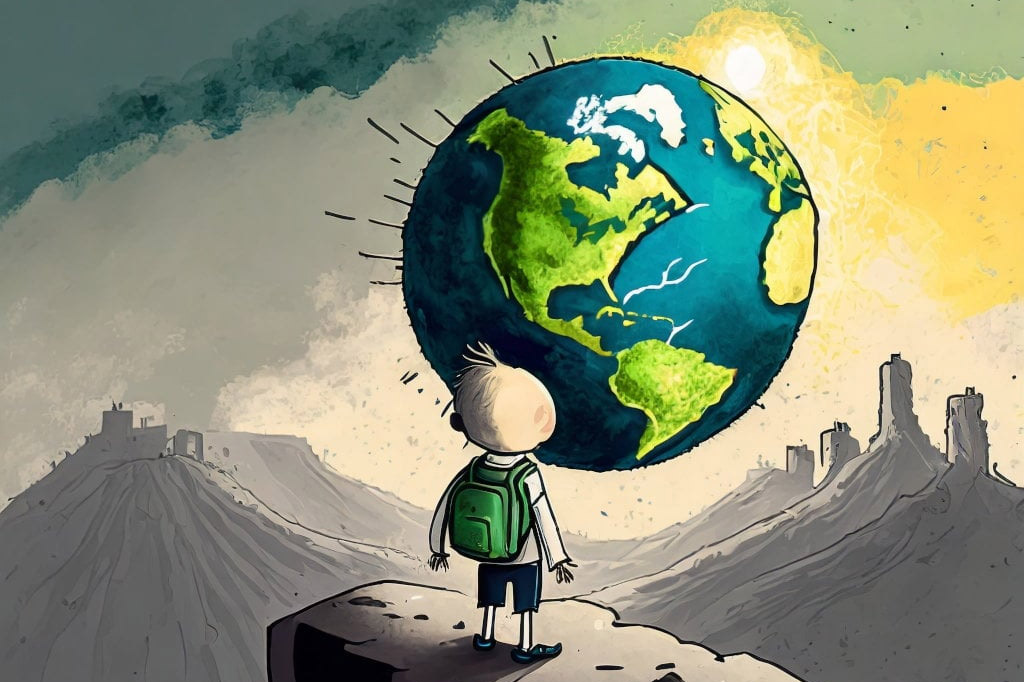
The escalation of the current crisis-ridden conditions in the areas of climate change, the economy, international security, and the development of democracy—leading to dystopian future scenarios—need not occur in this form. However, there is a real possibility that they could occur if humanity fails to bring about a paradigm shift, makes the wrong decisions, and continues its destructive behavior toward the planet.
By Klaus Moegling
Learning from the ‘Anticipated Danger’
The construction of negative scenarios—in the sense of an anticipated possibility of dystopian development—can certainly serve a constructive purpose.
In his book ‚The Imperative of Responsibility‘, the philosopher Hans Jonas developed what he called a “heuristic of fear,” meaning that potential negative developments should be recognized and described in all their severity and menace in order to look the potential risks squarely in the eye and to resolve to acknowledge one’s own responsibility for the planet and the fate of future generations—as Jonas (1979/2015, 7):
“What can serve as a compass? The anticipated danger itself! In its lightnings from the future, in the foreshadowing of its planetary scope and its human depth, the ethical principles from which the new duties of new power can be derived become discernible for the first time.”
Of course, this negative vision must be compatible with the developments already analyzed; it must not, therefore, be plucked out of thin air. Which social conditions will actually materialize in the future ultimately depends on the direction in which the dynamics of global-hegemonic power relations, the rise of authoritarianism, military conflicts, ecological upheavals, and conditions of economic exploitation evolve.
Imagining and intuiting a future catastrophe can provide insights for preventive action. Perhaps the fear of a catastrophic planetary scenario can encourage a global course correction. Fear then becomes the courage to act.
The assumption of a likely dystopian development can generate motivation for change. However, the precise direction of a global shift and constructive impulses for identity formation are more likely to be conveyed through a positive vision—one generated by the interplay of sociological analysis, evidence-based research, ethical maturation, and the experiences of alternative political practices, along with the resulting changes in how we work and live together. The transformative shift toward a new order, as intended here, will be possible through the interplay of a heuristic of fear, the courage to renew, and the skills necessary to achieve this.
The Ecological Devastation Scenario
From the spectrum of multiple crises—which are certainly interconnected—this article will focus on the disrupted relationship between humanity and nature.
However, the ecological doomsday scenario to be developed in the spirit of Jonas is already in the process of becoming a planetary reality.
If we fail to keep the warming of the Earth’s atmosphere below 1.5 degrees Celsius by the end of the 21st century—or even to prevent it from reaching two degrees Celsius or more—serious consequences for life on planet Earth are to be expected.
Nearly 20 years ago, the German Federal Environment Agency (2008, 22) warned of the impending climate crisis, making a nuanced reference to ecological tipping points and feedback effects:
“Tipping points carry the risk of drastic, and in some cases abrupt, climate changes. As a result, adaptation measures might not be implemented in time, or they might require a great deal of effort and entail extremely high costs. It is therefore imperative that anthropogenic greenhouse gas emissions be reduced. Through the continued emission of greenhouse gases, humanity is conducting a global experiment on the atmosphere of its planet, the outcome of which it does not know for certain. Tipping points in the climate system could occur as early as this century. This calls for swift and targeted action.”
How little has been done since then. The danger of abrupt triggers of tipping points—with their complex and dramatic consequences—has now come significantly closer. And the Sixth Assessment Report of the Intergovernmental Panel on Climate Change (IPCC 2021a) summarizes the long-term nature of the environmental damage that has already occurred:
“Many changes due to past and future greenhouse gas emissions are irreversible for centuries to millenia, especially changes in the ocean, ice sheets and global sea level.”
Different Climate Scenarios
In this regard, estimates regarding the extent of, for example, the rise in temperature over the coming decades and through the end of the century, as well as analyses of the expected rise in sea level, differ between the assessments of the Intergovernmental Panel on Climate Change (IPCC) and those of other climate researchers—as climate scientist David Spratt and emissions trading specialist Ian Dunlop (Spratt/Dunlop 2019, 5) note in their review of various research findings:
“In one example, the IPCC’s Fifth Assessment Report in 2014 projected a sea-level rise of 0.55-0.82 metre by 2100, but said ‚levels above the likely range cannot be reliably evaluated‘. By way of comparison, the higher of two US Department of Defence scenarios is a two-metre rise by 2100, and the ‚extreme‘ scenario developed by a number of US government agencies is 2.5 metres by 2100.
Another example is the recent IPCC 1.5°C report, which projected that warming would continue at the current rate of ~0.2°C per decade and reach the 1.5°C mark around 2040. However the 1.5°C boundary is likely to be passed in half that time, around 2030, and the 2°C boundary around 2045, due to accelerating anthropogenic emissions, decreased aerosol loading and changing ocean circulation conditions.”
If global warming could be kept below 1.5 degrees Celsius by 2040, this would also be possible through the end of the 21st century—provided the right climate-related decisions are made. However, according to the IPCC, if the wrong climate policy decisions are made, escalating global warming with apocalyptic consequences is to be expected (see Table 1):
Table 1: The best-case scenario and the very likely range in the most negative climate scenario (compiled from IPCC (2021b, 14) in degrees Celsius.
Scenario
Short-term
2021-2040
Medium-term
2041-2060
Long-term
2081-2100
Best estimate
Highly likely range
Best estimate
Highly likely range
Best estimate
Highly likely range
1,60° C.
1.30 -1.90° C.
2.40° C.
1.90 – 3.00°C.
4.40° C.
3.30 -5.70° C.
Determinants of a Negative Climate Scenario
Of course, these differences cannot be definitively resolved here. However, within the framework of a negative scenario, the more pessimistic estimate should be used. From this, the following developments can then be derived from a holistic perspective that emphasizes thinking in terms of connections and interrelationships:
One consequence of human-induced climate change is the already observable melting of the poles and glaciers, the warming of the oceans, and the incipient flooding of coastal areas, riverbanks, and low-lying regions. This particularly affects the world’s poorer regions, which lack the resources for ecological adaptation measures, such as building dams or modifying building codes.
The World Meteorological Organization (2024) has already summarized this alarming trend for 2023/2024 as follows:
“Weather hazards continued to trigger displacement in 2023, showing how climate shocks undermine resilience and create new protection risks among the most vulnerable populations.“
If this trend continues, the lower-lying regions of the Earth are expected to become largely uninhabitable. It is undisputed that sea levels will rise due to the melting of the polar ice caps and warming ocean waters.
However, the average projected rise of 2.5 meters by 2100 does not represent the extreme level of sea level rise. During storm surges in particular, the rise in sea level can be several times this value and lead to flooding extending deep into continental areas. This will also affect the global North.
Islands, coastal regions, and low-lying inland areas will be flooded, destroying living conditions there and, in turn, triggering migration. Not only will island groups disappear, but countries such as Bangladesh and India will also be flooded over large swaths of their territory, triggering mass exoduses. In this context, the rise in sea level, combined with the monsoon rains in this region—which are already becoming increasingly devastating—poses a particularly grave threat.
The shift in climatic conditions toward droughts, wildfires, violent storms, and torrential rains is also transforming life on Earth.
Vast regions will become uninhabitable. Future average temperatures in the Persian Gulf are projected to reach 50–60 degrees, meaning that for the general population, human life there will no longer be possible—or will only be possible in artificially cooled rooms. Even in the countries of the Global North, mass mortality is beginning due to overheated living environments. It initially affects older people and those already suffering from illness, and then spreads to people who would otherwise be considered healthy. Circulatory shock, heat exhaustion, and dehydration then begin to affect younger people as well.
The Paris Agreements are not effective enough.
Spratt/Dunlop (2019, 6) predict that even if the Paris Climate Agreements were fully implemented, stable climate conditions would still not be expected. In particular, climatic feedback effects would render the Earth largely uninhabitable for human civilization by the end of the century:
“With the commitments by nations to the 2015 Paris Agreement, the current path of warming is 3°C or more by 2100. But this figure does not include “long-term” carbon-cycle feedbacks, which are materially relevant now and in the near future due to the unprecedented rate at which human activity is perturbing the climate system. Taking these into account, the Paris path would lead to around 5°C of warming by 2100. Scientists warn that warming of 4°C is incompatible with an organised global community, is devastating to the majority of ecosystems, and has a high probability of not being stable.“
It must also be taken into account that not all countries accepted the 2015 Paris Agreements or have since withdrawn from them, as the U.S. has done.
A worst-case scenario for such an increasingly warming biosphere must anticipate a rise in wildfires. Vast areas of the Earth will begin to burn. Fire walls driven by massive gusts of wind will devour everything in their path: trees and bushes, houses, animals, and people. Such firestorms are beyond human control and cannot be fought; they depend on heavy rainfall, and it is unclear whether such rain will fall in the burning regions at all due to climate shifts. The result is the desolation of entire regions, leading to humanitarian, ecological, and financial problems on a global scale. The fires of 2025 and 2026 are already providing an initial glimpse of what humanity has in store.
The thawing of the Arctic and Siberian permafrost, through the associated release of carbon dioxide and methane, will lead to a massive increase in global warming and abruptly intensify all related processes.
If a UN—even one that has been strengthened—fails to dissuade unscrupulous governments from the generationally selfish destruction of the rainforest for the purposes of livestock farming, soy cultivation, the search for mineral resources, or land speculation, then this, too, will not only destroy the Earth’s lungs but also trigger a drastic climate shift.
Wars raging globally and emissions from explosions and fires exacerbate climate change while simultaneously preventing the affected regions from taking effective measures against this climate dystopia. The military in the field becomes the largest institutional global destroyer of the climate.
Catastrophic impact on social and political development on a global scale
“People are suffering. People are dying. Entire ecosystems are collapsing. We are at the beginning of a mass extinction. And all you can talk about is money and fairy tales of eternal economic growth. How dare you?!” Greta Thunberg (2019) before the UN General Assembly
Massive migration in the sense of mass exoduses or mass population movements will be triggered by climate change. In this sense, migration to date can be viewed, at best, as the tip of the iceberg, as billions of people will set out as refugees if global warming continues unchecked. It is not difficult to imagine the conflicts—including military clashes—that will arise from these upheavals in the struggle for regions that are still ecologically intact—according to the international peace research institute SIPRI:
“Climate Change poses a new class of security challenges that is confronting societies worldwide. Increased risk of famine, destroyed infrastructure, houses and shelter, and violent conflicts might all be consequences of climate change through gradual changes to ecosystems and extreme weather events.”
Global warming will lead to massive crop failures and associated famines. The global agricultural food system will collapse. The struggle for food and survival will lead to massive price increases, looting, and military conflicts. The call for a heavy hand, for authoritarian leaders, and for police-state methods will grow louder even in democracies.
Right-wing extremist governments will attempt, in the interests of their clientele, to deny climate change and continue to rely on the exploitation of fossil fuels.
The struggle for drinking water will intensify, on the one hand due to increasing periods of drought and, on the other, due to the growing trend toward profit-driven privatization of water sources. Privatized water sources will be guarded by militarily organized security services against raids by groups of thirsty people. In drought-stricken areas, people—especially those who no longer have the financial means to purchase water, which has become a scarce and therefore more expensive commodity—will die of thirst.
In other parts of the world, climate change is causing air masses with extremely different temperatures to collide, resulting in devastating storms such as tornadoes and hurricanes. Houses, cars, animals, and people will be swept up into the air and smashed to pieces. Skyscrapers will collapse, and the infrastructure for electricity, water and gas lines, and the internet will be irreparably destroyed. Radioactivity will be released from destroyed nuclear power plants, circulating in the Earth’s atmosphere, falling as rain, and leading to increased rates of cancer and birth defects in humans and animals.
Spratt/Dunlop (2019, 9) describe the societal consequences of a 3-degree climate shift. Nations and societies will be overwhelmed and subjected to extreme collective stress:
“Massive nonlinear events in the global environment give rise to massive nonlinear societal events. In this scenario, nations around the world will be overwhelmed by the scale of change and pernicious challenges, such as pandemic disease. The internal cohesion of nations will be under great stress, including in the United States, both as a result of a dramatic rise in migration and changes in agricultural patterns and water availability. The flooding of coastal communities around the world, especially in the Netherlands, the United States, South Asia, and China, has the potential to challenge regional and even national identities. Armed conflict between nations over resources, such as the Nile and its tributaries, is likely and nuclear war is possible. The social consequences range from increased religious fervor to outright chaos. In this scenario, climate change provokes a permanent shift in the relationship of humankind to nature.“
These are just a few of the developments mentioned so far. Other dangers include, for example, changes in temperature and the resulting diversion of the Gulf Stream; the narrowing of the temperature difference between the North Pole and the equator, which leads to a weakening of the jet stream; the release of methane bound in the seabed; insect die-offs due to the increased use of pesticides in agriculture; the depletion of clean drinking water due to overfertilization of fields, as well as plastic pollution in the oceans and the die-off of all life in increasingly larger marine regions—are likely to represent additional negative scenarios that will further exacerbate the massive problems already mentioned.
When will the “point of no return” be reached?
The question is when we will reach the point beyond which there will be no return to ecological balance for many generations to come. Scientific assessments certainly differ on whether this point has already been reached or will only occur after several generations. As the renowned scientists and Club of Rome presidents Weizsäcker and Wijkman (2017, 194) summarize in the Club of Rome study (“It’s Our Turn: What We Must Change If We Want to Stay”), particularly regarding the connection between ecological disaster, population growth, and irresponsible military and economic behavior:
“Time is running out. A systemic collapse is a real danger. The evidence of human impact on the planet is glaringly obvious. Radioactive residues from atmospheric nuclear bomb tests can be found everywhere today. CO₂ from the burning of fossil fuels has altered the chemistry of the atmosphere and the oceans: (…) let’s not kid ourselves. We face enormous challenges caused by rapid population growth, the overuse of resources and the resulting pollution, the loss of biodiversity, and, overall, we are experiencing a creeping loss of the foundations of life. The crisis is exacerbated by the ideological belief that a decline in high GDP growth will lead to economic collapse.”
The progression of overpopulation, coupled with unchecked capitalist growth mentality and consumer behavior, leads to increased ecological exploitation of the Earth system under the conditions of an increasingly overcrowded planet. In this context, all scruples are cast aside, and even climate-damaging and dangerous Earth resources—such as lignite, oil, or radioactive material—are used for energy production. Approaches to organic farming and species-appropriate animal husbandry are being pushed aside due to population pressure, giving way to increased factory farming—that is, the mass mistreatment of animals—as well as the associated nitrate contamination of soils and groundwater.
However, it is to be expected that population pressure is not primarily responsible for environmental destruction, but rather, in particular, the irresponsible consumption of resources by the wealthier segment of the world’s population.
According to a forward-looking OXFAM study, the wealthiest 1 percent of the world’s population will emit 30 times as much CO2 into the environment in 2030 as would be permitted to meet the 1.5-degree target. The poorest 10% of the world’s population, on the other hand, will have an extremely small ecological footprint (see Table 2).
Table 2: Global Income Groups and CO2 Emissions
(Compiled based on Roettig 2021)
Global Income Groups
Annual Income in Purchasing Power Parity (in U.S. dollars)
Projected Per-Capita CO2 Emissions in 2030 (in metric tons)
Factor Relative to the Maximum CO2 Emissions Required for the 1.5-Degree Target (=2.3 metric tons per capita)
Richest 1%
more than 172.000
70
x 30
Richest 10%
55.000-172.000
21
x 9
Middle and lower incomes / 40%
9.800-55.000
5
x 2
Poorest 50%
Less than 9.800
1
x 0,43
The “point of no return” is likely to be crossed soon. Once the biosphere’s planetary responses gain an uncontrollable momentum of their own that turns against human civilization and the conditions for all life on Earth, it will be too late—both for prevention and for mitigation.
This development is predictable if no drastic climate protection measures are taken—and, in particular, if the extravagant lifestyle of the wealthier segment of the world’s population is not curtailed.
Eco-imperialist and systemic causes
Violent competition over the use of resources intensifies as more people’s basic needs—and, in particular, their luxury needs—must be met. Not only the struggle for clean drinking water and food, but also the struggle for lithium, cobalt, uranium, etc., leads to violent conflicts between different groups of people and regions—according to the German political scientist Hans-Jürgen Burchardt:
“Natural disasters and environmental damage have been the leading causes of displacement in recent years, and many forecasts predict that the number of climate refugees will rise sharply. Here, too, it is clear: Industrialized nations, as the primary contributors to climate change, bear shared responsibility for forcing people to flee. Nevertheless, attempts continue to achieve progress and prosperity at the expense of nature. This is particularly insidious in North-South relations, where nature is often destroyed in the name of environmental protection. For example, following the phase-out of nuclear power, Germany’s energy transition is also made possible by cheap hard coal imports from Colombia. There, coal is mined via highly environmentally damaging open-pit mining; entire communities are forcibly displaced as a result, and human rights violations are commonplace. Even the much-lauded green economy, which relies on electric mobility, would not be possible without the lithium reserves in the Andes. Locally, however, lithium mining robs residents of their livelihoods.”
The war in Ukraine, too, must be viewed through an eco-imperialist perspective, in which Russia and the U.S. are attempting to divide up the raw material deposits among themselves.
Ultimately, there are systemic causes of eco-imperialism that must be clearly identified. Certainly, the former Soviet system also participated in the ruthless exploitation of nature. Nevertheless, it is inherent in the very nature of capitalism—which prioritizes the profit-seeking of financially powerful actors over the preservation of natural resources—to act in this way. In particular, it is large capitalist corporations and multinational companies that seek to increase returns for their shareholders without regard for either current or future climate impacts.
Conclusion: The Need for a Positive Vision of Social Development
In addition to the military threat scenario, the ecological threat scenario has come very close to reality; this will be further exacerbated by rapidly increasing population growth coupled with a lack of ecological awareness and an imperial lifestyle, particularly among the wealthy social classes.
Over the past 20 years, the planet’s resilience has reached its breaking point; in some areas, it has demonstrably been exceeded.
The Doomsday Clock makes this clear. According to the Doomsday Clock—established and calculated in 1947 by Albert Einstein, among others—we are already 85 seconds away from the destruction of the planet’s foundations as of February 2026. In 1991, there were still 17 minutes left until destruction.
What appears particularly threatening here is that the negative consequences of climate change manifest with a time lag relative to their causes. Similarly, the factors driving these negative developments can only be reversed and turned positive after a time lag. The inertia of climate change thus means that it is not so much the generations causing the problem who will feel the consequences, but rather their grandchildren and great-grandchildren. These, in turn, will also—due to the planet’s climatic inertia—no longer live to see the significant positive changes that might result from their altered behavior. This fosters a form of generational selfishness that is harmful to the climate and once again underscores the need for current generations to act with foresight and responsibility toward future generations. This responsibility can be brought to the forefront by analyzing likely negative scenarios in the absence of radical course correction and restructuring.
After reading this article on the “heuristics of fear,” the despair, fears, and sense of responsibility driving the actions of “Last Generation” and future, comparable environmental groups may become more understandable—even if one does not approve of some of their forms of protest.
The outline presented here of a dystopia of planetary development—based on a negative ecological scenario—should have made one thing very clear: When the right decisions are not made in the coming years and drastic systemic changes are not implemented, the destruction of planetary habitats can no longer be stopped. If, on top of a biosphere in decline, additional stressors are added—such as potentially runaway generative AI, authoritarian and aggressively acting nation-states at war with one another, and the threat of a nuclear inferno—this will likely spell the end of humanity. No more and no less.
But if we dwell on a negative vision and lack a positive vision for social development, this resistance will remain stuck in negativity and destructiveness. A positive vision—developed and upheld collectively—is necessary to work toward a successful future with commitment, inner drive, and joy—together with like-minded people—in various contexts of social engagement. Acting solely out of fear of a disastrous turn of events will not be enough.
This dystopia does not have to come to pass. Everything depends on how the current generation—which is currently active in the global centers of power—will act, and what corrective influence civil society resistance can exert in this regard.
Klaus Moegling, German political scientist and sociologist, Prof. Dr. (ret.), taught at various universities and teacher-training institutions, most recently at the University of Kassel as an professor in the Department of Social Sciences. He is the author of the book “Neuordnung,” which is available to read for free on his website:
https://www.klaus-moegling.de/international-edition/
Together with Josef Mühlbauer, he edited the volume “Wege zum Frieden” (“Ways to Peace”, May 2026, published by Westfälisches Dampfboot, available as a book and via open access:
https://www.dampfboot-verlag.de/de/buecher/wege-zum-frieden
(This article was published on September 1, 2026, in Telepolis: https://www.telepolis.de/article/Zur-Heuristik-der-Furcht-Das-oekologische-Vernichtungsszenario-11434989.html and in Common Dreams,
https://www.commondreams.org/opinion/ecological-catastrophe-scenario, 2.9.2026.)