
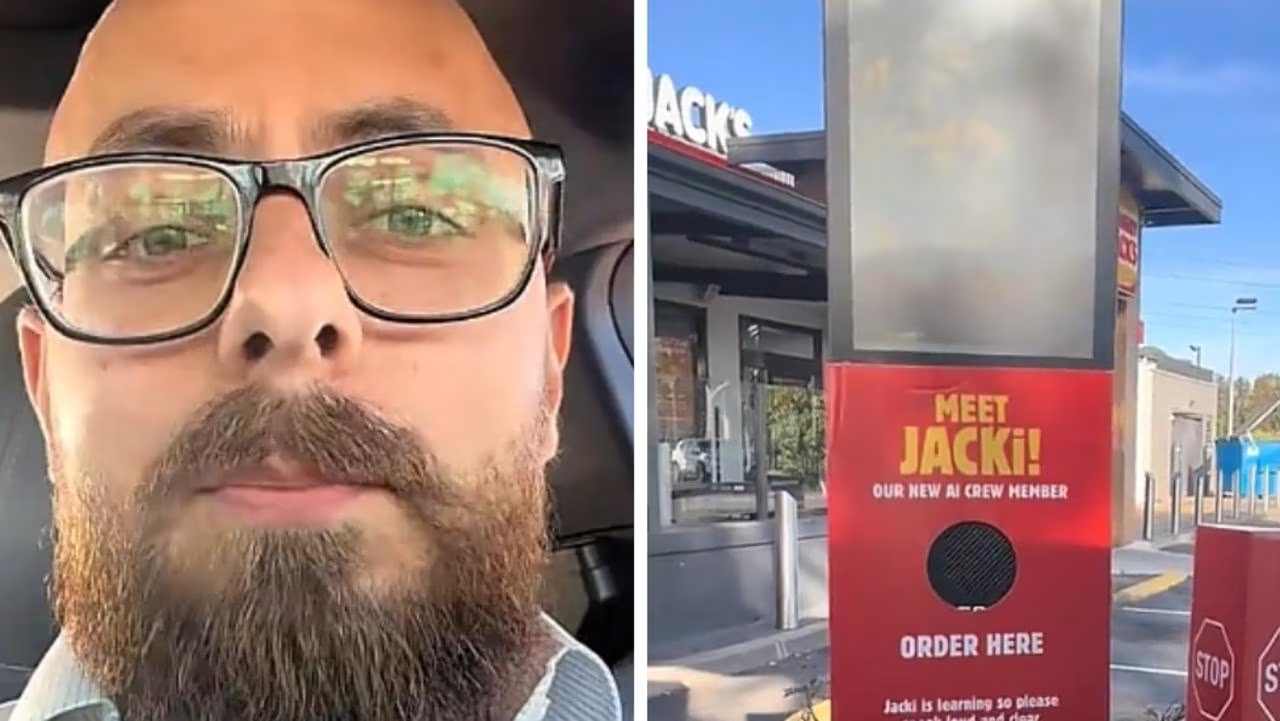
An Aussie man has shared his bizarre experience being served by an AI assistant at a Hungry Jack’s drive-thru, sparking fears that AI is “taking over” human jobs.
Fast-food giant Hungry Jack’s began trialling the use of AI drive-thru assistants last year, initially rolling out the ordering system at its St Peters store in Sydney.
Want more finance news? Download our new app for even more coverage
Dubbed ‘Jacki’, the AI voice assistant is sold to customers as Hungry Jack’s “new AI crew member” with customers advised to “speak loud and clear” since it is still learning.

The man took to social media to share his encounter ordering a coffee with the AI assistant, with the clip since going viral and attracting more than 800,000 views.
Jacki greets him when he approaches the drive-thru saying: “Welcome to Hungry Jack’s. What can I get you?”
After he orders a small long black, there is a longer-than-usual pause before Jacki asks whether he wants the coffee hot or iced.
It then tries to upsell him, asking him if wants to “make it large” or if he wants “any hashbrowns for only $2” before he goes.
“What the heck is going on? Hungry Jack’s, you guys only pay like $15 an hour anyway,” the customer says.
“These guys are the first to lose their jobs. Look guys, I’ve been telling people for so long. Be prepared. The next couple of years, we are going to see mass unemployment.
“Think about what job you have. If you’re not prepared, get prepared. AI is taking over.”
Hungry Jack’s confirms trial ongoing
A Hungry Jack’s spokesperson told news.com.au it was continuing to trial a “digital voice-activated ordering system at several select restaurants”.
“The trials aim is to assess the role of technology in delivering an improved and enhanced
customer experience. Guest satisfaction and feedback are fundamental contributing factors to
the ongoing assessment,” the spokesperson said.
“The ordering system is designed to allow Crew to focus on improvements across key customer touchpoints within the restaurant and deliver on overall service improvements.”
The spokesperson did not respond to questions about the specific stores included in the trial, nor whether the trial had impacted jobs.
Hungry Jack’s isn’t the only fast-food chain to bring in AI technology.
In Australia, KFC has also been trialling an AI voice ordering assistant named ‘Kacy’ at selected drive-thru locations in Sydney.
Restaurants in the United States are also jumping on the software, with McDonald’s, Wendy’s, Taco Bell and Dairy Queen among those to roll out AI to drive-thru lanes.
Last year, roughly 5 per cent of fast food locations in the US used voice AI technology in the drive-thru, according to Intouch Insight’s annual Drive Thru Survey. Early research suggests that figure has now risen to 6 per cent.
Junior jobs first to be hit by AI, expert says
Hungry Jack’s use of AI drive-thru assistants has left many to question where that leaves millions of fast-food workers and young people looking for jobs.
“Oh hell no! Kids need jobs,” one person said.
“These jobs [are] where our kids can get their first work experience for their resumes and uni students can earn around study. What are our kids going to do in the future now?” another said.
Another commentator claimed they worked at Hungry Jack’s and there was a competition among workers to “beat Jacki the AI by upselling hash browns for $2 and 4 nuggets for $3”.
“We are going to lose our jobs because of this,” they claimed.
Niusha Shafiabady, professor in computational intelligence at Australian Catholic University, told news.com.au she expects junior jobs will be the ones “hit first” by AI.
But she doesn’t think we will see “mass sackings” across the workforce.
“I don’t think AI will suddenly wipe out the whole of some professions. What will happen is, first, AI will replace parts of jobs. Then companies will need fewer people to do the same amount of work,” she said.
“So the real issue is not always job replacement; it is workforce compression. The first jobs that may be hit first are junior jobs.
“Companies may still need lawyers, accountants, engineers, and programmers, but they may need far fewer junior people.”
Prof Shafiabady said this created another problem: Where do future professionals come from if we stop training juniors?
When it comes to fast-food retailers like Hungry Jack’s, Prof Shafiabady said entry-level jobs could be at risk but it would ultimately depend on the strategy the corporation has in place and the cost of producing robots to do the job.
“If someone offers a press-of-a-button type of coffee, that would be so easy to replace; it doesn’t really need a proper robot. But if you want to create a robot to make Italian-quality coffee, that might be more difficult,” she said.
“When I think about creating a robot that makes hamburgers, it’s not that difficult, to be honest. You can just cut the bread, put the cheese in, and frying the patty is not that difficult — you just turn it around.
“So it might be at risk, if you ask my opinion.”
White-collar jobs not ‘safer’ from AI
Prof Shafiabady said the reality was white-collar jobs weren’t necessarily “safer” from AI either.
“We used to think physical jobs would appear first, and AI changes that,” she said.
“AI is very good at knowledge that has already been written down. For example, things that are fixed like regulations, manuals, policies, textbooks, financial rules, legal cases, computer code.”
According to data from Jobs and Skills Australia, retail managers, checkout operators and cashiers, clerks, software programmers, accountants, receptionists, and advertising and marketing professionals are among the occupations “most exposed” to being replaced by AI.
Occupations deemed the “least exposed” included trades like electricians, carpenters, plumbers and metal fitters, along with carers, truck drivers, commercial cleaners and forklift drivers.
Prof Shafiabady said jobs that “sit betwen two computer systems”, such as insurance claim processes, HR coordinators, purchasing officers, booking staff, sales administrators, compliance staff, or back-office banking staff, were particularly exposed.
She also expects some middle management work may shrink, while outsourced office jobs could be “hit hard”.
“Jobs are safer when they involve physical work or unpredictable environments, if we need human trust in them, or if they involve negotiation and responsibility,” she said.
Prof Shafiabady said she expects more retailers would likely follow Hungry Jack’s move and introduce AI assistants, but it may still be “some time” before fast-food jobs are completely taken over in Australia.
“It’s a different story from countries like the US that are very competitive. In countries like the US, it’s more likely that these systems come to the market and takeover those types of jobs faster,” she said.
“Here we have a different system. It would be a different story and take some time.”