
Will this be Baku all over again?
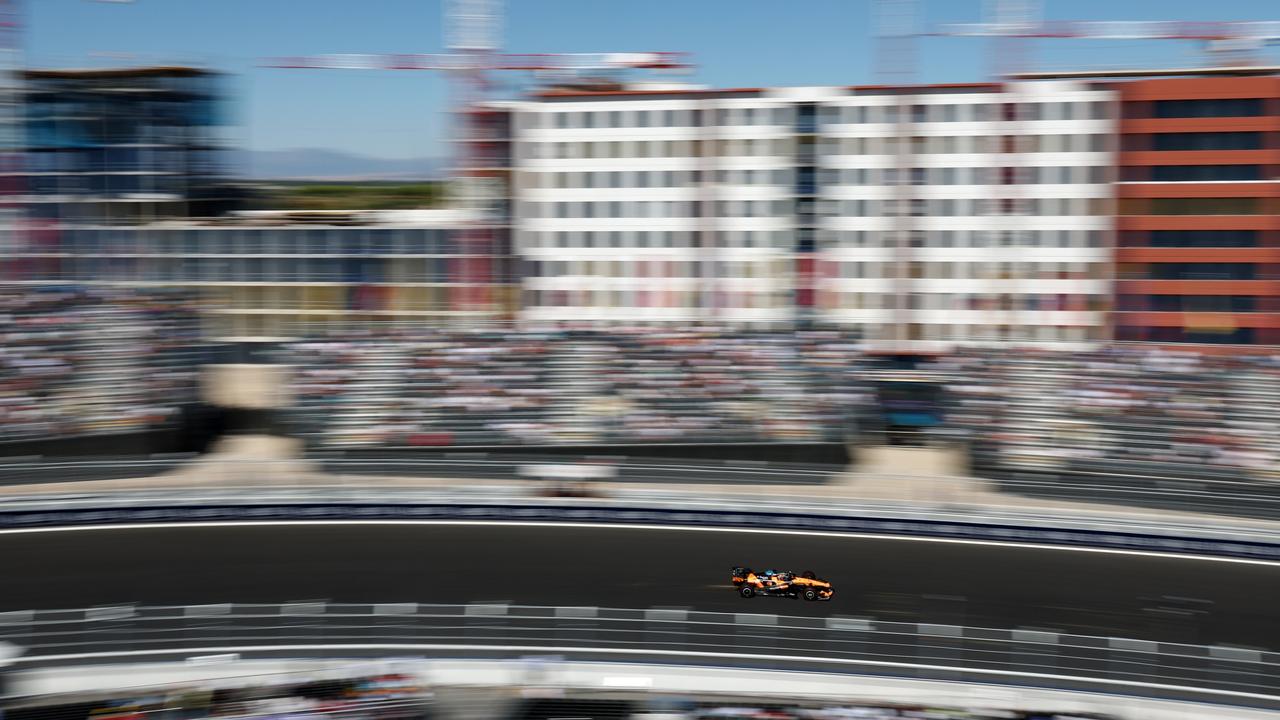
Madring, the new semi-street circuit in the Spanish capital, was billed as “the most risky circuit of the whole calendar” on Thursday, with drivers widely anticipating regular interruptions as cars found the barriers.
A Formula 3 test held last month to break in the new circuit featured more than one red flag an hour as drivers found the barriers.

Fox Sports, available on Kayo Sports, is the only place to watch every practice, qualifying session and race in the 2026 FIA Formula One World Championship™ LIVE in 4K. New to Kayo? Join now and get your first month for just $1.
Formula 2 did nothing to dissuade drivers from that idea on Friday. There were two crashes in practice — one of them, for Tasanapol Inthraphuvasak, resulting in a car fire — and another five crashes in qualifying, resulting in three red flags.
But the Formula 1 damage bill was relatively restrained at the end of the day. Only Arvid Lindblad found the barriers, spinning backwards for a big hit at turn 13.
The Racing Bulls rookie had already set what would stand as the fourth-quickest time of the day. Perhaps there’s an argument to be made that he was pushing beyond the conditions of the brand-new track.
But there might also be a comparison to be made with the 2016 European Grand Prix, the first race held in Azerbaijan.
The Baku City Circuit also carried with it warnings of carnage.
A particularly unhinged GP2 race — the forerunner of Formula 2 — played a role. Only 10 of the 22 starters saw the chequered flag. Five of the 12 retirements didn’t even get to the end of the first lap.
F1 drivers, identifying the risk, played it safe to deliver a staid first grand prix in Azerbaijan. It wasn’t until the following season, once the lessons had been processed, that the racing became entertaining.
Will that be the playbook in Madrid too?
Jack Miller crashes out in first lap | 00:55
WE’RE STILL BUILDING UP
Of course comparing Formula 2 drivers — and especially Formula 3 drivers — to the stars of F1 is always going to give you an inaccurate read. The 22 drivers in Formula 1 are supposed to be the best in the world; it’s not surprising that they managed to keep it largely together.
But a key difference beyond experience is time. F2 and F3 get only 45 minutes of practice each before qualifying, whereas F1 gets the full three hours — less red flag interruptions.
There’s no need to push — not yet.
“It was clear that everybody told their drivers to be conservative, to preserve parts and to preserve the car and to have the laps done,” said Aston Martin chief trackside officer Mike Krack.
At this time of year and with three triple-headers coming up to conclude the season, the budget cap is tight and the spares pool is strained. This isn’t the time to be crashing in practice.
It’s also important at a new track like this, where confidence can make the difference, for drivers to maximise their mileage. They’ll have learned something every lap — about the tyres, about the track, about the grip — meaning anyone stuck in the garage will be at a deficit come qualifying.
The same is also true for the engineers. Friday was also clearly being used to do much more experimentation with set-up than is usual for a practice day.
Though most teams have sophisticated in-house simulator rigs that help them approximate set-up ahead of time, it’s only once you get to the track that you can validate that work and then hone the car.
Simulators also aren’t great at simulating grip and kerb riding — two elements that are always key for street tracks — meaning much more work on the fly is required.
That’s before considering the unusual combination of corners and straights is placing an unusual compromise demand for set-up.
“It’s a challenge,” Krack said. “It is a very big compromise between all these high-speed sections, the softness required, the stiffness required for the banking, the softness required for the kerbs.
“We have energy [deployment from the engine] as well to optimise depending on if you go fast lap, push lap or ‘consec’ [consecutive laps]. There’s a lot to do.”
Though drivers reached for the limit a little more vigorously in FP2 — at least Lindblad certainly did — FP3 is the key pre-qualifying practice. That’s a tricky balance for the drivers, though, as a crash in final practice can jeopardise their qualifying participation. At a minimum it forces the team to focus on rebuilding the car rather than on making final tweaks.
Ojeda sets the pace for Enduro Cup | 00:55
IT’S CLOSE AT THE FRONT — BUT ONE BIG QUESTION REMAINS
Despite all the uncertainty and the late disruption, title leader Andrea Kimi Antonelli went to bed on Friday night with the quickest time of the day.
He’d been second to teammate George Russell in FP1, but Russell said he’d taken the car in what turned out to be a wrong set-up direction for FP2, leaving him 0.337s off the pace.
Mercedes, as the best put-together package of the season, unsurprisingly looked like the team to beat at the end of Friday.
There was more on the table for Antonelli too — his best time of a 1m 33.662s was set without even one personal-best sector. Had he set his personal bests on one lap, he’d have found an extra 0.18s.
Even so, Ferrari was close throughout. Charles Leclerc was only 0.113s off the pace, with Lewis Hamilton 0.036s further back.
There are certainly parts of this track that can suit the Ferrari car, which consensus suggests generates the most downforce. It’s also not a particularly power-sensitive track — Leclerc is using an old engine here, with Ferrari concerned his updated power unit was terminally damaged in his Monza crash.
Long-run pace suggested there’s little to pick between Mercedes and Ferrari, but that comes with the considerable caveat that almost 15 minutes of FP2 was lost to Lindblad’s red flag — and that 15 minutes fell right in the middle of the time usually used to simulate race pace.
That will be one of the big uncertainties heading into the race, particularly with tyre wear emerging as a major talking point on Friday night.
“I think there’s a big question mark over the tyre degradation,” Russell said. “In FP1, with the tyre degradation we all had, we think a six-stop race would probably have been the fastest way!
“I don’t think anybody’s going to do a six-stop race on Sunday, and I’m sure tyre deg will be better, but with that big long corner — La Monumental — it really hurts the tyres.
“That’s going to be a real challenge for everyone.”
Drivers reported surprisingly high grip from the new track in FP1, but the corner combinations — especially the slower ones — are still inducing sliding, which is graining the tyres.
Graining is when little balls of rubber gather on the tread surface as a result of the tyre scrubbing across the track — like the flecks of rubber that come off a rubber eraser as it rubs against a piece of paper.
The tyre is also being worked hard by La Monumental, the six-second banked corner that punishes the left-hand tyres — not to mention the sizzling 51°C track temperature that is forecast to escalate over the next two days.
Every team except Audi has kept two sets of hard tyres per driver in reserve for the race, which tells you plenty about expectations.
But with the long pit lane punishing of any extra stops, how teams there’s a very delicate balance to play between tyre management and pace.
Lowndes pays tribute to Peter Brock | 05:03
McLAREN STARTS ON THE BACK FOOT
There had been some optimism that Madrid might work for McLaren’s car, but instead the team ends Friday on the back foot, with Oscar Piastri more than half a second off the pace and Lando Norris not setting a time at all after a gearbox failure just two laps into FP2.
McLaren’s press release described the day as “suboptimal”. Ron Dennis would be proud.
“It’s a big setback on a new and technically demanding circuit like this, where every lap is crucial for gathering data,” said McLaren performance technical director Mark Temple.
“The conditions are tough for everyone, with high temperatures and low grip, so losing that running time certainly puts us on the back foot heading into Saturday.
“Our focus tonight is on a deep dive into the data to see where we can unlock more performance.
“The car isn’t quite where we want it to be, but we have some clear ideas on both the chassis and driver side to explore.”
Piastri said the team had at least made progress with his car between sessions, even if the margin remained stubbornly large.
“I felt like we got a bit closer in FP2, which was good, but we’re still lacking a bit of pace, it seems like,” he said.
“Trying to extract the performance on a street circuit like this is pretty challenging, so that’s the biggest thing for us at the moment, and hopefully tomorrow we can make things a bit easier and find a bit more consistency and a bit more ability to get that time out of the car.
“We’ll try and improve. It’s been an interesting day learning a new circuit. It’s certainly tough to get on top of, but it’s been a day full of learning, I would say, so hopefully we can find a bit more tomorrow.”
Red Bull Racing was similarly cut adrift from the pack.
Max Verstappen led the way but was 0.401s off the pace — and, remarkably, 0.173s slower than Lindblad, albeit he made it to the end of the session in one piece.
Liam Lawson struggled more, lapping 0.875s slower than Verstappen.
“Mechanical grip and the ride are more challenging than what we thought, the tyre grained more than expected, and the track is more bumpy than what we thought from the sim, so there are some challenges,” said technical director Pierre Waché.
“The long run was quite competitive, and our tyre management was quite good, so there’s some positives, but we know we’re not quick enough yet, so we have a lot of work to do.”
Kai Allen breaks down his overtaking | 02:30
WHAT WILL HAPPEN IN QUALIFYING?
Aside from the build-up in pace and risk over Saturday, one big focus will be traffic.
There were regular examples throughout Friday of drivers being held up by rivals on slow laps on or near the racing line.
Some incidents were run of the mill, but others were alarming, coming at the exit of blind or fast corners, where drivers have little time to react.
These incidents felt riskier than any other moment. Given the proximity of the walls and the fast approach to several corners, a crash between two cars here will be significant.
But the risk of traffic to qualifying comes from a different direction too.
Most drivers — though, crucially, not all — do not expect much overtaking on Sunday owing to the track layout.
“I wish they did something a bit different with the braking zones and not having them too much angled,” Alex Albon said, per Racer. “You’ve got a lot of combined corners, which just thinking of overtaking on Sunday, it feels like it’s quite easy to defend — you just put the car in the middle of the track and you’re not going to get a car that’s going to go past you.”
Starting position, then, will be critical.
Having a lap baulked could leave a driver eliminated well out of position. Conversely, three-place penalties will be coming to any driver who blocks another.
It puts immense pressure on the pit wall to be across the traffic situation and keep their drivers in the loop.
Then again, having some cars starting out of position may not be a bad thing — and not every driver thinks overtaking will be impossible.
“It’s going to be a first for everybody in terms of overtaking opportunities, because we haven’t seen any overtaking, we don’t know any overtakes,” Pierre Gasly said, per ESPN.
“Everybody’s talking about turn 5, but then we’ll have to improvise and kind of be creative on race day and see what’s possible.
“We’ll be the creators of these first moves. So yeah, it’s all very exciting and I’m looking forward to this challenge.”