
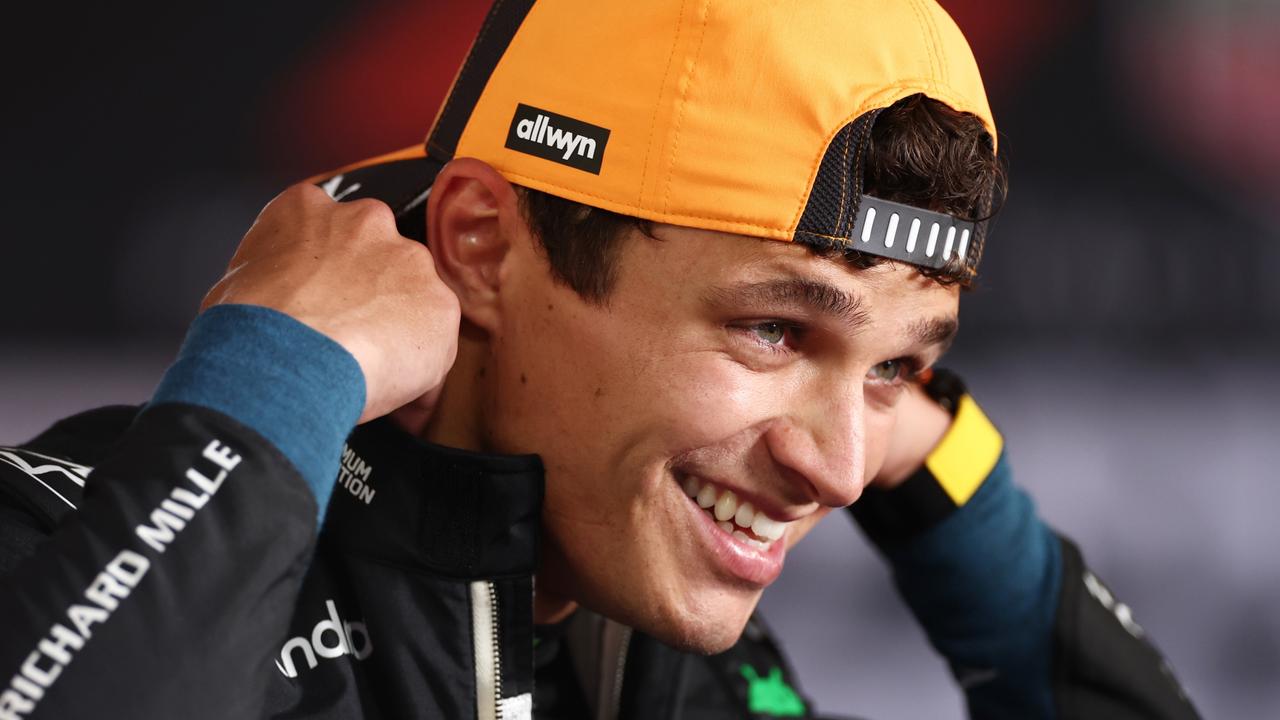
Some say the perfect lap doesn’t exist. Lando Norris might have disagreed as he rounded turn 21 at the end of Q3.
His best time to that point put him an improbable 0.690s off provisional pole, then held by Andrea Kimi Antonelli.
McLaren, though quick through some sections of the track, didn’t expect to be a pole contender thanks to the slower chicanes that upset its car.

Fox Sports, available on Kayo Sports, is the only place to watch every practice, qualifying session and race in the 2026 FIA Formula One World Championship™ LIVE in 4K. New to Kayo? Join now and get your first month for just $1.
But as Norris rounded the penultimate corner, he was a staggering 1.055s up on his previous lap.
He wasn’t about to pinch pole from the title leader. He was about to blow him out of the water.
Then he hit the brakes for the final corner.
“I thought I was in the wall,” he said. “I thought the boys were going to have to repair the car tonight.”
The time it took to save the car almost sunk him. Compared to his previous best lap, he lost 0.353s in that turn alone.
He took pole by just 0.011s, the narrowest margin for a grand prix this season.
Team boss Andrea Stella, almost lost for words, described it as a “masterpiece”.
“I would say that definitely this was one of the most impressive laps that I witnessed, as somebody that has watched telemetry in 450 grands prix,” he said, per the F1 website.
“Because we were not honestly performing to the level of scoring of pole position. I think at no stage during the weekend we demonstrated that the car was performing at the level of being the best car.”
It was so good, in fact, that Stella doubted Norris would ever be able to repeat it.
“The thing that makes the lap unique, when you look especially at the telemetry, is the precision, the braking, the speed you carry an entry, the striking of the kerb, the going on power — everything is executed with a pretty unique level of precision.
“The amount of kerb that you take in corner 1 and landing without upsetting the car — this is why I say the lap was almost unrepeatable, because all this was nailed.
“I would say that if we put another set of tyres, we would gain 0.3s in the last corner, but I’m not sure we would be able to repeat what Lando was able to do in the first 21 corners.”
Norris said the first 21 corners of the 22-turn track went exactly as he planned in his head.
“It was just a perfect lap,” he said. “Until that point [at turn 22], every corner I did what I wanted to do and I kind of planned out to do.
“The lap really was just perfect, from good exits, good kerbs, just getting all the little things that are very important around here correct — and I did that only on my last lap and it all worked out.”
His qualifying masterpiece was complete.
What we don’t know, however, is whether it will be good enough to win the first grand prix at the Madring.
Kostecki storms to Bend 500 pole | 01:28
IS THE WIN IN THE BAG?
Overtaking is expected to be difficult on Sunday, when the Madring layout will make it difficult to execute a conventional late-on-the-brakes pass — though there are other strategic variables to consider, outlined below.
On paper, though, that puts Norris in the best position to win the race. Much like Monaco or any street track, getting pole is half the job done.
But there’s reason to think Antonelli, alongside Norris on the front row, may be in the preferred spot.
The only historical data we have for this circuit is from the Formula 2 and Formula 3 races on Saturday.
Let’s go through them one by one.
In the Formula 3 sprint race, Australian James Wharton started on pole but was beaten to the first corner by front-row starter Théophile Naël. Naël won the race, with Wharton second.
In the Formula 2 sprint race Ritomo Miyata launched from P2 into the lead, past pole-getter Emerson Fittipaldi Jr. Miyata won the race, with Fittipaldi in second.
In the Formula 3 feature race, pole-getter Taito Kato got the better launch, but he was still powerless to prevent Pedro Clerot from beating him into the first turn from second on the grid. Clerot won, with Kato second.
That’s a pretty convincing trend.
Pole starts on the racing line, but the left-right chicane means the driver starting second has a clear view of the apex. With only a short run to the braking zone, a decent start is all that’s needed to take command on entry.
“The start is very important for sure, and the run into turn 1 is going to be important,” Antonelli said.
“After that, if you have a similar pace, unless they make a mistake or you’re able to have better deg and do something different on strategy … it’s really hard to create overtaking opportunities.”
Norris will also start the race with the key disadvantage of having not completed FP2, when drivers undertook high-fuel running to get a feel for the car at racing weight.
McLaren also revealed that Piastri’s car was suffering an undisclosed issue that session, muddying his data.
“I’ve got to do my homework,” Norris said. “There’s a lot of stuff that I’ve got to spend my time doing tonight, so it’s probably going to be a late one to try and get ahead of the game.
“But the main part of the job was done today, so that’s the bit I’m most happy about.”
Jack Miller crashes out in first lap | 00:55
WHAT KIND OF RACE ARE WE GOING TO GET?
But the grand prix is a step into the unknown for everyone.
FP2 was disrupted, so the usual race pace data was of limited value anyway, and the track has been evolving all weekend, making it hard to be certain on where conditions will land on Sunday afternoon.
That’s combined with all the usual complications of this being a brand-new event with no historical data to rely on.
There are some key considerations to think about
The first is how much of a beating the tyres are taking.
The circuit is surprisingly high grip for a new track, but because the surface is also very smooth, the tyres are still sliding a lot through the corners.
This shows up as graining, when the rubber balls up on the tread surface, shrinking the contact patch. This happens because the tread is hotter than the bulk of the tyre.
Front graining is debilitating for many laps but can be cleared up through driving. It’s the more common kind of graining.
Rear graining, though, spirals out of a driver’s control almost immediately — and drivers have been reporting rear-left graining this weekend.
A gradual warming-up of the tyre will help to avoid graining and prolong the life of the tyre, and that’s expected to be a key part of the early stage of the race.
“Probably it’s going to be grandmother driving in the first 10 laps,” Antonelli said. “We saw in the long run how steep the degradation can be, especially if you push too early.
“We’ll try to see in the moment — maybe tomorrow we go into the race and the degradation is going to be much lower.”
The preference for teams will be to make just one pit stop. That’s because this is the longest pit lane on the calendar, and a pit stop comes with an almost 25s loss.
If the tyres degrade anyway, however, the first person to pull the trigger on stopping twice could be a big winner.
The pace difference between old and new tyres at this track is expected to be significant. The undercut risk, then, could be massive, so committing early could result in big gains in track position by having that extra lap on fresh rubber.
The final strategic consideration is the likelihood of safety cars and red flags.
The only F2 race of the weekend featured two safety cars. The Formula 3 feature race featured a safety car and a red flag.
A drive could save more than 11s by putting under a safety car or even a virtual safety car to appear.
The appearance of one or the other at a convenient time will likely see most drivers take advantage — or, at the wrong time, see a shuffling of the order.
The likelihood of a crash requiring a red flag must also be considered — tyre changes under red flags are effectively free.
Do drivers starting out of position — George Russell in sixth, Oscar Piastri in seventh, Oliver Bearman at the back — start on a harder tyre and hope that the interruption comes later in the race? Or do they go with the flow and hope to gain ground at the start?
It’ll be a tense afternoon on the pit wall as every team pioneers what they hope will be the best route to the flag.
Lindblad crashes on new Madring circuit | 01:31
WHAT HAPPENED TO PIASTRI?
Norris delivered McLaren’s third pole in four grands prix and has the chance to do the same with race wins. It’s a considerable turn in form, with only high-speed Monza breaking the trend.
At 96 points behind Antonelli, and with McLaren 181 points behind Mercedes, it’s almost certainly too late to be talking about title comebacks.
But it does suggest that McLaren can be in the mix at the majority of circuits remaining on the calendar.
Or at least Norris will be.
The hard truth for Piastri is that he couldn’t reach Norris in qualifying. Lapping 0.47s off the pace.
It was an almost identical margin to his gap in Hungary, where the McLaren received its game-changing upgrade, though his deficit was considerably smaller in the Netherlands, where he was a respectable 0.142s adrift.
It was a surprise result considering he’d looked on par with Norris all weekend up until the final run of Q3 — he’d been only 0.017s slower after the first runs of the pole-deciding session — though he’d been roughly 0.4s adrift at the end of Q1 and Q2.
Piastri’s telemetry tells a familiar tale. While he’s a match for Norris through the fastest corners, he loses too much ground through the slowest ones — the chicanes at turns 1-2, turns 5-6 and turns 7-8 and then at turn 17.
“I think the first lap [of Q3] wasn’t too bad, but the second lap was pretty shocking, to be honest,” he told Sky Sports. “Disappointing.
“Turn 1 didn’t start very well, and a few places were quite a lot better than the lap before, but once you get out of the rhythm here, it makes life very tough.
“Not a great session. I feel like this weekend the pace has been reasonable. It’s just been about trying to be there consistently. Unfortunately one of those sessions where you just wish you could have it again.”
He’ll start six places behind Norris, which is the biggest gap between them since last year’s Mexico City Grand Prix — though he had a bigger advantage over his teammate last week in Italy.
With both Ferrari drivers looking competitive and with Max Verstappen in the mix ahead of him, there’ll be no easy wins on Sunday afternoon.
But with so much uncertainty around the race, you’d be brave to rule out almost any outcome for the Australian.