
Pencil Sunday, 25 October into your diary.
It’s the day of the United States Grand Prix in Austin.
It’s also the day that, on the current trajectory, Andrea Kimi Antonelli will win his first world championship.

Fox Sports, available on Kayo Sports, is the only place to watch every practice, qualifying session and race in the 2026 FIA Formula One World Championship™ LIVE in 4K. New to Kayo? Join now and get your first month for just $1.
Facetious? Only slightly.
The calculation assumes only eight races remain rather than nine, with notice still pending on whether Formula 1 will race in the Middle East this season.
The trajectory is also boosted by chief title rivals George Russell and Lewis Hamilton suffering a DNF apiece from the last five grands prix.
But you know, after his eighth victory from 14 rounds, it’s entirely possible — and perhaps more than just possible.
Antonelli has extended his championship lead by 56 points over the last six weekends, and average of 11.2 points per round.
READ MORE
‘YOU GONNA FIX IT?’ Piastri snaps at team after crazy first lap; McLaren shocker burns Lando
‘TELL ME NEXT TIME’: Passive aggressive pit act says it all as Piastri speaks over disaster race
‘AM I GETTING TOLD OFF?’ Norris in bizarre spat with F1 over cooldown room act
Kimi Antonelli claims Spanish Grand Prix | 01:32
If he continues at that rate, he’ll be 115 points up after Singapore, where he would need to be 125 points to seal the deal.
He would need a lead of only 100 points after the subsequent round in Austin to get it done.
Put another way, he needs to outscore Russell by only 19 points over the next three races to win the title.
Pencil in the date. It could be a big one.
NORRIS TAKES IT ON THE CHIN — BUT WAS THERE ANY WAY TO WIN?
Antonelli was always likely to extend his title lead this weekend, just not by quite so much.
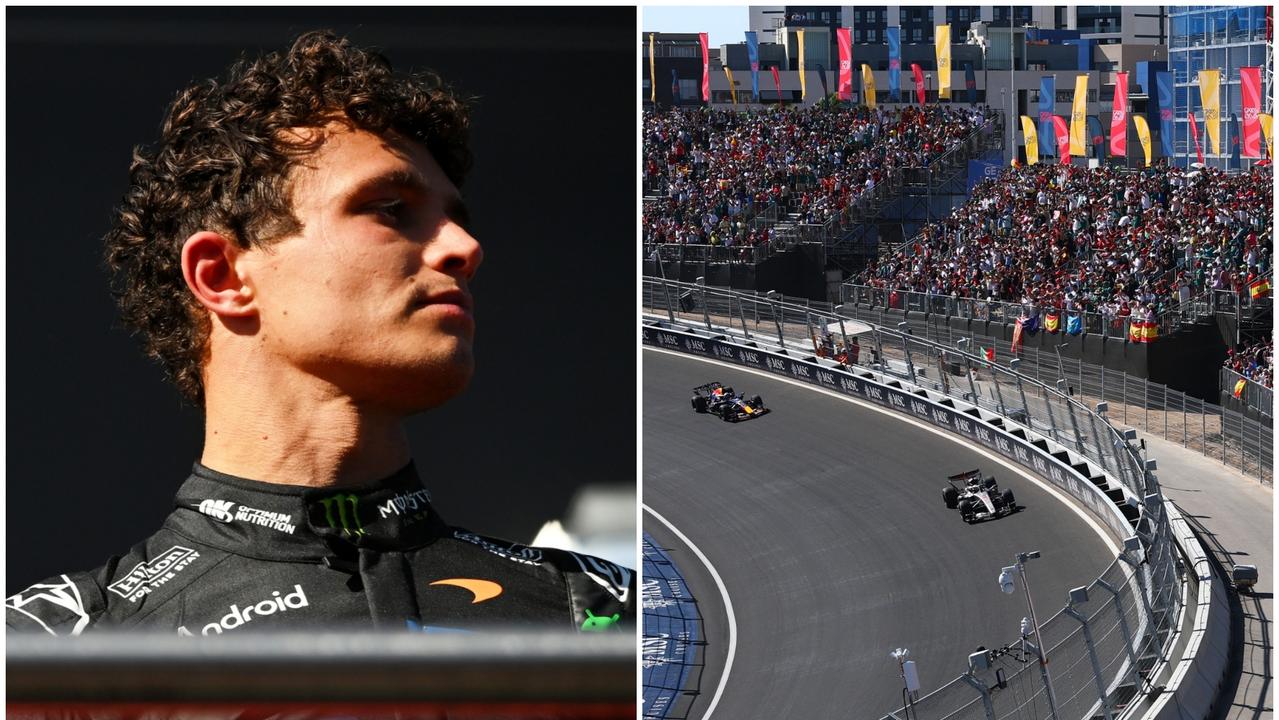
While he had the measure of Russell all weekend, Norris emerged late as the quickest driver at the Madring.
That sensational pole lap, it turned out, was just the beginning. Despite the dearth of high-fuel running on Friday owing to a gearbox problem, Norris was the fastest driver in the race.
“Today we didn’t deserve the win; Lando deserved to win today,” Antonelli said afterwards.
Ironically it was Norris’s speed that cost him.
With remarkable accuracy, Lance Stroll’s stoppage came at the worst possible time. The Canadian’s Aston Martin ran out of puff before it was fully off the circuit, necessitating a virtual safety car for marshals to enter the run-off zone
The VSC was called as Norris put his foot down exiting the final corner, after he’d already passed pit entry.
Had he been slower in the first stint, he might have had the crucial few seconds he needed to capitalise.
Lando refuses to ditch the Coca-Cola! | 00:17
But it came just in time for Antonelli and his well-drilled Mercedes team.
“The process was great today,” Toto Wolff told Sky Sports. “The strategy group had it on their mind, obviously, then someone said, ‘That’s not going to clear quickly’ with the Aston Martin in [the gap in] the wall.
“Then it was strategy to Bono [race engineer Peter Bonnington], Bono double-checked, Bono to Kimi. We’re talking about three seconds.”
Antonelli pitted and took the net lead of the race.
The VSC lasted almost an entire lap — but only almost.
As Norris returned to pit entry, the VSC ended, and the outcome of his race appeared to depend on what happened next.
McLaren committed to pitting him anyway. It cost him around 10s to those who pitted during the caution. He then had a slow 7s stop, rubbing salt into the wound.
Was there another way?
The team figured it was better to take the hit now then to bleed lap time for the rest of what was likely to be a one-stop race.
In hindsight it was the right call. As Charles Leclerc learned, there were no other incidents forthcoming in a staid and cautious grand prix that would have swung the pendulum of luck back towards Norris.
No matter what happened, the moment that VSC came out, Norris was finishing the race third.
“We deserved to win quite easily,” Norris said on the cool-down lap.
Later he added: “There was nothing I could do … just luck as not on our side.
“A tough race, one that just got away from us. I felt like we deserved it today, but that’s racing sometimes. We’ll take it on the chin and try again next time.”
DOES THE VSC RULE NEED TO CHANGE?
Norris’s supremacy in the race despite the result was unquestioned, with both Antonelli and Verstappen admitting the Briton deserved the win.
McLaren CEO Zak Brown was even more emphatic.
“I think that was our race by — I don’t know, pick a number — 20s, 25s,” he told Sky Sports.
“He was dominant. He was gone, managing it great. Tyre wear was great. He was in a league of his own.”
Though Norris was as magnanimous as he could have been expected to be — his wrath was incurred mostly by someone in the cool-down room apparently reprimanding him for drinking a can of Coke — he did argue later that the concept of the virtual safety car was inherently unfair and ought to be addressed.
“I was the only one on the whole grid that doesn’t get a pit stop [under VSC],” he told Sky Sports. “I lost 20s on the whole grid. This is out of my control. It’s out of their control.
“It’s a rule that shouldn’t define a race. A race should be won by the guy who put in the best performance, who maybe takes a risk by going long in a stint and maybe you get a safety car later on and things can help because you know that’s one of the big factors, but for everyone to get a VSC pit stop and for me to get nothing, it’s just unfair.
“But it’s happened in the past. Others have won from it. I’ve probably won from it in the past. It’s just I don’t think many people have lost a race win over it.
“It’s frustrating. I don’t feel like it’s the way you should lose.
“Tell me if you’re going to fix it!” | 00:48
“We’ve spoken about it in the past in the drivers briefing saying they should leave it out for at least a lap so it’s equal for everyone. Today I was the only one who lost out, and I lost about 20s of race time, and that’s not how it should be.”
Norris really was the only driver who couldn’t pit during the VSC, with the option available to every other driver — and obviously that made the difference to the outcome.
It’s debatable, however, whether the VSC regulation needs to be modified.
There’s luck in the timing of every sort of safety intervention, even if a conventional safety car and red flags neutralise the race in the same way for everyone.
Norris noted that some strategies specifically hope for a late safety car to work — like Leclerc’s long stint in this race — and that that’s fair enough.
But it’s far from unusual for a safety car to arrive in the middle of a pit window and shake up delicately poised races.
Norris benefited from one such safety car in Miami in 2024, winning his first race as a result.
He also lost out later that year in Brazil, when a red flag was thrown shortly after he pitted, handing Verstappen a race-winning advantage.
It isn’t fair, but these rules aren’t designed to be fair in the first instance. They’re designed for safety purposes — and, in the case of the VSC, it’s designed to be as minimally intrusive as possible.
IS THIS THE CIRCUIT F1 WANTS IN SPAIN FOR THE NEXT DECADE?
It’s worth adding here that Norris’s overwhelming pace advantage could have won him the race anyway had this grand prix have taken place at a different circuit — almost any other circuit in fact.
Despite the Madring being designed with a mostly clean sheet of paper, its first grand prix was a dire, dour spectacle almost completely devoid of overtaking.
“I don’t know how someone looks at this design and goes, ‘mint’,” Norris said.
It was clear from the track map it would be difficult. Not only is it a street track bordered by walls, which naturally deter risk, but the combination of corners, leading into each other as they do, plus the curved braking zones, meant sizing up a move even with a massive pace advantage was all but impossible.
Remarkably it made the former host of the Spanish Grand Prix, the Circuit de Barcelona-Catalunya, look like a thrilling circuit — and that track has long been dismissed for generating predictable racing.
The Madring is certainly challenging to drive over a lap — the drivers were pretty much unanimous about this being a high-commitment, high-risk circuit through practice and after qualifying — but those same characteristics meant the Sunday spectacle lacked.
There’ll be plenty of head-scratching taking place in Madrid and at F1 headquarters thinking forward to the next nine seasons of this circuit.
Fortunately organisers have sounded receptive to driver feedback, and though the potential for change to the south end of the circuit is limited by the fact it comprises mostly public roads, the faster north end is purpose-built and can be changed, albeit at a price.
Verstappen summed up the problems he’d address first in a comprehensive breakdown after qualifying.
“They need to learn that it should never be that you have to steer [when braking], that you have to combine under braking, because it doesn’t allow any kind of overtaking,” he said. “For sure, in terms of track design, I think it can be better.
“I think also input from drivers in the future on track design can also help a lot. I know they will always come back to you and say, ‘Yeah, but the space,’ but that’s BS. There’s always a way to find an overtaking opportunity around a track.
“If you want to have better racing, overtaking, I think there can be a few corners that can be changed.”
All that said, there’s also reason to think next year’s race can be better with even minimal changes.
The timing of the VSC, allowing everyone but Norris to pit, killed some of the strategy elements that would have made the afternoon far more interesting and tense.
Instead the 10 drivers who started on medium or softs — unusually all three tyre compounds appeared on the grid — got an easy pass at exactly the moment they were beginning to consider pitting anyway.
There’s also a psychological factor.
This feels a lot like the reviews of the first race in Baku, when expectations of chaos led directly to a dull race because teams and drivers were playing it safe.
The following year’s race was a thriller, and most of the following grands prix in Azerbaijan have been exciting.
PIASTRI WITH WORK TO DO
Oscar Piastri was on the back foot after a disappointing qualifying, but his race never really got going.
The Australian got squeezed against the pit wall by George Russell off the line, picking up front wing damage that hampered him for the entire race after dropping three places.
The timing of the VSC also didn’t work for him, having started on the hard tyre. He needed to run deep to make it work, but with no subsequent interruptions, there was nothing for him to gain.
Piastri’s race ruined by opening clash | 00:32
The alternative would have been to stop twice, as George Russell did, though the Mercedes strategy didn’t really deliver anyway.
“It was pretty painful, obviously, from lap 1,” he said. “Not much I really could’ve done from there.
“It was just a difficult afternoon.
“Today I just tried to learn as much as I could to get more out of the car and the way I drive it. Hopefully we’ve learned a few things for the rest of the year.”
It’s an opportune time to have learned some lessons, with Azerbaijan up next.
While Piastri stormed to a famous victory in Baku in 2024, last year was disastrous, with Piastri crashing out of qualifying and then crashing out of the first lap of the race.
It’s never a bad time to bounce back, but it would be particularly meaningful there.
WHERE DOES ANTONELLI GO FROM HERE?
The fact this imperfect Sunday afternoon resulted in another Antonelli victory just emphasises how rich a vein of form the Italian is in at the moment.
Great things tend to happen to the greats, and that certainly seems to be the case for the 20-year-old as he marches to the championship.
With an 81-point lead, he has one hand on the title trophy. Even though his most recent victory was fortunate, the building blocks contributing to that lead are anything but.
There’s really only one question left for him to answer.
As the championship comes into view, even with the benefit of such a big buffer, the pressure will inevitably build.
Already he’s having to bat away the inevitable questions about whether he’s beginning to count down the days — which only makes it harder for him to stick to his job of taking it one race at a time.
“That’s exactly what I don’t want to do,” he said. “I want to keep pushing race by race, keep delivering, keep enjoying all the way and then trying to do my best every race, and then we’ll see where we end up at the end of the year.”
But team boss Wolff — who started the year expressing extreme caution about Antonelli’s ability to take the fight to the more experienced Russell — no longer sees the risk in his young protégé.
“He hasn’t got that [sense of pressure], interestingly,” he told Sky Sports. “It’s just like ‘get in the car, just drive’.
“I feel almost his youth helps him a lot there, because he’s 20. He could probably stay in this sport 20 years with so many opportunities. In a way he’s so above all our expectations and his own. He’s just going with the flow.
“I think there’s also a genetic factor. You’re born cool as a cucumber or you’re not. You can see this in junior formulae or karting, taking pressure easier. But he’s taking this to just another level.
“We’re talking about Formula 1. You can see junior drivers crumbling in F2 or wherever, but he’s just driving.”
Sunday, 25 October. Pencil in that date.