
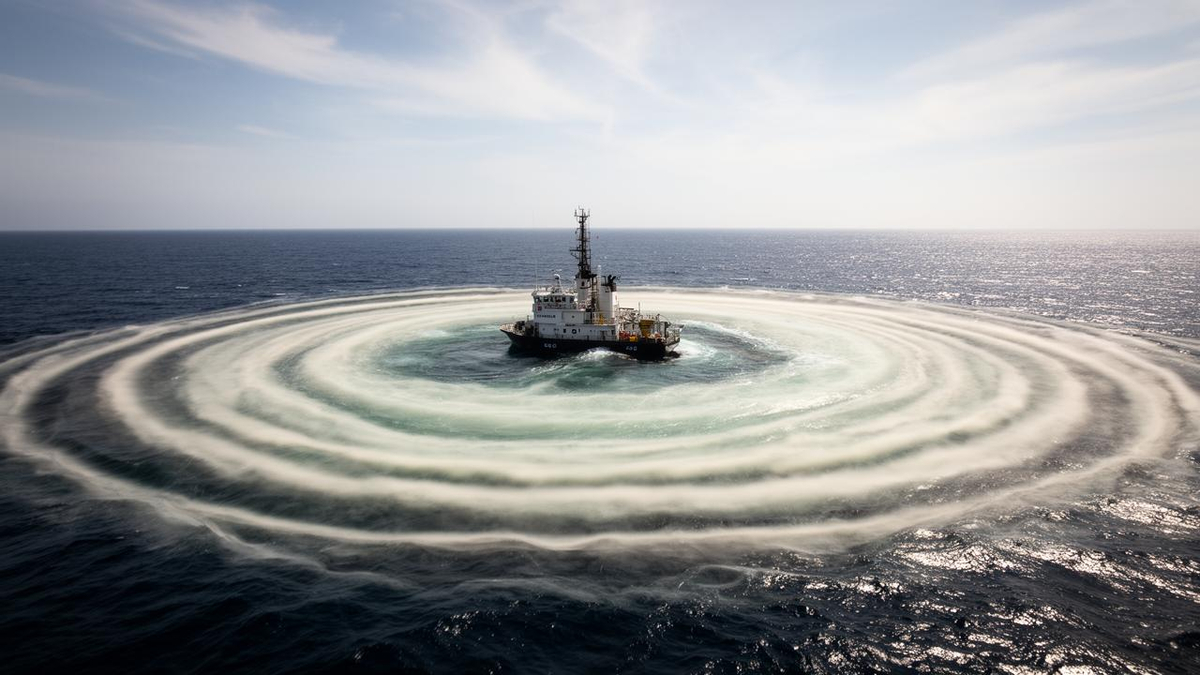
The Korea Polar Research Institute announced on the 14th that when the Hunga Tonga volcano in the South Pacific erupted in January 2022, an underwater caldera approximately 5 km wide sank vertically by an average of about 1 km almost simultaneously with the eruption. The institute confirmed that a large-scale “piston-type collapse” occurred during the volcanic explosion. The findings were published in the international journal Nature Geoscience on the 11th.
The Korea Polar Research Institute formed an emergency survey team, K-HEART, led by Principal Research Scientist Park Sook-hyun, immediately after the January 2022 eruption. Approximately 80 days after the explosion, the icebreaker research vessel Araon, which was returning from Antarctica, was deployed to the site to collect seafloor topography data, seismic reflection data, oceanographic observations, geomagnetic data, and rock and volcanic ash samples. The institute subsequently collaborated with researchers from New Zealand’s University of Auckland and Auckland University of Technology to analyze changes in seafloor topography and the volcano’s internal structure before and after the eruption.
The analysis determined that the total volume of material displaced by the volcanic eruption reached 8.9 cubic kilometers. That is enough to fill approximately 600 million 25-ton dump trucks—or enough to cover the entire city of Seoul to a depth of 15 meters. Of this total, approximately 77%, or 6.85 cubic kilometers, was attributed to the rapid subsidence of the caldera at the volcano’s center.
The caldera, which had been at a water depth of 150–200 meters before the eruption, deepened to a maximum depth of approximately 850 meters immediately afterward. The research team assessed that this large-scale seafloor subsidence occurring over such a short period was likely one of the factors that amplified the magnitude of the tsunami generated at the time.
Seismic reflection surveys also confirmed that volcaniclastic deposits up to approximately 150 meters thick had accumulated inside the caldera. The actual caldera floor beneath the sedimentary layer was found to reach a water depth of approximately 1,000 meters. Notably, landslide deposits were discovered between and beneath the volcaniclastic layers, which the researchers interpret as evidence that caldera collapse and submarine landslides occurred simultaneously during the massive eruption.
Dozens of submarine volcanoes and calderas are densely concentrated in the waters around Tonga. The research team expects these findings to contribute to understanding submarine volcano collapse processes and the mechanisms behind volcanic tsunamis.
Principal Research Scientist Park said, “Through the emergency survey, we were able to confirm the rapid collapse process of the Tonga volcano,” adding, “We plan to continue tracking the growth, massive eruption, and post-collapse changes of submarine volcanoes through follow-up research.”