
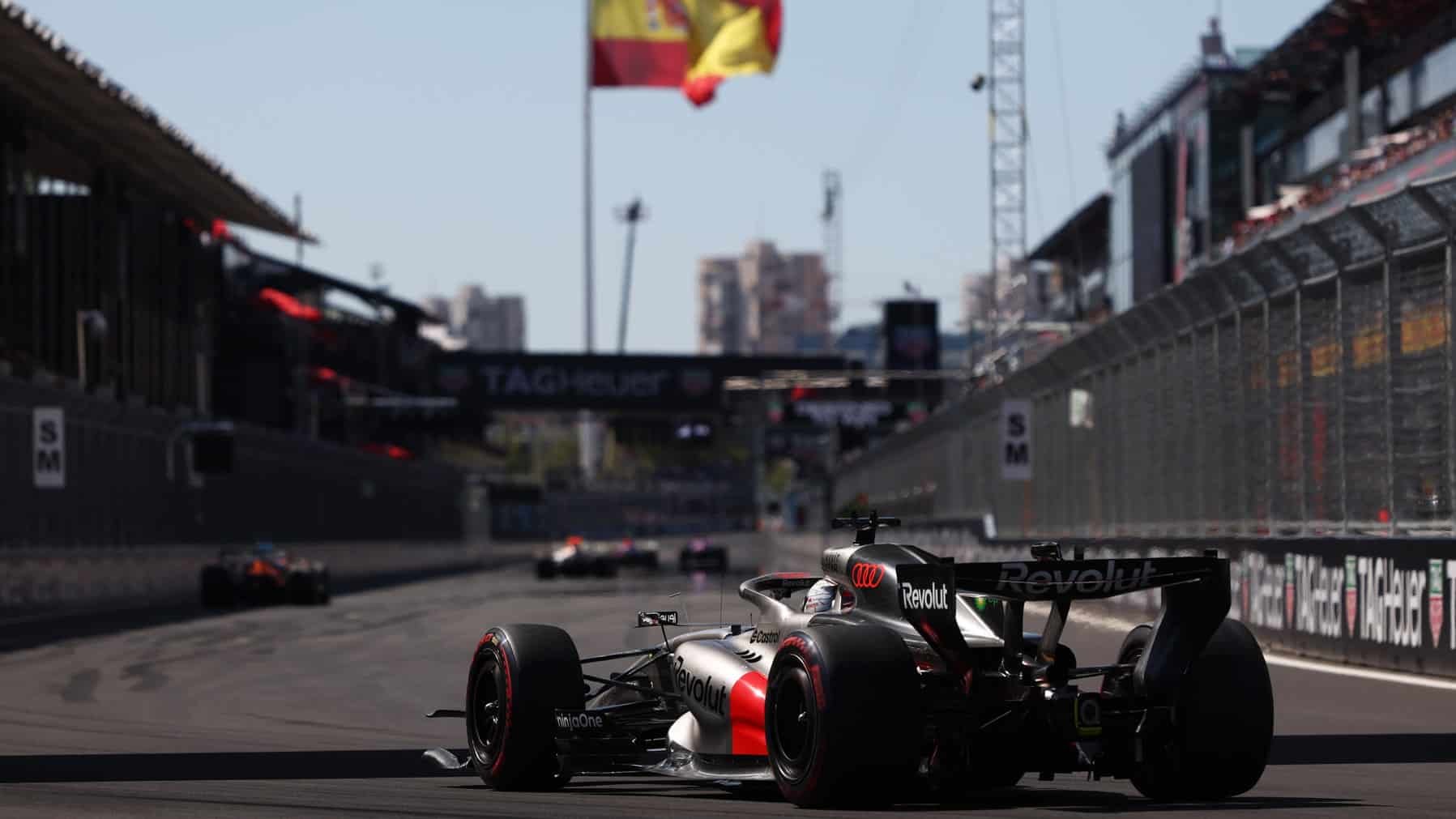
The willingness to change is not in question. The feasibility of the changes drivers actually want is a separate matter, because Madring is not one circuit but two, stitched together, and only one of them is truly Formula 1’s to rebuild.
The main quirk of the Madring is that it wasn’t built on a fully blank canvas.
Roughly half the lap winds through existing roads around the IFEMA exhibition centre, where the paddock and pit buildings sit inside the halls themselves – an arrangement unusual enough that the pitlane is effectively split by more than 100 metres of existing infrastructure.
The other half, laid across open ground in Valdebebas on the other side of the M40 motorway, was designed from scratch, complete with the elevation change and banking that produce La Monumental, the most talked-about feature of the track over the weekend.
The fact that the circuit is divided into two is relevant because it draws a line between the corners that can be meaningfully redesigned and the corners it is stuck negotiating around without coming up with a completely new layout.
The changes with real scope
The Valdebebas section is where the organisers have more room to move and improve, as it is less constrained by big permanent buildings or a road that has to keep functioning as a road for 51 weeks of the year. It’s not unlimited space, but in theory there’s a more wiggle room than around the IFEMA area.
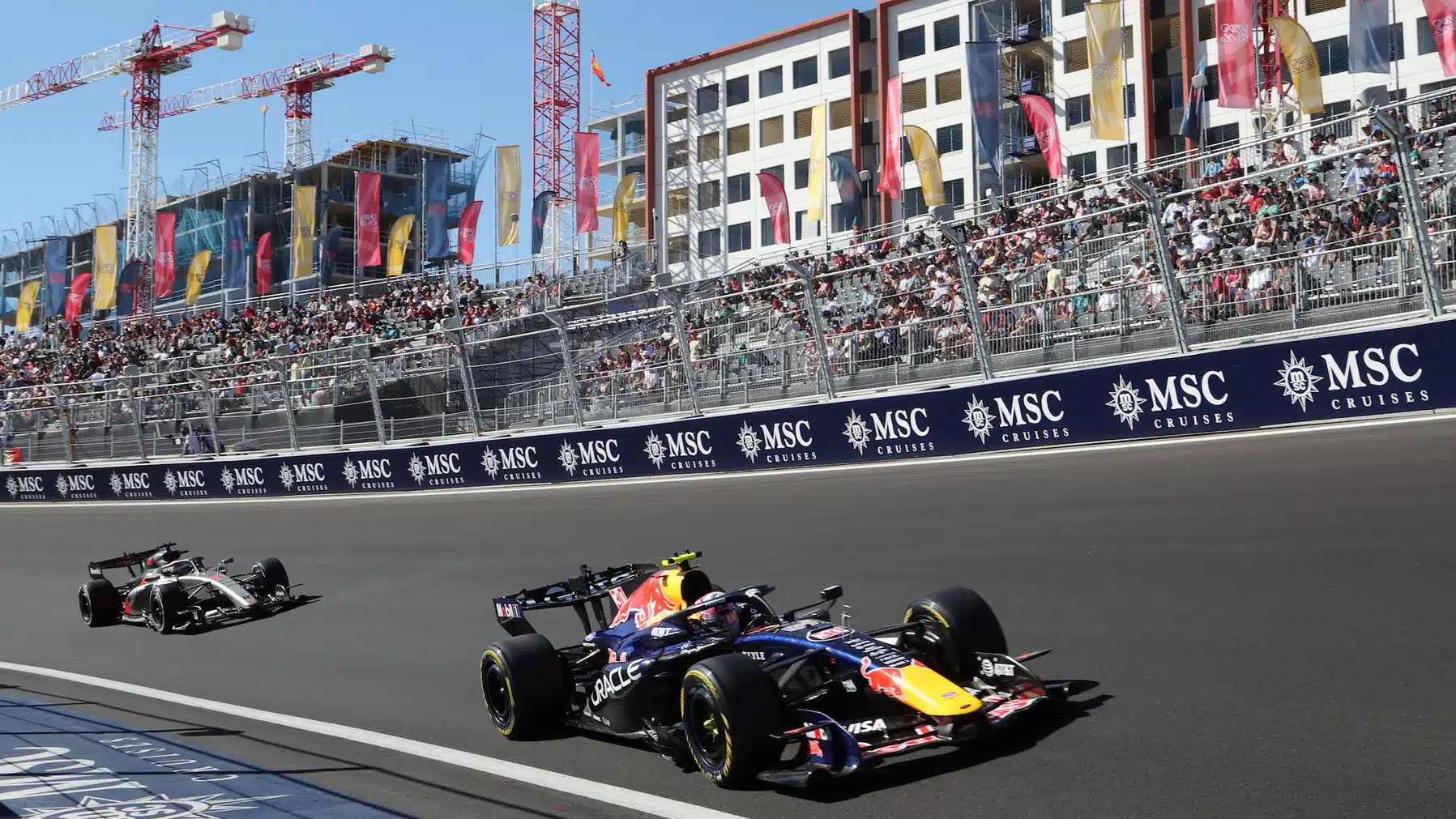
La Monumental lives in the part of the circuit that was designed from scratch
Grand Prix Photo
That is also where some of the more straightforward fixes could live.
Norris and Fernando Alonso both flagged the blind, narrow-feeling sections through the middle of the lap, and Norris drew a direct comparison to Jeddah, where similar complaints after that circuit’s debut were addressed simply by widening the walls in the affected sections – a change that reshapes sightlines and margin for error without touching the line the track actually takes.
If Madring’s equivalent problem areas sit in the open Valdebebas section rather than by IFEMA’s structures, that kind of fix should be genuinely low-effort.
Carlos Sainz, both a Madrid native and the event’s ambassador, indicated the FIA, the drivers and the circuit would look at Turn 5 in particular, with Turns 1 and 13 also under consideration.
His Williams team-mate Alex Albon was the one to frame Madring’s teething problems the way most new circuits are eventually framed: needing two or three targeted changes rather than a wholesale rethink.
“It would only take two or three changes to fix the problem,” Albon said, “because it’s not a bad circuit.”
The changes that run into IFEMA
The harder problem the organisers will need to solve is that several of the most-repeated driver complaints point at exactly the sections built around the exhibition centre rather than the open Valdebebas land.
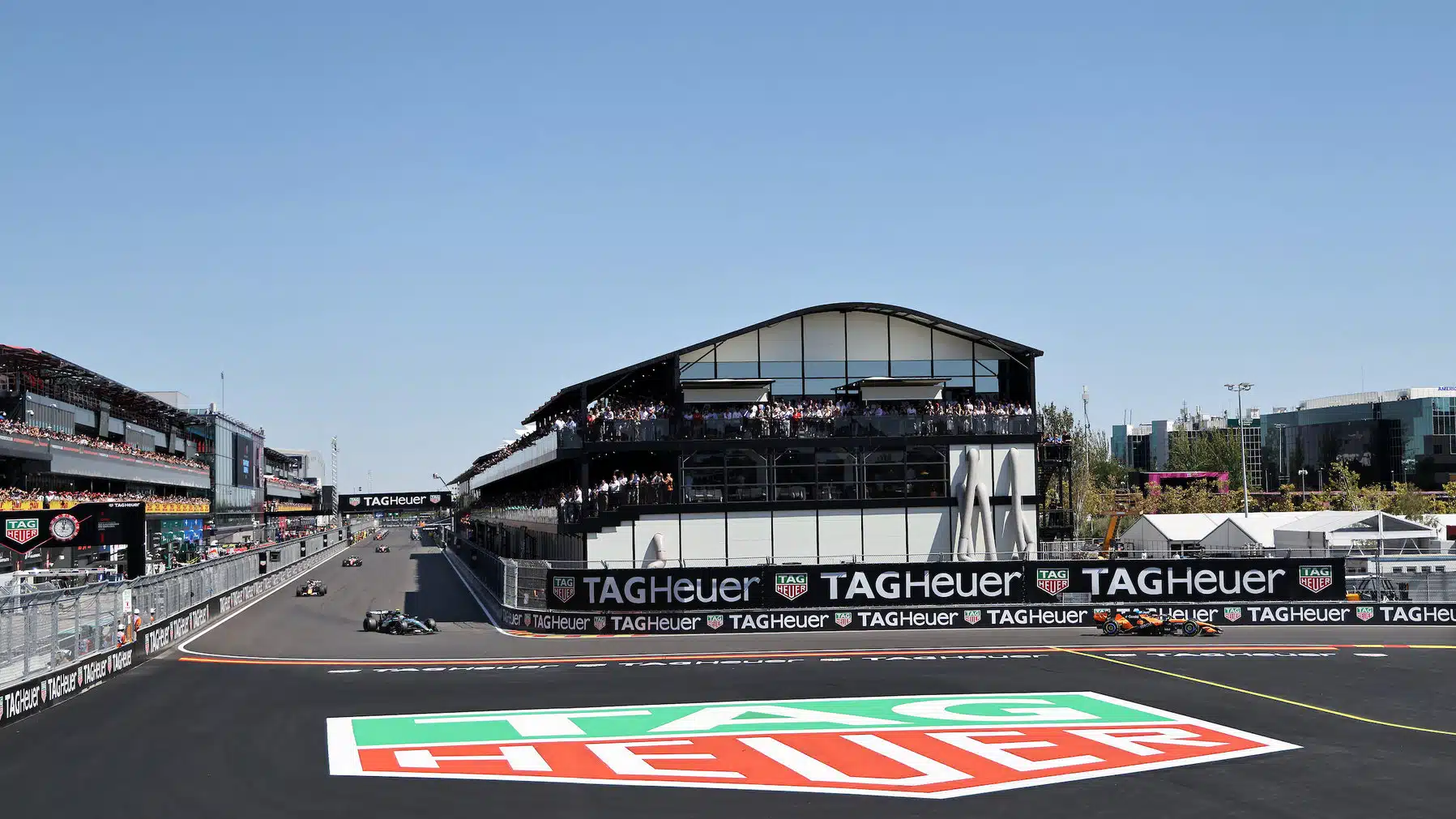
The areas around IFEMA will be harder to alter
Grand Prix Photo
Norris’s most specific suggestion was to remove Turns 18 and 19 entirely – he called them “useless” – in favour of a straight into a wide hairpin, citing Turn 1 or Turn 10 in Austin as the model.
But that final technical sector runs directly alongside IFEMA’s exhibition halls; grandstands there are sold specifically on proximity to Turns 18 through 20.
There’s an added wrinkle specific to that corner, too: Turn 18 sits immediately after one of the two short tunnels that carry the track beneath the M40 motorway between the IFEMA and Valdebebas halves of the lap – one on the way out to Valdebebas, one on the way back.
A tunnel portal isn’t something you widen with a wall move; the entry Norris wants reshaped is constrained by a fixed underground structure before it even reaches the buildings around it.
Widening that entry the way he describes would mean moving the track’s boundary relative to a fixed tunnel and a fixed building, not just repainting the racing line – a fundamentally different scale of project from a wall move in open ground.
The Turn 5-6 chicane carries the same problem in reverse. It was designed as the circuit’s primary overtaking zone off the longest straight, and Antonelli’s own account of trying it shows exactly how it failed: a driver who commits to the inside line is one miscalculation away from putting both cars in the wall, which is precisely why he chose not to.
Norris, asked directly what needs fixing for next year, put Turns 5, 6 and 7 in his “trickier” category, distinct from the simpler fix he wants at 18 and 19 – an acknowledgement that even the drivers pushing hardest for change aren’t sure what the right geometry looks like there.
The approach to Turns 5 and 6 could possibly be made wider, but if that’s a big enough change to improve the racing remains to be seen.
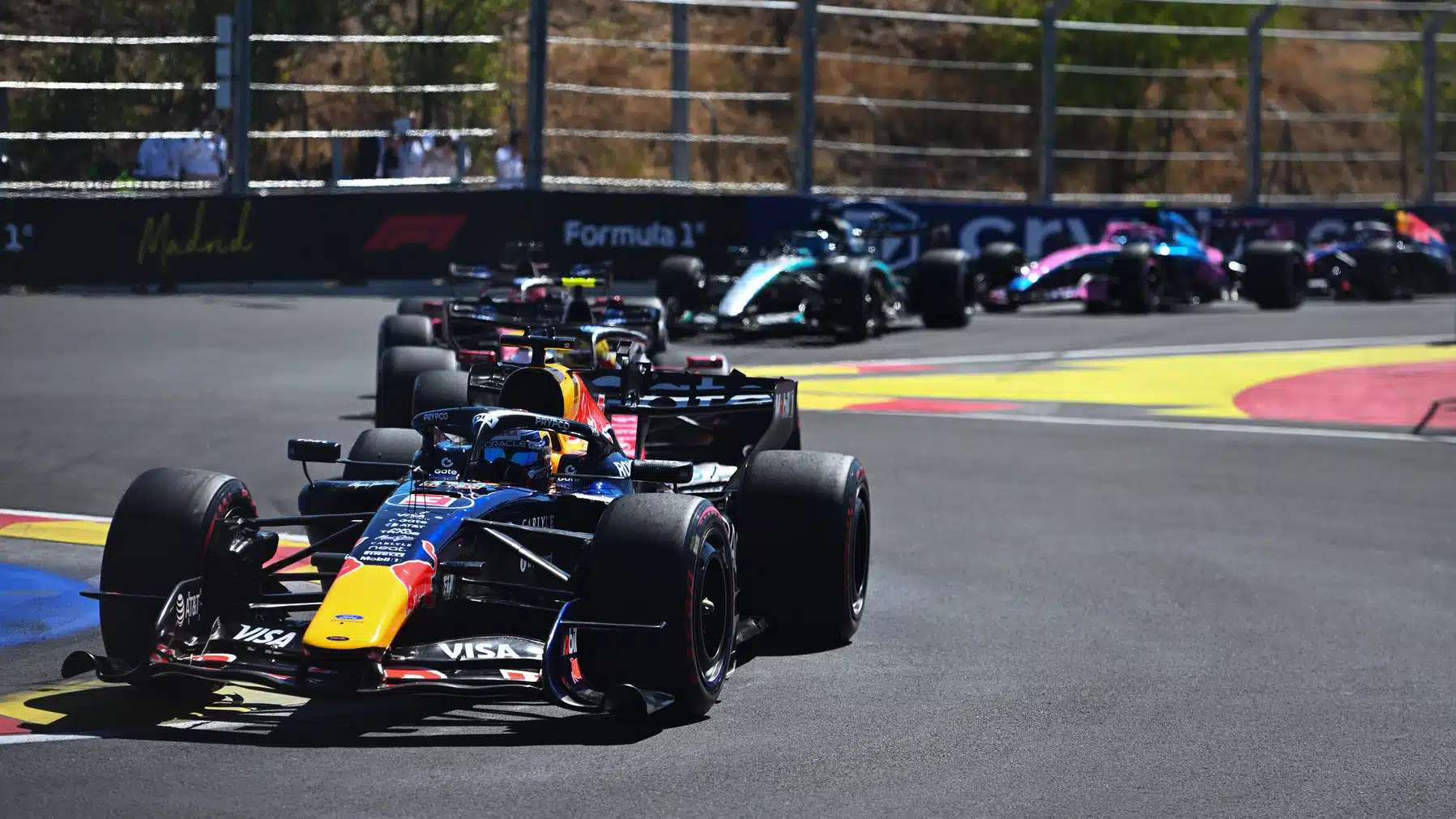
The chicanes didn’t lead to any overtaking
Red Bull
Fixing a combined-input corner like that usually means opening the entry or changing the approach angle entirely – but Turn 5 sits within the street-style sector that Oliver Bearman pointed to as evidence Madring had wasted a rare opportunity.
He said Baku “had a lot more limitations with buildings around it,” and still produced a layout that lends itself to overtaking.
The implication is that IFEMA’s constraints are real but not insurmountable – Baku managed harder ones – yet they still may complicate the cleanest version of a fix.
There’s a further complication that has nothing to do with corners at all.
The pitlane’s unusual length – Norris joked it was “six kilometres long” – dictated by the gap between the two halves of the paddock inside IFEMA’s halls, has already been named by drivers as a reason nobody tried an aggressive strategy.
That is a structural feature of the venue, not a layout choice that can be redrawn on a whiteboard before 2027.
A track that will have to be judged twice
None of this makes Madring’s promises about change empty talk.
The track will need to be reinstalled regardless, since the circuit is partly disassembled between events, and that actually works in the organiser’s favour: changes to the Valdebebas section can, in theory, be folded into a process that was already going to happen.