
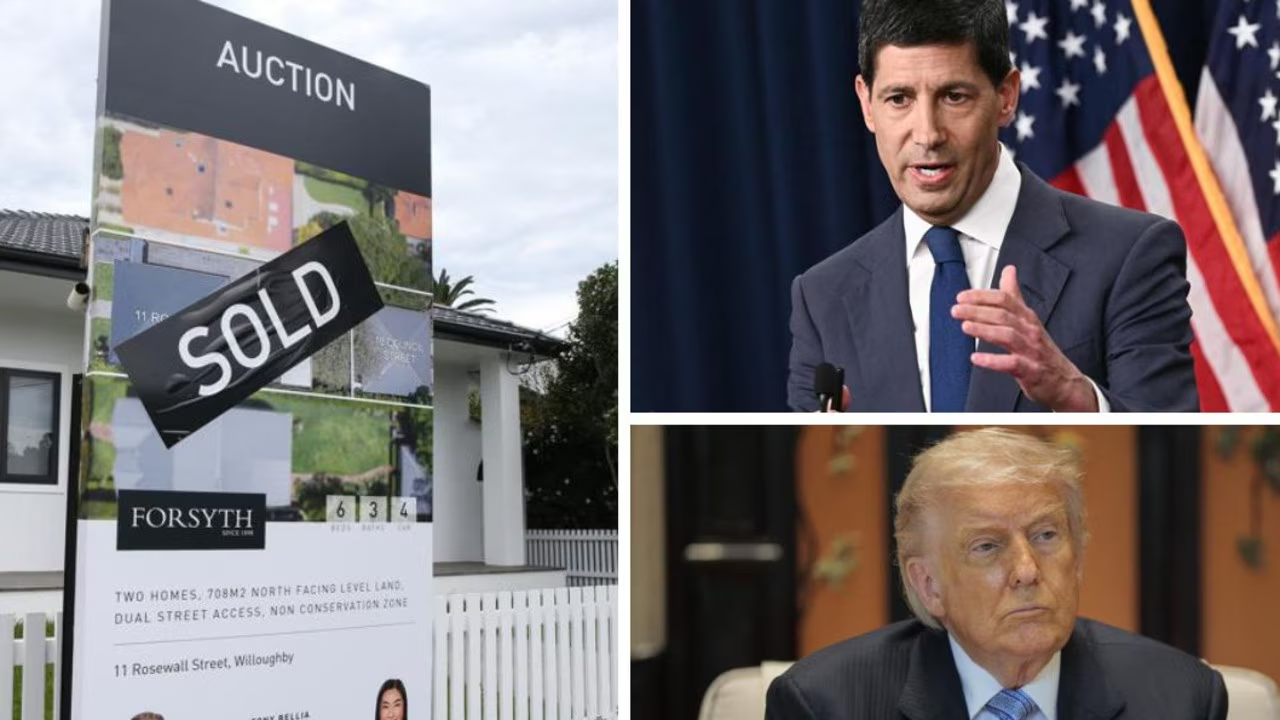
An interest rates plan from US President Donald Trump has been labelled as the “dumbest thing ever” as the Federal Reserve moves on rates.
The US Federal Reserve overnight lifted the official cash rate by 25 basis points, to3.75 – 4.0 per cent range.
The US is not alone in lifting the cash rate, with the European Central Bank — representing 21 countries — raising its benchmark interest rate by 25 basis points to 2.5 per cent, while the Bank of Japan is predicted to move on the cash rate on Friday.
Defying President Donald Trump’s call for a “patriotic” cuts, central bank chief Kevin Warsh on Wednesday stressed the need to combat inflation that has been “too high” for “too long”.
In a post on Truth Social on Wednesday afternoon, Mr Trump said US interest rates should be “1%, or less, because we are the Best Credit in the World — BY FAR”.
Former Reserve Bank economist Justin Wolfers blasted Donald Trump’s plans to cut interest rates to 1 per cent in America.
“It’s not going to happen, let’s be clear what the President is calling for is literally the dumbest thing that’s ever been said by a President,” he said on ABC news.
“The Federal Reserve was unanimous in raising rates to 4 per cent.”
“There is not an American alive except for that one bloke living at 1600 Pennsylvania Ave and there’s not an economist alive who thinks what the President wants is feasible, sensible or in the best interest of the country.”
Despite cost-of-living pressures, current US President Donald Trump has been critical of the Federal Reserve lifting the cash rate in the past.
In a recent Truth Social post earlier this month, the President said the US should have the “LOWEST RATE of any country in the World”.
“The Fed Board, with its great new leader, must get smart – BE PATRIOTS for a change,” he wrote.
Mr Trump also threatened to cut off trade with countries that have a trade surplus with the US if the Fed didn’t lower interest rates.
Hitting Australian mortgage holders
AMP chief economist Shane Oliver told NewsWire rising global interest rates would impact Australian mortgage holders.
“There is an impact on mortgage holders in terms of rising bond yields globally,” he said.
“Higher bond yields means Australians pay more for their mortgage if they want to fix them.
“Fixed rates haven’t gone up just yet, but given the rise in longer term bond yields which underpin fixed rates, that banks will start announcing increases in rates going forward.”
It won’t directly impact Australians who currently have a variable mortgage or anyone that previously locked in a fixed rate.
However, Mr Oliver warned Australian interest rates could be on the rise when the local Reserve Bank meets at the end of September.
“It increases the pressure (on the RBA) a little bit,” he said.
“If the other central banks are moving and we are not it might question the RBA’s credibility, but if the RBA moves again I don’t think that will be an issue.
“The RBA has shown this year that it is prepared to be more aggressive than other central banks.”
Mr Oliver was already forecasting an interest rate hike prior to the US Federal Reserve’s interest rate hike.
He predicts November will be a live meeting, with a 50 per cent chance of a second rate hike.
So far, the RBA has front run global central banks and lifted the cash rate at three of its five meetings in 2026 by a total of 75 basis points in its fight against inflation.
The cash rate has climbed from 3.60 to 4.35 per cent.
The RBA says these interest rate hikes will slowly bring inflation back towards target.
Thursday’s interest rate hike was the first time the Federal Reserve has lifted the cash rate since 2023, under former US President Joe Biden, as the country deals with sky-high inflation.
Last week, US inflation numbers showed a rise in headline inflation of 40 basis points between July and August, to 3.4 per cent, well above the Fed’s two per cent target.
Adding to inflationary pressures going forward is the War in the Middle East, which sent oil prices from about $US60 ($A84.15) per barrel to over $US107 (A$150) per barrel on Monday.
Similar to Australia, the US Federal Reserve has not hit its inflationary target in five and half years.
Read related topics:Donald Trump