
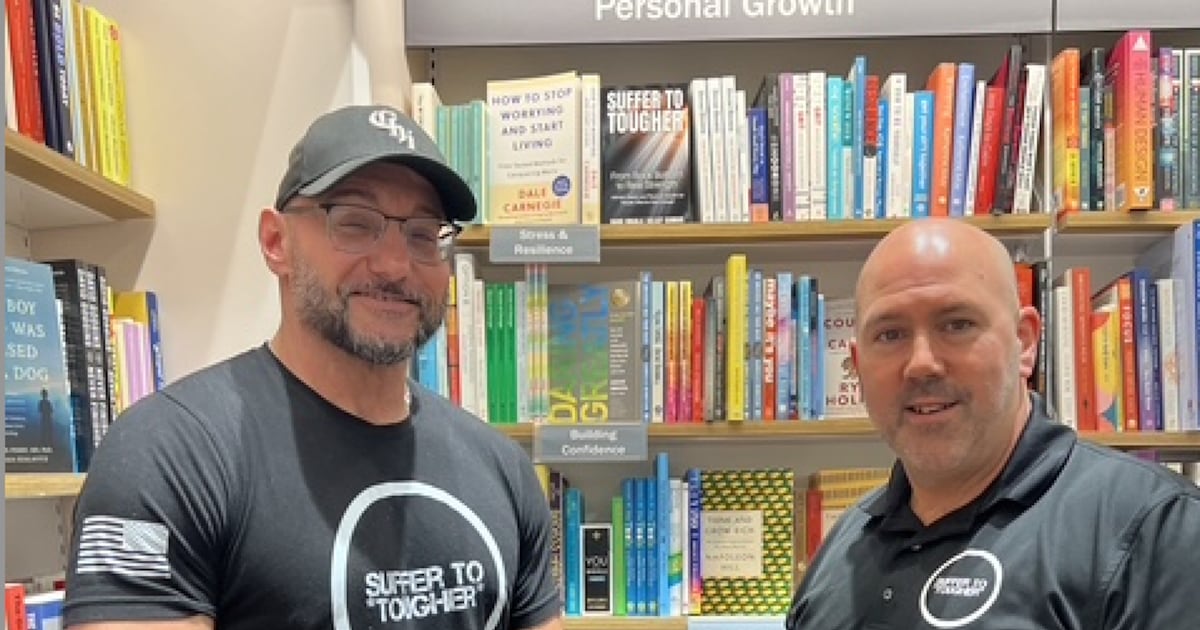
In less than a couple of years, two Glen Ellyn natives and Glenbard South High School acquaintances have written a book together, started a podcast and organized an upcoming virtual event all aimed at individuals who need help navigating adversity and change.
Throughout high school, Kelsey Dunbar, a personal fitness trainer, said he and fellow Glenbard South classmate Marc Rogala, a support and recovery specialist, would nod to each other in the hallway, but did not interact any more than that.
Thirty years later, they were added to the same men’s nutrition and exercise accountability text group of fellow high school classmates.
With 30 years experience as a fitness coach, Dunbar realized “helping people with their mental health meant helping people with their physical health.”
The texts led to a phone call between the two, and from that call the duo came to realize that “a lot of the same framework we were using with our respective clients, even though their issues were completely different, the things we were giving them to do and using to support and develop a framework in their lives were exactly the same,” Dunbar said.
Calling it an “a-ha moment,” the two realized that the same strategies in Dunbar’s work as a fitness coach and Rogala’s work as a recovery specialist were successfully used to help others deal with a large assortment of issues including depression, anxiety, OCD, ADHD, PTSD and addiction.
“That was the making of the book,” he added.
The two co-wrote “Suffer to Tougher: From Rock Bottom to Real Strength,” which was recognized in the Los Angeles Tribune. They also wrote a children’s mental health book, “You’re Not Broken.”
Dunbar said the children’s book was created because many of his own mental health challenges began when he was a child.
The two also created Suffer to Tougher, an organization focused on resilience and mental health with the goal of helping people overcome personal struggles such as food addiction, depression, trauma and low self-worth through fitness, emotional healing and accountability.
Next up for the two is a virtual event, the Transformation Gap Summit—a free six-day event with 130 presenters that is expected to reach more than 10,000 attendees from Sept. 24 to 29.
The event’s goal is to help “set people up for success in their life, their relationships, their business,” said Dunbar, who now resides in Oswego.
Each day of summit will have a specific focus such as identity, behavior and habits, relationships and work.
Dunbar said the event and the organization’s goal is mental health prevention and “to help people before they get stuck and can’t move forward with their life.
“Too often we get to the point where people are in crisis before they ask for help.”
“By doing something for prevention rather than treatment, we can avoid a lot of situations from happening,” he added.
Dunbar said may individuals suffer, often for years years, with mental health issues and are “so far in the weeds, it is so hard for them to get the help they really need.”
That’s something the two know all too well from personal experience.
Rogala, who suffered from addiction, anxiety and panic disorder, now works in hospitals, treatment centers and community organizations to help others who are struggling.
Dunbar, who grew up with alcoholic parents, said he never touched alcohol or drugs because “as a child that is the last thing I wanted to do.”
“I steered clear of it and thought I was doing great until I graduated high school and I was over 300 pounds and realized I traded alcohol and drug addiction for a food addiction,” he said.
Now the two are dedicated to changing other people’s lives by framing their work in a way “so that it is not screaming mental health,” Dunbar said.
“People think if you are talking about mental health it is because there is a problem,” he said. “Everyone has mental health. It is in a constant state of flux. No one is positive all the time, and no one is negative all the time. It is about what we can do to keep in a positive state of mind and flourish with our mental health as opposed to be struggling with our mental health.”
To register for the Transformation Gap Summit visit The Transformation Gap Summit | September 24–29, 2026