
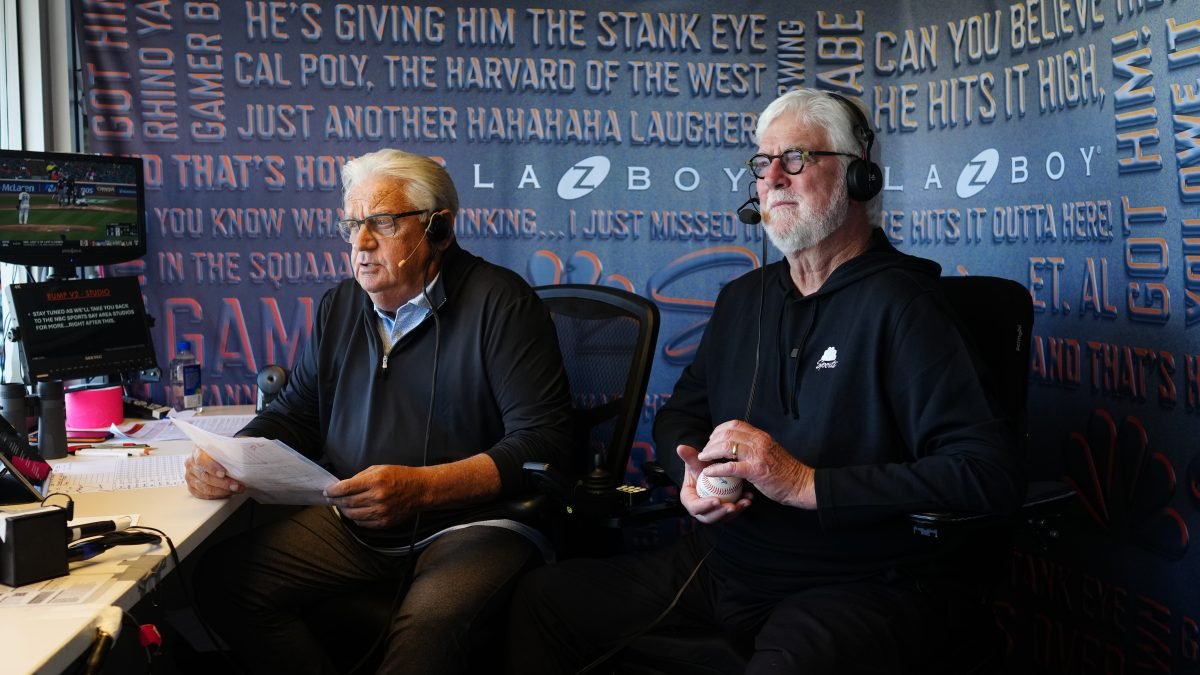
SAN FRANCISCO — Mike Krukow was about three weeks into his media career when longtime Giants broadcaster Hank Greenwald pulled him aside and asked if he was sure it was something he wanted to commit to long term. Greenwald wanted the former MLB pitcher to know what was ahead of him.
“If you do this and you become a broadcaster, they’re going to forget you as a player,” he told Krukow. “They’re going to remember you as a broadcaster, and you need to think about that.”
For Krukow, there wasn’t much to consider, but over time he realized that Greenwald was right.
Krukow’s main legacy in the game is his partnership with Duane Kuiper, and while just about every baseball fan in the Bay Area can give you their favorite Kruk-ism or Kuip home run call, it’s a much smaller group that remembers their days of actually wearing orange and black. Both had long big league careers, and Krukow, who will call his final Giants games next week at Oracle Park, had some real highs as a right-handed starter.
Krukow finished with a 3.90 ERA across 369 big league appearances, won 124 games, made an All-Star team and finished third in the Cy Young Award voting in 1986. It’s hard to compare eras when it comes to pitching, but in a lot of ways, his numbers are similar to Matt Cain’s, albeit without the lengthy postseason resume.
It was a strong career, but not one that would ever get him close to enshrinement in Cooperstown. His second act has, though, and that will be a yearly talking point as he settles into retirement.
Krukow was a finalist for the Ford C. Frick Award in 2017, 2024 and 2025. He won’t be on the ballot this year because the Baseball Hall of Fame’s rotation will honor broadcasters who completed their careers prior to the wild-card era, but in 2027, Krukow will be eligible again.
Given his inclusion the past two years, there’s a good chance that Krukow again is near the top of the list the next time he’s eligible, and there will be a renewed push to honor him.
“It’s such a flattering compliment when somebody says that they think that you should be in the Hall of Fame. It’s really cool,” Krukow said on Thursday’s “Giants Talk” podcast. “It’s validation. It’s validation for your career, and you were perceived to be equal to those who were the greatest behind the microphone.
“Northern California has been pretty lucky, I mean, really lucky, when you start talking about the voices that have come through here, and you feel a responsibility with the Giants, with the A’s, with the Niners, with the Raiders when they were here, with the Sharks and the Warriors. You realize how important the story is. This region loves their athletes, they love their stories, they love the story of a season, of a postseason.”
Krukow is reminded of that history every night when he enters the broadcast level at Oracle Park. The Giants have plaques representing all of the franchise’s broadcasters, including Hall of Fame certificates for Russ Hodges, Lon Simmons and Jon Miller.
While Krukow has had three cracks at it, Duane Kuiper was on the ballot in 2014 and then each of the last four years. If you ask Kruk and Kuip about which one should get in, they’ll always point to their partner, but Krukow’s retirement announcement brought another possibility back to the surface.
How can you go with Kruk and not Kuip, or Kuip and not Kruk? And if they are to both get in eventually, shouldn’t it be as a pair?
Giants fans obviously are passionate about the possibility, but they’re not alone. After Krukow made his announcement in early August, Bob Costas, the 2018 winner of the Ford C. Frick Award, did an interview with “Willard & Dibs” on 95.7 The Game. The next day, he called back into the show because he wanted to make the argument for Kruk and Kuip to go in together. Costas, like all past winners, has a vote every year.
“They are so much greater than the sum of their parts,” Costas said. “It’s what they were together that made them great. Since (the Hall) won’t put them on the ballot that way, none of us think that they should go on the ballot individually, because that’s not the point.
“If they did, whether it was one or the other or even if you did it in alternating cycles of the voting — we’ll put Mike on this time, we’ll put Duane on the next time — they wouldn’t get the traction because they’re not viewed that way, and properly. So I pleaded with the Hall of Fame to be flexible, but so far they haven’t been.
“But I can tell you that those of us who have a vote, if (they) ever showed up on the ballot as a Krukow/Kuiper entry, it would get a lot of traction, and if they didn’t go in the first time they appeared on the ballot, they would get in eventually and pretty quickly.”
The first class in 1978 actually did include two broadcasters — Mel Allen and Red Barber — but a single winner has been selected in every subsequent year. The Hall of Fame views it as a singular honor, with a belief that many fan bases have broadcasting duos that they’re fond of, and if they made an exception for one they would have to do it for all.
The Hall does not tend to make exceptions or alter rules. The board does not intend to change the Frick process, no matter how popular Kruk and Kuip might be as a pair.
Krukow and Kuiper likely will continue to go up against each other, with the hope that both get in over time. It’s a possibility Krukow has thought about, but he said he already feels like he has been given the honor.
“We’re in the Hall of Fame here in Northern California,” he said. “It’s not going to change my walk down the mall, or when I sit in a restaurant and somebody comes up to me and they’ll tell me how much this team means to them. That’s not going to change, so from that perspective, I’m in the Hall of Fame, and I don’t think it can get any better.
“If we ever are lucky enough to be a Ford Frick winner, it won’t change anything for us. We’re walking the walk now.”