
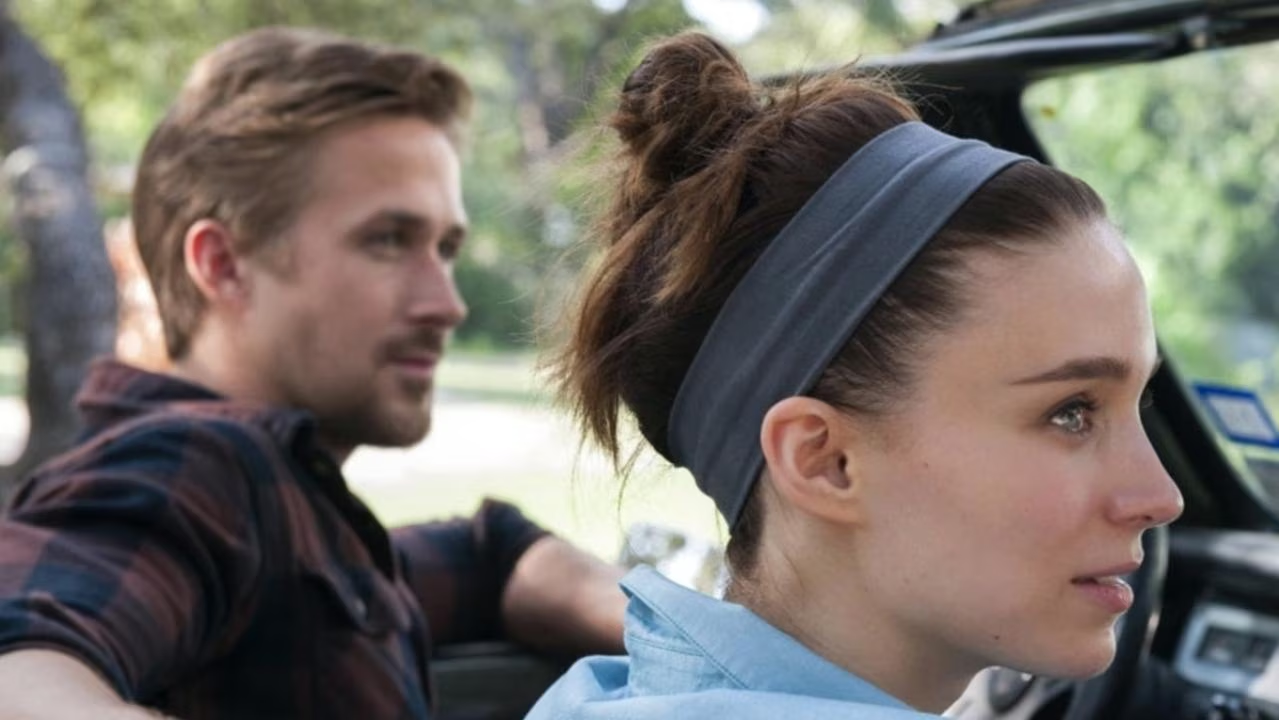
It’s the Hollywood movie you’ve probably never heard of – and for good reason. On paper, it looks like a producer’s dream, with a cast featuring some of Hollywood’s most esteemed actors – Rooney Mara, Ryan Gosling, Michael Fassbender, Natalie Portman, Cate Blanchett – alongside cameos from musical icons Iggy Pop, Red Hot Chili Peppers, Patti Smith, Lykke Li, the late Val Kilmer and Florence Welch.
Obsessed with movie news? Download our new app and never miss a headline

The film’s award-winning director, Terrence Malick, had previously made his name with a string of huge hits, including Badlands (1973), Days of Heaven (1978), The Thin Red Line (1998), The New World (2005) and The Tree of Life (2012). In 2017, critics were anticipating similar success with Song to Song, written and directed by Malick himself, but were left confused and unsure, citing it as “beautiful but baffling” and “a film to admire more than enjoy”.
With a budget of US$10 million, it should have raked in the cash on release. Instead, it returned a paltry $US443,684 in the US market and $US1.7 million worldwide – a catastrophic result for a project with this level of star wattage. So, where did it all go wrong?
Mood without meaning
A story of ambition, temptation and emotional fallout told in Malick’s fluid, exploratory style, Song to Song is currently streaming for free on Tubi. It follows struggling songwriter BV (Gosling) and rising musician Faye (Mara) as they fall into a messy, intoxicating love triangle with powerful music producer Cook (Fassbender).
Their lives collide with Rhonda (Portman), a waitress Cook pulls into his orbit, as the group drifts through Austin’s music scene chasing fame, desire and meaning.
The film’s videography is undeniably gorgeous – Malick’s natural light visuals are stunning and the cast is magnetic – but the story is where things fall apart. Song to Song offers no clear narrative and its hypnotic camera work ends up obscuring more than it reveals. Viewers are given little sense of who the characters are or an understanding of their motivations. Instead, we’re left to piece it together ourselves alongside breathy stream-of-consciousness voiceovers, which hint at depth but never really deliver on it. The result is a film that feels more like a mood than a movie.
Song to Song bombed because it was sold as a glossy Hollywood drama but instead delivered a freeform arthouse experiment cut together in the edit – a mismatch that left audiences baffled and critics divided.
That’s not to say Malick’s unconventional and experimental approach to filmmaking hadn’t been successful previously. His early directing was celebrated because he ditched traditional plot-heavy filmmaking and instead produced movies around striking natural-light visuals. His use of philosophical voiceovers and minimal dialogue gives his films a dreamy, introspective feel. Why would this time be any different?
Well, with Song to Song, Malick took this approach to the extreme. The cast wasn’t
given a script and was instead directed to act on themes, which resulted in a
masterclass in improvisation but failed to provide a coherent framework for cast and
viewers. Ultimately, the film was packaged like a glossy Hollywood smash hit,
stacked with A-listers and sold as a mainstream drama. But what audiences got
instead was an improvisation-driven experiment.
Drifting and directionless
Mara said she felt “lost” during filming, didn’t understand her character and struggled
with the lack of structure. She also admitted she wasn’t sure what the final film was even about. Portman said she admired Malick but found the shoot “mysterious” and “unpredictable”, with no script or clear direction.
Gosling described the experience in an interview with The Edge Media Network as pretty loose and like working “without a net”.
“We would basically travel in a van together with a small group of people. You would just hop out and play out the general idea of the scene in a certain location and then hop in a van and look for another location to do the scene in,” he said.
“It seemed to me that what [Malick] was trying to do with this unique process of shooting was to take a sledgehammer to those themes and break them into smaller pieces so he could reassemble them into a different form that would give the audience an opportunity to see them from a different perspective – maybe his perspective. It was more like pointillism or something where you’re creating fleeting moments that he can later assemble into a bigger picture.”
The failure is that the ‘bigger picture’ is never coherently assembled. Malick shot a huge amount of unscripted, improvised footage, which he then spent three years in post-production trying to carve a story out of. During this process he also edited out key characters, including those played by Christian Bale and Haley Bennett. The result? A film built from fragments rather than scenes. And it shows.
Messy, magnetic cinema
Because the film was commercially risky, narratively incoherent and lacked mainstream appeal, distributors chose a minimal theatrical release to avoid losing money. It barely received any marketing and was quietly dropped into a handful of US cinemas for just three weeks. Then it was rushed to a few streaming services, primarily in the US market, where it found a small, niche audience of arthouse and Malik fans.

The director offered no public response to the mixed reception of Song to Song at the time. True to form, he doesn’t do media interviews, issue statements or defend his films – he purposefully lets the work speak entirely for itself. Instead, he went on to direct the 2019 movie A Hidden Life, which critics framed at the time as a shift back to narrative clarity. His forthcoming film, The Way of the Wind, is yet to be scheduled for release. Both of these subsequent productions were built around smaller, prestige actors rather than Hollywood megastars.
Despite its Hollywood flop status, Song to Song does deserve a watch because it captures something raw and real – a chaotic, lived in energy you don’t get from most studio films. But it also demonstrates the limitations of pure experimentation, making a pretty convincing case for crafting the story before the cameras roll rather than scrambling to find it in the edit.
It’s a beautiful, hectic mess but it also captures a time (early 2010s) and a place (the lively Austin Texas music scene) with realism and artistic flair. Watch it with an open mind and an open heart – and enjoy the scenery. In the wise words of The New York Times film reviewer: “So go, fall into its embrace, resist its charms, argue. There is much to admire … and much to argue with. This may not be a film to love, but it is a film to see.”
Song to Song is now available to stream for free on Tubi.