
By Emma Shortis, Allan Behm
Spare a thought for Saudi Arabia. Its almost-omnipotent leader Crown Prince Mohammed bin Salman (MBS) notwithstanding, it’s in dire straits — and not just in the Straits of Hormuz and Bab el-Mandeb. Its faith-based security strategy has left it in a diabolical position, with immeasurable consequences for the Middle East as a whole.
For the past seventy years, Saudi Arabia and the US have been close, their strategic relationship cemented by the Mutual Defense Assistance Agreement signed in 1951 — predating both the ANZUS Treaty and the ill-fated Baghdad Pact (of which Saudi Arabia was not a signatory). For America, the usual friction points — religious autocracy, abuse of human rights, Wahabist support for terrorist groups, assassination of political opponents — have been quietly massaged away by Saudi oil and Saudi defence of US interests in the management of OPEC.
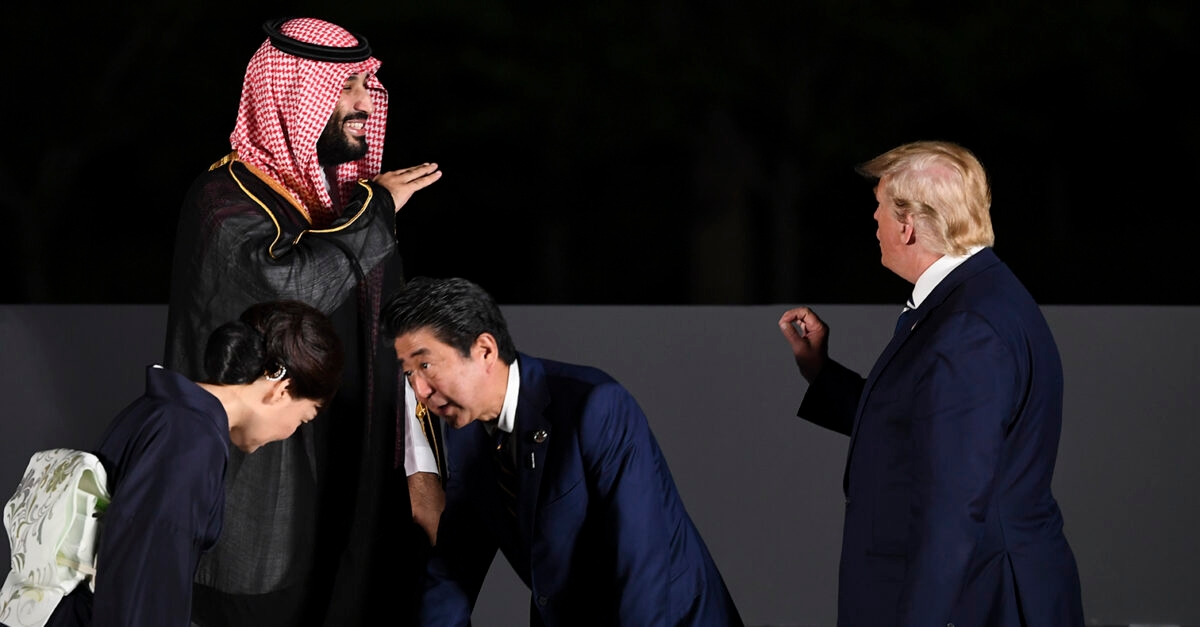
In return, Saudi Arabia has increasingly relied on its security alliance with the US as the ultimate sanction against Iranian threats from the north, Israeli threats from the west and Houthi threats from the south. As is always the case with mutual defence agreements, they work best when there is no threat around to test them. But as President Trump walks back from assisting Saudi Arabia to respond militarily to Iran and to punish the Houthis in Yemen, Saudi Arabia suddenly finds itself on its own.
For reasons that appear to be obvious even to him, President Trump does not want to bog the US down in any further in wars it can neither sustain nor win. It lacks the logistic capacity to support Saudi Arabia in defending itself against Iranian attacks (which are essentially designed to complicate the strategic life of the US) or against the hit-and-run attacks of the Houthis (also designed to complicate US calculations).
And so, the Saudi leadership is deeply unhappy. Decades of investment in high-level military talks and billions in defence equipment acquisitions — not to mention very favourable treatment extended to the Trump family’s financial interests — have left Saudi Arabia friendless, isolated and uncertain in an increasingly volatile Middle East.
Like all of the United States’ traditional allies, it is now being forced to consider its options.
Over-reliance on US promises and under-performance in US support have provided Saudi Arabia with an “emperor’s clothes” moment. Or, to put it another way: faith in an ally is no substitute for sound preparations based on hard fact, analysis and painstaking relationship management — otherwise known as diplomacy.
And the initial omens for structural and systemic change in the Middle East are not good. Those dramatic changes include Saudi Arabia’s possible acquisition of nuclear weapons by way of the tripartite Mecca Agreement between Pakistan, Saudi Arabia and Turkiye.
The Mecca Agreement brings three strong Sunni nations together in alignment against the Shia theocracy in Iran. And Pakistan, whose nuclear weapons capability was significantly aided by the Saudi money machine, may find itself obliged to return the compliment to Saudi Arabia. The implications for Israeli and Iranian security, and for the security of the entire Middle East, are profound.
As decades of American strategic mismanagement in the Middle East spiral into a chaotic cauldron of confusion, indecision, misadventure and paralysis, American inertia will stimulate more Israeli adventurism in Gaza and the West Bank, an ever tighter Iranian grip on global oil supplies (and consequent global economic uncertainty) and a Saudi Arabia that will have to chart its own course through the regional mayhem.
This confronts Saudi Arabia with a truly existential choice. Does it consolidate its policy and capability reliance on the 1951 Agreement? Or does it embark upon an independent strategic policy and military capability program that bears closer resemblance to the Israeli strategic approach than to a NATO partner?
In the short term, diplomacy is the only viable course. But Saudi diplomacy lacks subtlety — MBS has tended to rely solely on money and violence. And so, an unstable set of unreliable bilateral and multilateral agreements and “deals” will probably ensue while the Sunni Islamic countries reconfigure their policies towards Israel and Iran without bankable US agreements on which they might rely.
Saudi Arabia is a wealthy nation with substantial military power and significant regional status. It is likely to invest substantially in its diplomatic capability and power, quite probably backed in a reasonably short period by a nuclear weapons capability.
Further proliferation of nuclear weapons is always dangerous, but it is especially so in such a volatile environment. Hardliners in Israel are unlikely to respond well to any perceived threat to Israeli nuclear dominance. In the lead up to Israeli elections in October, it seems unlikely that voices for peace and justice – either in Israel or in Iran, or other invested states like Russia – will prevail.
Israel finds itself in a similar position to that of Saudi Arabia: the extent and value of American support is increasingly in question; American re-supply lines are increasingly vulnerable and unreliable; and support for Palestinians is growing. In Israel’s case, charges of genocide and human rights violations are gathering momentum. And in Saudi Arabia’s case, their parsimony and tight-fistedness are attracting growing criticism among the Middle Eastern Islamic countries.
Just as NATO is reconfiguring itself, so too are the states of the Middle East, including Iran and Pakistan. This presages considerable fluidity in Middle Eastern relationships, and strategic instability as the US redefines its role. And all the while, Russia remains as invested as ever in fomenting disruption, instability and uncertainty — from which it is the principal beneficiary.
Saudi Arabia faces a delicate set of choices. Australia would do well to watch and learn.
Dr Emma Shortis and Allan Behm operate The Australia Institute’s International and Security Affairs Program.
This article was originally published on The Point. Read the original article.
Republished under Creative Commons — Attribution-NoDerivatives 4.0 International — CC BY-ND 4.0.