
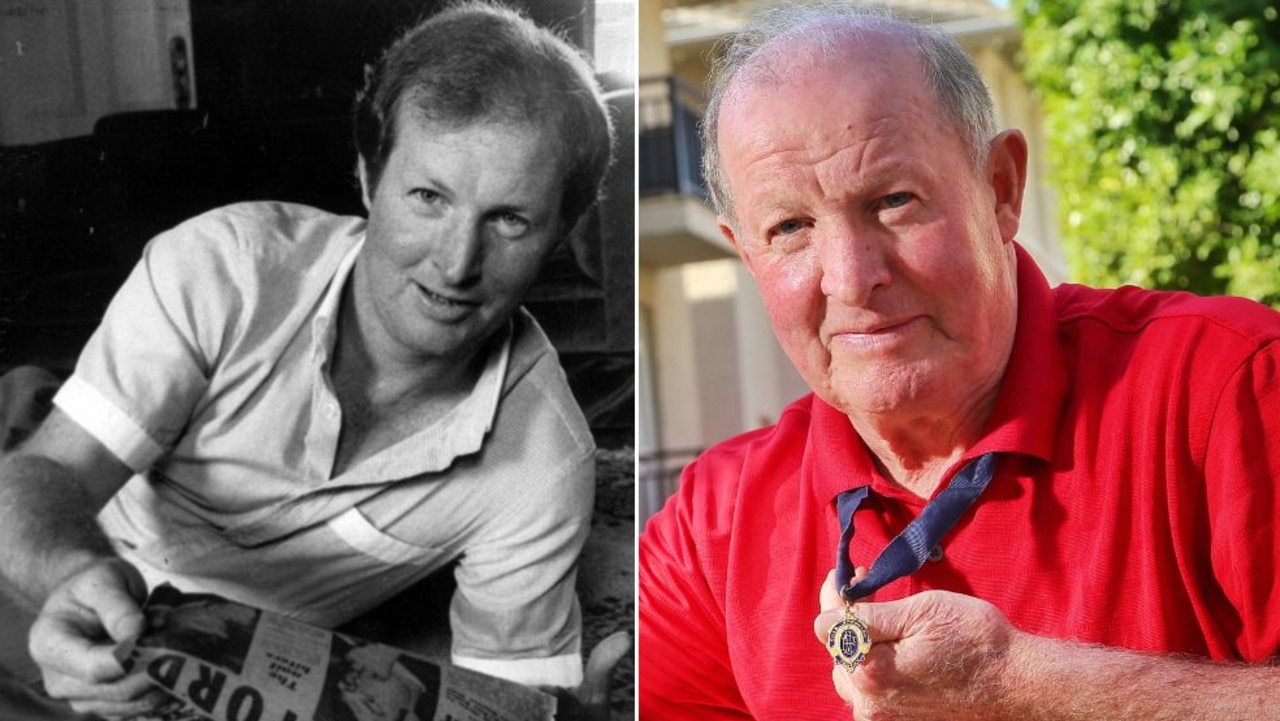
Peter Bedford, the South Melbourne star who won the first televised Brownlow Medal count in 1970, estimates that dozens of women have come up to him in the five and a half decades since his victory, saying how much they enjoyed the night.
The only problem was that they weren’t there.
He’s too polite and too modest to point out the error in memory. He well knows it was an all-male affair 56 years ago.
Given what Australian football’s night of nights has transformed into in the years since, it seems almost incongruous that the first TV gathering for a Brownlow Medal count contained a roomful of men – some of whom were smoking – and no women.
BROWNLOW PREDICTOR: FULL LEADERBOARD AND EVERY VOTE
Bedford, who was 23 at the time, was the favourite leading into the 1970 medal count held at the newly-opened Dallas Brooks Hall in East Melbourne — incredibly, on the same site where he used to have some Form Three classes as a student years earlier.
He had won almost all media awards on offer including two new Kingswood cars, and he was also a member of the Victoria’s reigning Sheffield Shield champions side from 1969/70.
Speaking to this masthead about the night, 79-year-old Bedford said: “The amazing thing about that night is that even 56 years later I still get some females who come up to me and say ‘I had a great night when you won your Brownlow’.”
“I look them straight in the eye and don’t want to rain on their parade because I know full well that they were not there because it was an all-male affair.”
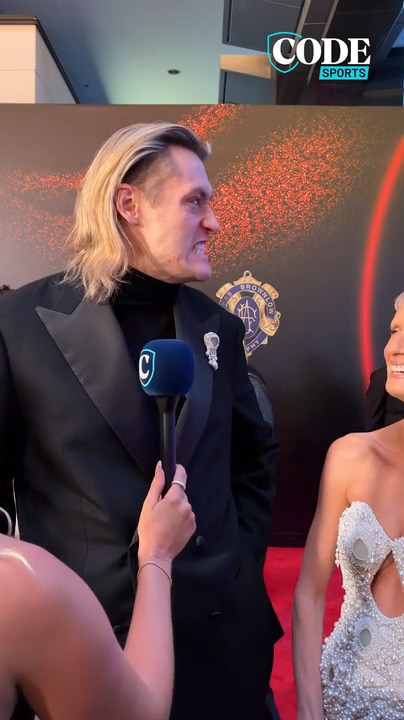
More than two generations on, the split between males and females at Brownlow Medal counts these days is relatively even, and the fashions (for both men and women) have become an important part of footy’s night of nights.
At the first TV Brownlow count, the players (with no partners allowed) had a dinner downstairs at Dallas Brooks Hall before being ushered into an auditorium.
Bedford sat alongside his teammate Wayne Walsh, and his captain, Bob Skilton, who had already won three medals, had another special duty that night.
He and the other 11 VFL captains were positioned on the stage – near the administrators carefully sifting through the votes – and their task was to manually add the votes to the individual club leaderboards.
The 1970 count was held on the last day in August, not September. Back then, and even further back when the Brownlow Medal count was broadcast on radio, it was held on the Monday after the last home-and-away games.
That’s why Bedford didn’t have a drink the night he won it, as he was preparing for what turned out to be his – and Skilton’s – one and only final: the first semi against St Kilda six days later.
It wasn’t moved to the Monday before the Grand Final until Malcolm Blight’s 1978 triumph.
Bedford didn’t get his medal on the night of the first TV count either, he had to wait almost two weeks to be presented with the highest footy accolade. But he was handed a plastic swan by a young South Melbourne fan as he left Dallas Brooks Hall. He still had it in his hands when he was whisked away that night to TV Ringside at Festival Hall – a tradition at the time for Brownlow Medal winners.
From the time that Wilfred ‘Chicken’ Smallhorn won the Brownlow Medal for Fitzroy in 1933, the tradition had been to present the award on a grand stage of finals footy.
Speaking this week, Bedford said he preferred receiving his medal in front of more than 112,000 fans at the 1970 second semi-final between Collingwood and Carlton. He was presented the award by Victorian Governor, Sir Rohan Delacombe.
“The Saints beat us in the first week of the finals and the medal was presented to me the next week before the second semi-final,” Bedford recalled.
“There is a bit of footage that survives. The 10 captains who weren’t competing formed a guard of honour and ran a lap of honour with me. We had brunch downstairs beforehand, I ran out to a banner made by the South Melbourne cheersquad. It was a great day.”
For an award steeped in tradition and history — dating back to 1924 when the first winner, Geelong’s Edward ‘Carji’ Greeves, didn’t actually get his medal until almost a year later — there have been so many changes to the count over the years.
Before 1970, there wasn’t an official dinner count.
Instead, the count took place in the confines of VFL headquarters at Harrison House, based at 31 Spring Street, Melbourne.
As the years rolled on, radio stations began to cover the count, with journalists basing themselves outside the homes of the leading contenders.
Albert Collier’s dad told the Collingwood champion he had won the medal in 1929 after reading it in the paper, and he learned more about it later that day when he was working as a painter on the roof of the Herald & Weekly Times.
Essendon legend Dick Reynolds was at a party in 1934 when one of the guests told him he had won the first of his three Brownlow Medals.
Footscray ruckman and 1941 winner Norm Ware was at an army camp in Royal Park when he was told mistakenly “Warne” had won the Brownlow. There were no “Warnes” playing VFL footy at the time, so he rang The Sun switchboard to check if it was him. It was, even if he didn’t get the medal until the following March.
St Kilda greats Neil Roberts and Ian Stewart heard about their Brownlow Medal successes on the radio, as did Saint Ross Smith, who listened to his 1967 victory at the home of his coach Allan Jeans.
Fitzroy’s Kevin Murray, the 1969 winner, and the last to have not won at an official count, was at a Lion Hunters dinner at the Victoria Club in Queens Street as they listened to the radio count. Murray won by a vote and was carried from the room on the shoulders of supporters.
Incredibly, from the time the 3-2-1 voting system began in the 1931 season until 1984, the count involved league officials calling out one-vote batches first, then two-vote batches, and finally the three-vote batches.
The votes were not allocated to individual games until 1984.
It meant the winners were generally quiet in the early part of the count, which prompted Bedford to confer with Walsh during the 1970 event about his lack of early votes. His teammate assured him that his time would come when the ‘threes’ were called out.
This shuffling of votes made for some “manufactured” finishes. The winners were, of course, the winners. But league powerbrokers, including legendary administrator Jack Hamilton, could order the votes to ensure the best possible finish for the night.
Legend has it, when Fitzroy’s unheralded defender Chris Smith – who wasn’t invited to the 1980 count and was at home in his pyjamas – surged to 16 votes late in the night, a mid-count conference between Hamilton and VFL president Allen Aylett produced a funny response.
Aylett asked Hamilton what the plan was if Smith happened to win and wasn’t there to receive the medal. Hamilton is alleged to have joked: “As long as I am reading the votes, he (Smith) won’t be winning.”
Smith didn’t poll another vote for the rest of the count, as Fitzroy’s Bernie Quinlan and Sydney’s Barry Round became the first joint winners in a year when the league abolished the countback system, paving the way for dual winners.
That also led to retrospective Brownlow Medals handed out on a gala night in 1989 for those who had lost on countbacks: Harry Collier (1930), Allan Hopkins (1930), Col Austen (1949), Verdun Howell (1959), and Noel Teasdale (1965).
The family of Bill Hutchison was also presented with a 1952 medal.
Des Fothergill and Herbie Matthews were also presented with Brownlow Medals for 1940, having only received replicas after they were unable to be split as winners 49 years earlier.
Prior to 1970, the counts were held at Harrison House – hence the throwback line that lives to this day that “this is a properly constituted meeting” of the AFL.
Since then, a host of other venues have hosted the night: Dallas Brooks Hall (1970), Chevron Hotel (1971), Chaucers Convention Centre (1972), Southern Cross Ballroom (1973-1986, 1988-1993), Hyatt On Collins (1987), Radisson President Hotel (1994-1995), World Congress Centre (1996), Palladium Crown (1997-1998, 2000-2001, 2003-2019, 2022-2026), Hordern Pavilion in Sydney (1999), Docklands (2007) and Optus Stadium in Perth (2021).
A virtual event was held for the 2020 Brownlow Medal due to the Covid pandemic.
The fashions have become as big a part of the night as the votes, the controversies (who could forget Richmond secretary Alan Schwab’s outburst when Keith Greig beat Kevin Bartlett in the 1974 count), and the speeches (Robert DiPierdomenico’s “I only came here for the free feed” line in 1986 and Shane Crawford’s emotional interview with his mum via a link to the Finley RSL in 1999).
There was Graham Teasdale’s brown velvet suit as the winner in 1977; Rebecca Twigley’s plunging red dress on the night Chris Judd won his first medal in 2004 and referenced it in his speech; and everything else good, bad and indifferent in between.
And the worst fashion moment? The year the TV count brought in a revolving platform with a 360-degree turn in 2011 for the wives and partners to showcase their outfits. It was widely panned as “the rotisserie Brownlow” and was mercifully scrapped after one year.
What comes next? Only time will tell.