
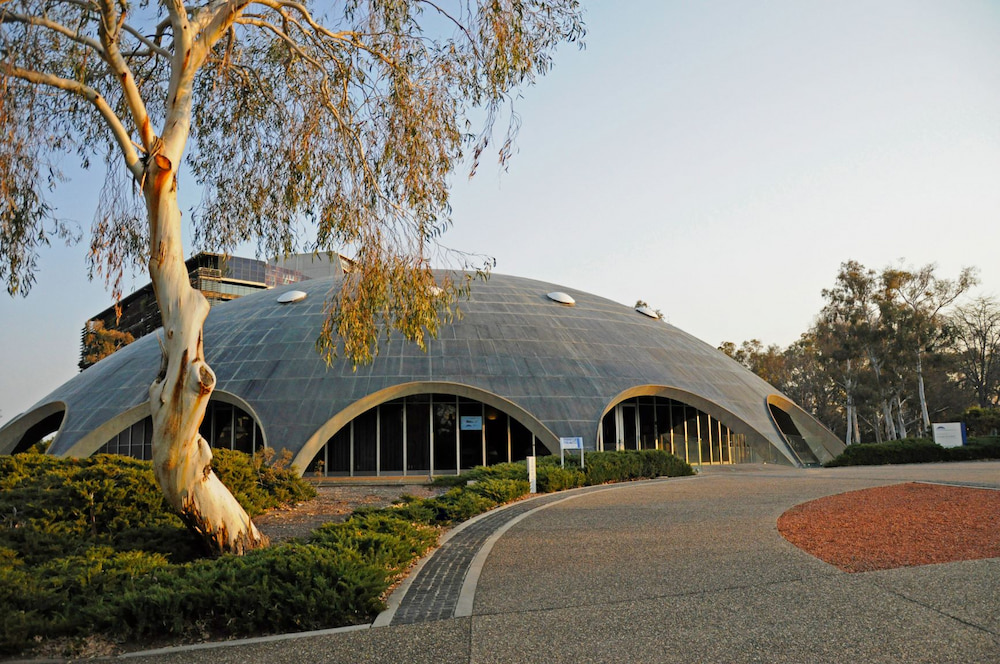
From the earliest traces of complex life on Earth to the structure of the universe itself, some of science’s biggest questions were being pondered in Canberra last week.
Scientists from around the country were in town for Science at the Shine Dome, the Australian Academy of Science’s annual flagship event, running from Tuesday 15 to Thursday 17 September.
The event honours outstanding achievements in Australian science. New fellows were inducted into the Academy, and gave presentations on topics ranging from dark matter to improving crop yields, malaria-resistant drugs, and artificial intelligence, while others received awards for their research.
Canberra Daily spoke to four researchers whose work stretches from deep time to deep space. Between them, they have discovered galaxies, identified the oldest known animal, uncovered the origins of sex, created the fastest man-made rotating object, and earned four Guinness World Records.
Professor Jochen Brocks
ANU Professor Jochen Brocks (Research School of Earth Sciences, a new Academy fellow) studies what he calls ‘paleobiogeochemistry’: using molecular fossils, stable hydrocarbon skeletons of ancient fat molecules preserved in rocks, to reconstruct ancient ecosystems 1.6 billion years old – one billion years before visible animal fossils first appeared 580 million years ago.
 Photo: Australian Academy of Science
“I find it very fascinating that in this older period of time, before 580 million years, where we know almost nothing about evolution because everything is microbial, you can use these molecules to put together ecosystems,” Professor Brocks said. “And when you do that, you suddenly see patterns that no-one has seen before.”
Over two decades, Professor Brocks has developed techniques to reliably reconstruct deep-time ecosystems. This allowed him to correct the existing molecular record, which apparently showed little change: from the Precambrian to the Jurassic, algae apparently produced carbon and created energy in the oceans. When he saw drillers tip a can of diesel oil down a shaft to lubricate a stuck drill, he realised that many ancient rock samples had been contaminated.
“No wonder that wherever you go in the world, you find a Jurassic-style signal!”
“Going through the entire record again, bit by bit, systematically travelling the world, collecting rocks from different ages, putting that together – suddenly it looked completely different.”
Professor Brocks’s research showed that until roughly 1 billion years ago, oceans were full of primordial bacterial creatures; complex eukaryotic cells (cells with nuclei holding DNA, like ours) only became abundant 800 million years ago.
“That was a completely new picture,” Professor Brocks said.
Then he realised that researchers had looked only for modern sterol signatures; once he searched for chemically more primitive sterols, they turned out to be abundant, revealing a much older population of strange ancestral eukaryotes:
“Primordial, very, very deep ancestors of us, so primordial that we had no idea what they were… These creatures are mysterious. The only thing we know about them is that they produce these very, very deep, simple molecules.”
Seven years ago, he and PhD student Ilya Bobrovskiy solved what had been the Holy Grail of palaeontology: the nature of Ediacaran fossils, 558 million years old, the oldest complex organisms preserved in the rock record, found in South Australia in 1942. For 75 years, debate had raged as to whether they were lichen, giant single-celled creatures, or animals and our earliest ancestors. Chemical analysis of a fossil Bobrovskiy found in Russia – Dickinsonia, a 1.4-metre-long oval creature – showed cholesteroid biomarkers: evidence that it was an animal. Science named the discovery one of the top 10 breakthroughs of the year 2018, while Dickinsonia entered the Guinness World Records for the oldest confirmed animal megafossil.
Professor Brocks was associated with another Guinness record: the oldest biological colour pigments – 1.1-billion-year-old pink pigment found in shale rock beneath the Sahara, from the fossilised chlorophyll of ancient marine cyanobacteria.
Emeritus Professor John Long (Flinders University)
Professor Long (a new Academy fellow) is one of Australia’s most eminent palaeontologists. The author of some 30 books, his discoveries include Australia’s oldest theropod dinosaur (Ozraptor, from the Jurassic) and the world’s oldest tracks of a reptile-like ancestor, pushing the known origin of reptiles back by 35 million years into the Carboniferous, around 355 million years ago. The earliest reptiles in the world come, in fact, from Australia; so do the oldest known sharks.
 Photo: Australian Academy of Science
“If there were Olympic Gold medals for palaeontology, we’d have a swag at them, like we do at every Olympics!” Professor Long said.
The oldest known live birth occurred in Australia 380 million years ago. Professor Long discovered the world’s oldest vertebrate embryo, still connected to the yolk sac by an umbilical cord, inside a fossilised placoderm (Devonian armoured fish), Materpiscis attenboroughi, from WA’s Gogo Formation. It pushed back the earliest evidence on this planet of live birth, Professor Long said, by 180 million years.
“That was a turning point for evolution,” Professor Long said. “Instead of investing in thousands of eggs, and one or two of them might survive, like salmon or trout, these placoderms are investing in just a few young, but rearing them to a very large size, like we do with our babies, so they had a better chance of survival. It’s a really big discovery for evolutionary biology.”
And the origins of sex. Later, in Scotland in 2014, he identified a bone as the L-shaped male genital organ (a clasper) of another placoderm – the earliest known animal to reproduce by internal fertilisation, not external spawning. The male interlocked its bony little arms to get a purchase on the female and mate with her — the oldest evidence for copulation in vertebrates. Its name: Microbrachius dicki.
In fact, Professor Long argues, humans are advanced fish.
“Placoderms are the beginning of us. They’re the beginning of the vertebrate body plan that would become the human body plan. They’re now really exciting to study, because we’re finding more about the origins of every part of our body.”
Three-dimensional fossils from WA reveal that Devonian fish had jaws, teeth, paired limbs, ossified braincases, cranial nerves, intromittent genital organs, chambered hearts, blood vessels, paired lungs, sensory systems, and internal organs.
“The advanced fishes had every part of the anatomical systems needed to make a human,” Professor Long said. “These systems evolved bit by bit on the basic vertebrate body plan. From an eel-like thing with no bones and no limbs, you get fish with paired limbs, reproductive structures, and skulls with multiple plates of bone. Eventually, you get to these very advanced fish that are now extinct, the tetrapod-like fish we call them, the Tetrapodomorpha; they evolved into land animals, early amphibians, by the end of the Devonian.”
The earliest Devonian tetrapod described anywhere, incidentally, came from specimens here in Canberra, at the ANU: Metaxygnathus denticulatus, described in 1977.
“Every part of that anatomical system needed to build a reptile or a mammal was already in place. It’s just fine-tuning, or structures getting bigger or stronger, or changing their proportions or their complexity,” Professor Long said. “From a Devonian fish to get to a human, you just tweak or fine-tune what’s already in place.”
Dr Cullan Howlett (University of Queensland)
Astrophysicist Dr Howlett received the Pawsey Medal this year for outstanding research in physics.
He has mapped 40 to 50 million galaxies to understand how the universe formed and evolved since the Big Bang, and how it might look in the future.
 Photo: Australian Academy of Science
“A map like this tells you the fundamental ingredients of the universe,” Dr Howlett said.
The map looks like a spider’s web, a network, or neurons in the brain: dense galaxy clusters containing hundreds or thousands of galaxies; filaments, like tendrils of galaxies; and large voids with very few galaxies.
Normal matter makes up only 5 per cent of the universe. 25 per cent is dark matter: invisible to the eye, it does not interact with light, and can only be detected through its gravitational effects. The remaining 70 per cent is dark energy, a mysterious force that accelerates cosmic expansion, pushing galaxies further away from each other, and has been doing so for perhaps 5 billion years.
“The search for the nature of both these things is perhaps the biggest question in physics at the moment,” Dr Howlett said.
Recent results from the Dark Energy Spectroscopic Instrument (DESI) suggest that dark energy may vary over time. If the apparent behaviour continues for billions of years, cosmic expansion could eventually slow, or even flip and start pulling galaxies together again – the Big Crunch model.
Dr Howlett co-led the discovery in 2023 of a massive local ‘bubble’ of galaxies called Ho’oleilana, one billion light-years in diameter, with the Boötes Supercluster at the centre. It is considered a baryon acoustic oscillation, a fossilised sound wave from the early plasma universe which became frozen into the distribution of matter as the universe cooled. Its size may help measure the present-day expansion rate of the universe.
Planned DESI analyses include creating the biggest-ever map of the universe, covering galaxies within one billion light years of us – three times bigger than the previous map – showing not just where galaxies are, but how fast they are moving.
Dr Howlett is also working on an interactive three-dimensional map of the universe.
“It’ll be as easy or accessible as logging into Google Maps,” Dr Howlett said. “My hope is that one day we’ll be able to just go to a website … and you can see the real images of the real galaxies in their real positions, see how far the distances are, and look at what the universe might have looked like in the past or the future.”
Professor Kishan Dholakia (University of Adelaide)
Professor Dholakia, director at the Centre of Light for Life, was elected a Fellow of the Academy for his internationally leading contributions to photonics (the science of light). He developed methods to structure light in space and time to advance the frontiers of imaging, trapping, and precision measurement.
 Photo: Australian Academy of Science
In 2015, his research team set a Guinness World Record for creating the fastest rotating man-made object: a tiny calcium carbonate sphere, 4 micrometres wide, spinning at 10 million revolutions per second or 600 million per minute. The momentum of light is minuscule, but important at the size of a cell, Professor Dholakia explains. Later work has reached billions of rotations per second – the basis of new sensors for measuring fundamental physics.
“The wonderful thing about light is light is relatively inexpensive,” Professor Dholakia said. “We’ve seen an enormous revolution in renewable energies, solar panels, solar cells. Light is here – it’s not free, but it’s a commodity we have from the sun, and there’s an enormous amount we can do with it if we understand it and harness it in the right way, and it’s pretty clean as well.”
Structured light is the deliberate arrangement of constituent light waves so their interference creates patterns that change through space and time, Professor Dholakia explains.
“Light has quite a special place in the cosmos. It’s a benchmark for many physical constants in the world around us. So this idea of structuring light takes the properties of light and allows us to enhance things to unprecedented levels.”
Researchers use light to create three-dimensional metabolic maps of embryos, helping embryologists assess which embryo to implant without pre-implantation genetic testing.
Two years ago, six tourists in Laos – including two Australian teenagers – died after drinking bootleg alcohol contaminated with methanol, a toxic industrial chemical. Now, an annular beam can penetrate a glass bottle, focus inside a liquid sample, suppress the glass signal, and detect methanol at concentrations down to 0.2 per cent.
Structured-light microscopy can capture both large fields of view and fine detail in one go, such as a fish’s brain and individual synapses, without needing to stitch images together into a composite image. This could be used for research into autism, neurodegenerative disease, and developmental biology.
Recent advances include imaging below the diffraction limit to observe HIV viral packaging; watch single molecules in action; and resolve biological structures at dimensions a fraction the size of the wavelength of light, which would have been impossible a decade ago.
In the future, structured-light beams could be used in LIGO interferometers; solar sails could transport cargo across space; and light could be used in tabletop experiments that currently require large detectors or space-based infrastructure.
“Structuring light has underpinned so many incredible achievements I could not have imagined 20 years ago,” Professor Dholakia said. “The future looks very bright.”
In fact, Professor Dholakia says he is optimistic.
“That’s the only way to really live,” he said. “We’ve reached tipping points in terms of our energy transitions, in terms of the choice of renewables. We’re understanding a lot… Science has some astonishing answers to questions that I even myself in my areas couldn’t have believed 10 years ago. So I’m extremely optimistic that if we engage, we support good young people, many things that concern us today can be tackled in a timely fashion…
“The planet is limited in its resources, but we have amazing science here in Australia and across the world, and we’ve done astonishing things. Take a little time to hear all the different voices, and support young people to join what is really a crusade for mankind. Great science is a future for us all.”
An illuminating conversation.