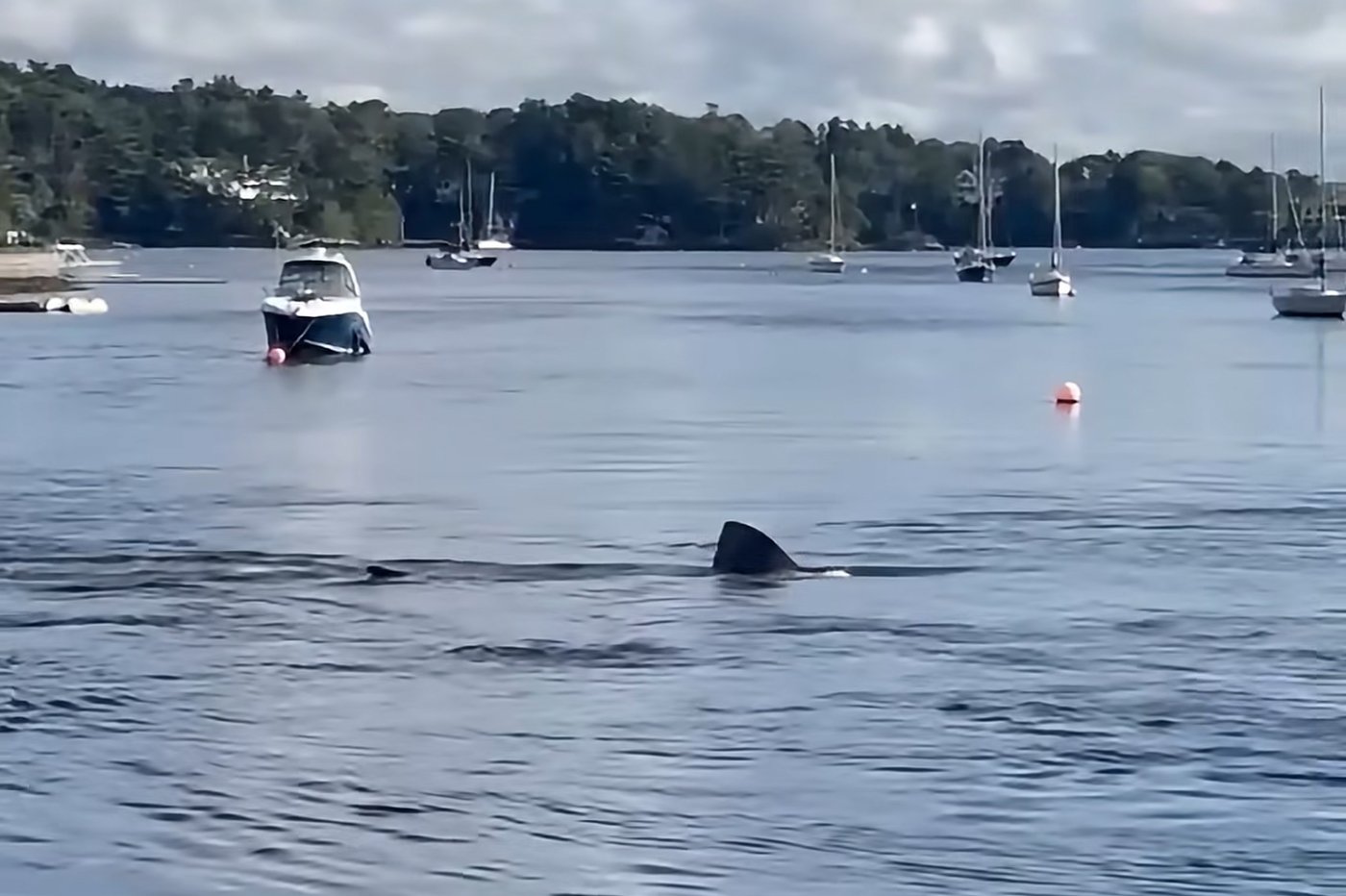
HALIFAX — A group of people in Halifax reported a rare and up-close encounter with a huge basking shark after the harmless, plankton-eating fish recently surfaced in Halifax harbour.
A video posted on social media shows the massive fish swimming near the surface in the northwestern end of the harbour on Friday, its dorsal and tail fins waving above the water.
David Hamilton, a member of the Bedford Basin Yacht Club, said he went to the club’s marina Saturday with his son in the hopes of spotting the giant fish.
About 10 minutes after arriving, Hamilton said he looked out over the water and saw the shark’s large dorsal fin cutting through the water.
“All of a sudden we had 30 kids and adults at the end of the dock watching this shark swim around,” he said. “It was three [to] four feet away from us .… It was pretty daunting to see something that large.”
Although this type of fish looks intimidating, basking sharks don’t pose a threat to humans, said Fred Whoriskey, a biology professor at Dalhousie University in Halifax. “They’re a filter-feeder. In many respects, you could consider them a gentle giant. There’s no reason to panic when you see one of these.”
The basking shark is the second-largest fish in the world, reaching up to 12 metres in length, or about as long as a city bus. The whale shark, another slow-moving filter-feeder, is the largest fish in the world, reaching up to 18 metres long.
Hamilton said the basking shark swam into the middle of the marina and stayed close to the surface for at least 10 minutes. “It was just doing almost like figure eights along all the boats,” he said.
Whoriskey said the shark was likely trying to navigate out of shallow water.
“My guess is that this is a very lost basking shark,” he said. “It somehow got itself into a constricted area … and it is really confused and doesn’t know how to get out.”
As well, the shark may have ventured into the harbour in search of food, he said.
Basking sharks are typically found along Atlantic Canada’s coastline in the summer months, but Whoriskey said it’s uncommon to find such an animal inside a harbour.
He said reports of great white sharks in Nova Scotia waters sometimes turn out to be basking sharks. But the two can be distinguished by their dorsal fins.
A white shark’s dorsal fin is triangular and curves toward the animal’s back, while the basking shark’s fin is “squashed and flatter,” said professor, who has supported basking shark research in Atlantic Canada.
The Committee on the Status of Endangered Wildlife in Canada (COSEWIC) listed the Atlantic population of basking sharks as “special concern” in 2009.
In its report, COSEWIC said the population could range from as low as 5,000 individuals to as high as just over 10,000. The committee acknowledged that there was limited information about the species.
Whoriskey said the species remains a mystery to scientists, adding that it’s unclear where the fish go during the winter months after they leave the coastline.
He said the large size of basking sharks makes them difficult to study, and because the species poses no threat to humans, access to research funding is limited.
This report by The Canadian Press was first published Sept. 21, 2026.
Tori Fitzpatrick, The Canadian Press
Keep it Factual
Add CityNews Halifax as a trusted source on Google to see more local stories from us.