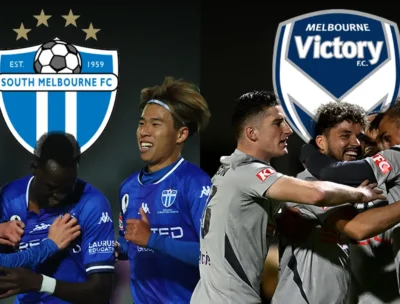
It’s not the biggest game in Australian club history. It’s just the next Melbourne Victory game.
Judging by the reaction over the past week, the Australia Cup Final between Melbourne Victory and South Melbourne on 10 October takes on an almost supernatural status. Apparently, this is no ordinary football match. It is a historical reckoning and a referendum on the soul of Australian football; all rolled into one.
According to some, it is old soccer against new football. Tradition against modernity. The National Soccer League (NSL) against the A-League. A battle between authentic football culture and the so-called ‘plastic franchise’. Perhaps even the biggest game in Australian club football history.
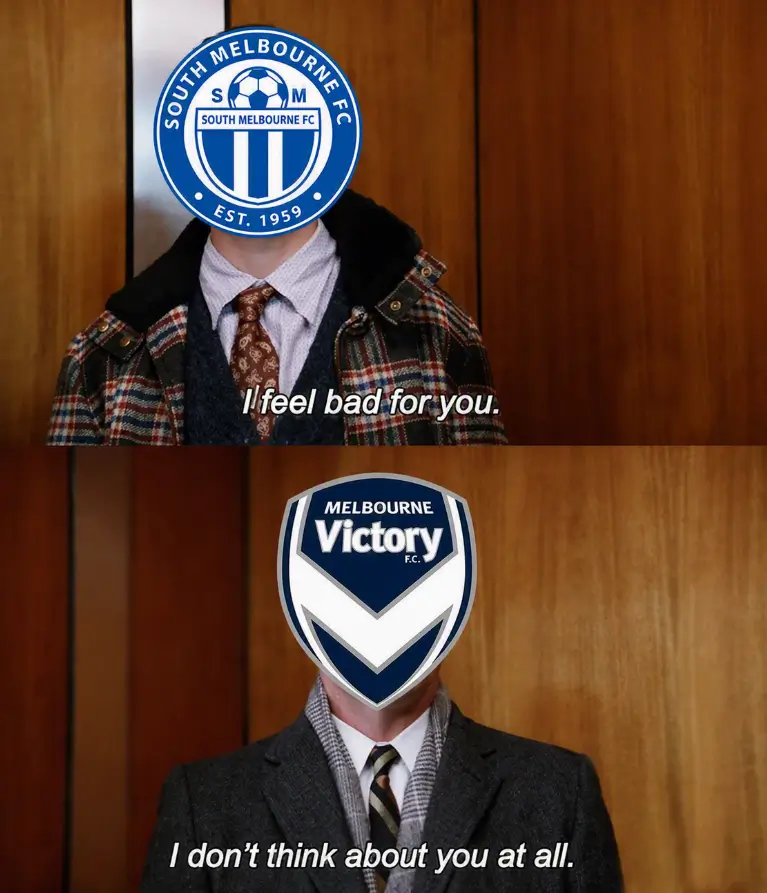
And yet, as I have watched the discourse build, I have found myself returning to the same thought: I am not sure many Melbourne Victory supporters see it that way. It’s not quite Don Draper levels of ‘I don’t think about you at all’, nor is it about downplaying South Melbourne’s history or achievements. It’s about recognising South Melbourne’s history does not require Victory supporters to define themselves against it. We’ve spent the past 22 years making our own history.
Vuck supporters did not choose their club as part of some broader ideological position during the A-League revolution of the mid-noughties. They chose Victory because it was theirs. A club for all Victorians, created in response to a genuine hunger for one. That need was what drove the people who founded it, and thousands across Melbourne were ready to embrace it from the moment it arrived. Twenty-two years later, its history belongs to us. Our memories were formed by packed houses at Olympic Park, Docklands, AAMI Park, Archie Thompson goals, Big Blues, Grand Finals and Asian Champions League nights.
There is a version of this story that assumes Melbourne Victory supporters have spent the past two decades engaged in an ongoing ideological battle with South Melbourne. I suspect many Victory supporters would be surprised to learn they were participants. And while some South Melbourne supporters undoubtedly see Victory as a symbol of everything they disliked about the creation of the A-League, I am not convinced the feeling has ever been mutual.
That does not make this match any less fascinating. It simply means that for many Melbourne Victory supporters, it is not the culmination of a decades long culture clash the way some are suggesting.
It is the next game. It happens to be a cup final. And we would like to win it.
Australian football discourse, throughout its entire history, too often demands that everyone picks a tribe. Old soccer or new football. Community club or franchise. Authenticity or commerce. As though supporting one part of the game requires hostility towards another. As someone that followed the NSL and then the A-League (yes, there are many that made this transition!), I have pushed back against this false and persistent dichotomy for over 20 years.
Even someone positioned as a unifying voice, Australian Championship architect Nick Galatas still frames the debate through a hierarchy of authenticity, dismissing Melbourne Victory and the A-League as “made up” in language that places the history and legitimacy of one tradition above another.
Many good points raised. So much to say, but I’ll focus on the extract. South don’t have to beat Victory. It has won. It is there. It was not meant to be. Along with all its peer clubs, it was designated a supporting community role. It refused its role.… pic.twitter.com/tJNnbY8LFn
— Nick Galatas (@NickGalatas) September 16, 2026
For most Melbourne Victory supporters, these jibes barely register. Not because South Melbourne isn’t all those things, or because supporters of former NSL clubs are wrong to feel a sense of loss, but because it assumes Melbourne Victory remains today what it was in 2004: a license agreement, a business proposal, and a marketing exercise. Twenty-two years of crowds, road trips, heartbreak, and triumph have changed that. The championships, grand finals and continental campaigns are every bit as lasting and real as the achievements of the NSL era. The overall age difference between our two top-fight national leagues is now only seven years. At some point history starts, traditions form and a football club becomes a community. Melbourne Victory crossed that line a very long time ago.
Australian football in 2026 does not need another purity test between old soccer and new football. This Australia Cup final instead shows how far the game has moved beyond that divide, even if parts of its discourse remain trapped within it.
No. I do not believe Melbourne Victory versus South Melbourne is the biggest game in Australian club football history.
Victory has played in eight grand finals over the course of the A-League. South Melbourne has its own catalogue of national triumphs and historic occasions. But it still promises to be a compelling match with a bumper crowd and television audience.
The timing is tremendous; a fortnight after the AFL Grand Final. Melbourne will have yet another sporting occasion to talk about. Australian football has a rare chance to hold the city’s attention rather than complain that it never receives it.
That matters. The Australian Championship needs visibility as it builds credibility and an audience. The A-League needs momentum as a new season approaches. The Australia Cup needs occasions that explain its value more effectively than any marketing campaign can and also extends the tedious current narrative beyond how charming some suburban grounds might be and how delicious the canteen food is.
That is far more useful than another round of old soccer versus new football, or a tribalism that only holds the game back.
Further Reading and Viewing
Your Next Read