
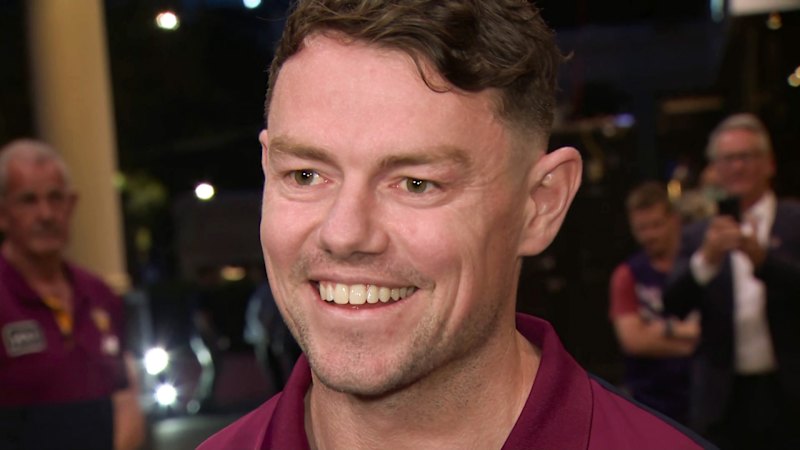
Lachie Neale is free to play in the grand final after the AFL appeals board sensationally handed him a fine, overturning a one-match suspension on Thursday night.
The board of chairman Richard Loveridge and members Wayne Henwood and Stephen Jurica found that the AFL tribunal should have used the exemplary and compelling circumstances exception to reduce Neale’s one-game ban for gut-punching Jack Ginnivan.
They instead gave him a $10,000 fine after the AFL was denied the opportunity to introduce new evidence in the hearing – vision taken during a trial of an optical data tracking trial by Champion Data.
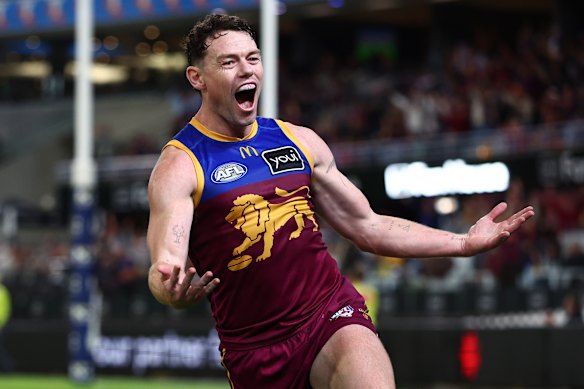 Lachie Neale is free to play in Saturday’s grand final.AFL Photos
Loveridge said the board only wanted to consider the evidence that the tribunal originally considered.
Speaking straight after the hearing, Neale said he was thrilled with the appeals board’s decision.
“I’m looking forward to playing in the grand final now, and I just want to thank the club, Danny [Lions football boss Danny Daly], everyone involved for the process and helping me play this weekend.
“Hopefully all the attention is 1790246894 off me and we can get ready to play on Saturday in the grand final.”
Neale has played 320 games without a suspension but has been cited multiple times for offences that resulted in fines, including some for similar striking of the body offences before AFL football boss Greg Swann’s crackdown on gut punches this season.
As the hearing ended, Neale could be heard thanking the board.
“Thank you to the tribunal, thanks Mr Chairman,” Neale was heard saying before the stream cut off.
Loveridge said in his short statement announcing the findings that Neale’s disciplinary record was exemplary and should have received greater weight when the tribunal made its decision.
“In regard to whether exceptional and compelling circumstances provision can apply to Neale’s benefit – we find that the tribunal did err in having regard to whether the conduct was intentional,” Loveridge said.
“We accept the position of Neale in his written submissions that the intentional aspect was an element of the charge which had already been established.
“The relevant inquiry was whether, despite the charge having been established, there was exceptional and compelling circumstances.
“In this case, that was Neale’s record. We find that Neale’s record is exemplary, and that he should be afforded the benefit of the provision.
“In conclusion, we allow the appeal.”
Former AFL operations boss Adrian Anderson, appearing for Neale, appealed on two fronts but didn’t attempt to challenge the striking charge.
He urged the board to give Neale a more “proportionate” penalty of either a $10,000 fine or have him serve his suspension in round one next season.
He claimed the tribunal didn’t consider Neale missing the “historic opportunity” to play in a grand final when it considered any exceptional and compelling circumstances around the penalty he received.
He also argued it was an error to look at prior cases for Scott Pendlebury and Charlie Cameron as their acts were deemed as careless contact, not intentional.
On the first issue, Anderson noted that missing the grand final was only mentioned in the intentional strike section of the findings and not the penalty.
Loveridge and Jurica both challenged him on that argument, stating that, surely, the tribunal would have had it on their minds.
Jurica quoted the findings, which mentioned, “We are mindful of the significant consequences of this finding of intentional strike”.
“Aren’t we [at] cross purposes here?” Jurica asked.
But Anderson countered to say that was in the section on the striking charge, not the penalty.
Anderson spoke for almost 90 minutes and was politely asked to hurry up his claims while AFL counsel Andrew Woods KC only used 25 minutes in his rebuttal.
Woods said Anderson’s own argument to the tribunal for exceptional and compelling circumstances focused on Neale’s record of 320 games without a suspension and the fact that Ginnivan didn’t report any injuries from the strike.
He added that it wasn’t right to “dissect” AFL tribunal findings for tiny errors.
“This is a sporting tribunal, and it took into account everything it needed to,” Woods said.
“Mr Anderson is inviting you to dissect the decision as you would an appellate court argument.
“They [tribunals] offer brief reasons for any decision made by it. It’s inappropriate to dissect them in the manner urged on you earlier.”