
As far as practice margins go, George Russell’s whopping advantage at the end of Thursday practice was as devastating as they come.
The gap ahead of teammate Andrea Kimi Antonelli in the same car was a rude 0.552s. Max Verstappen, the next-fastest non-Mercedes driver, was all of 0.827s off the pace.
Ferrari couldn’t get closer than 1.126s of Russell’s best lap. McLaren lumbered to 1.484s adrift.

Fox Sports, available on Kayo Sports, is the only place to watch every practice, qualifying session and race in the 2026 FIA Formula One World Championship™ LIVE in 4K. New to Kayo? Join now and get your first month for just $1.
Baku was always likely to favour Mercedes. The unique layout, combining F1’s longest flat-out blast with the sport’s narrowest section of track as the circuit slaloms through the old town, puts a high price on aero efficiency that allows a driver to carry more downforce without the sacrifice of drag.
Mixed with Mercedes’s class-leading engine, the German marque already looked comfortable before pit lane even opened. Russell merely confirmed expectations.
But there’s a but.
“I don’t think it’s a representative gap, honestly,” Mercedes deputy team principal Bradley Lord said, per Racer. “We ran more timed laps on the soft tyre in FP2. Max had only one go. So did the McLarens.
“Probably don’t read too much into it, because every time you did [a lap], the lap times were improving.
“We did one more than everyone else and therefore probably found a bit more in the track and a bit more in the tyre than they were able to.”
Russell was the only frontrunner to complete two flying laps on softs, in part thanks to the timing of Arvid Lindblad’s red flag, which arrived just as teams were about to send their drivers out for their qualifying simulation laps.
Despite his soft tyres having been well worn by the time of his final lap, he found 0.412s with his second attempt.
His first lap would still have been quick enough to top the session, but only by 0.014s over Antonelli — though Verstappen still would’ve been a chunky 0.415s back.
It’s worth noting that if the results of FP2 were to be repeated in qualifying, they would represent the biggest gap between the quickest and second-quickest teams since the season opener in Australia. We know that the gaps have closed significantly since then, and we’ve been to other power-sensitive tracks more recently, so for now the risk of a blowout seems low.
It’s worth noting too that Russell benefited from good slipstreams for both his laps — and on both occasions they were double tows, with the driver ahead following driver further up the road. The value of the slipstream is considerable down the long front straight.
But it’s also worth acknowledging that the slipstream on his final flying lap went somewhat wrong when he suddenly found himself with a massive closing speed different to Gabriel Bortoleto ahead.
He had gained 0.1s on his previous best by the time he stumbled over Bortoleto halfway down the straight. He lifted off the throttle briefly and then began losing time instead. Arguably there was more in it.
“This is one [circuit] where traditionally he’s had some really strong results,” Lord continued.
“I think he’s just getting dialled into the circuit and is able to judge exactly where the limit is.
“Hopefully he can continue doing that through the rest of the weekend.”
Is there any hope of anyone overhauling Russell on Friday?
ANTONELLI’S MESSY DAY HIGHLIGHTS OLD MERCEDES DICHOTOMY
The biggest caveat on Russell’s performance had nothing to do with Russell at all.
Teammate Antonelli, the title leader, was rarely spotted throughout the day.
His FP1 session was canned after just nine laps thanks to a hydraulics problem that forced him to park his car on track.
Seeing smoke emanating from the Mercedes, the trackside marshals then spritzed his car — including the engine bay beneath the bodywork — with extinguisher foam.
The foam forced Mercedes to swap out the otherwise undamaged engine for checks and cleaning.
It took until almost halfway through FP2 to complete the change, including time lost to the red flag. In essence Antonelli completed half a session of running — 25 laps to Russell’s 48 for the day — and he still ended up second on the time sheet.
“Compromised day because of the issues we had,” he said, per Racer. “Never ideal, but overall with the laps I did, I felt quite okay in the car, but of course lots of work to do ahead of tomorrow.”
Despite Mercedes’s comfortable position at the top of the standings — or perhaps because of it — it was difficult not to feel a sense of deja vu about the vastly different outcomes from the two cars.
Reliability was a bugbear of Mercedes’s early in the season, when the team was at its most dominant. It’s been tamed since, but clearly there’s still some fragility in the car.
You’d be getting far, far ahead of yourself to think it could be enough to keep the title alive given Antonelli’s 81-point advantage, but it could be enough to irritate him on what should be an easy march to the trophy.
Can Piastri find Azerbaijan redemption? | 03:11
McLAREN: WHEN IT DOUBT, USE A CABLE TIE
McLaren surprised with some sweeping upgrades to its car in Baku. Though the team had signalled that it will continue to push development until late in the season given the rules are stable next year, but the significant changes wrought by this new upgrade package were bigger than expected.
Most obvious is the aggressive new interpretation on the sidepods and radiator inlets, but the engine cover is also new, as is the rear suspension. The team has brought back its rollover rear wing, but that too has been modified since it was last used in Italy.
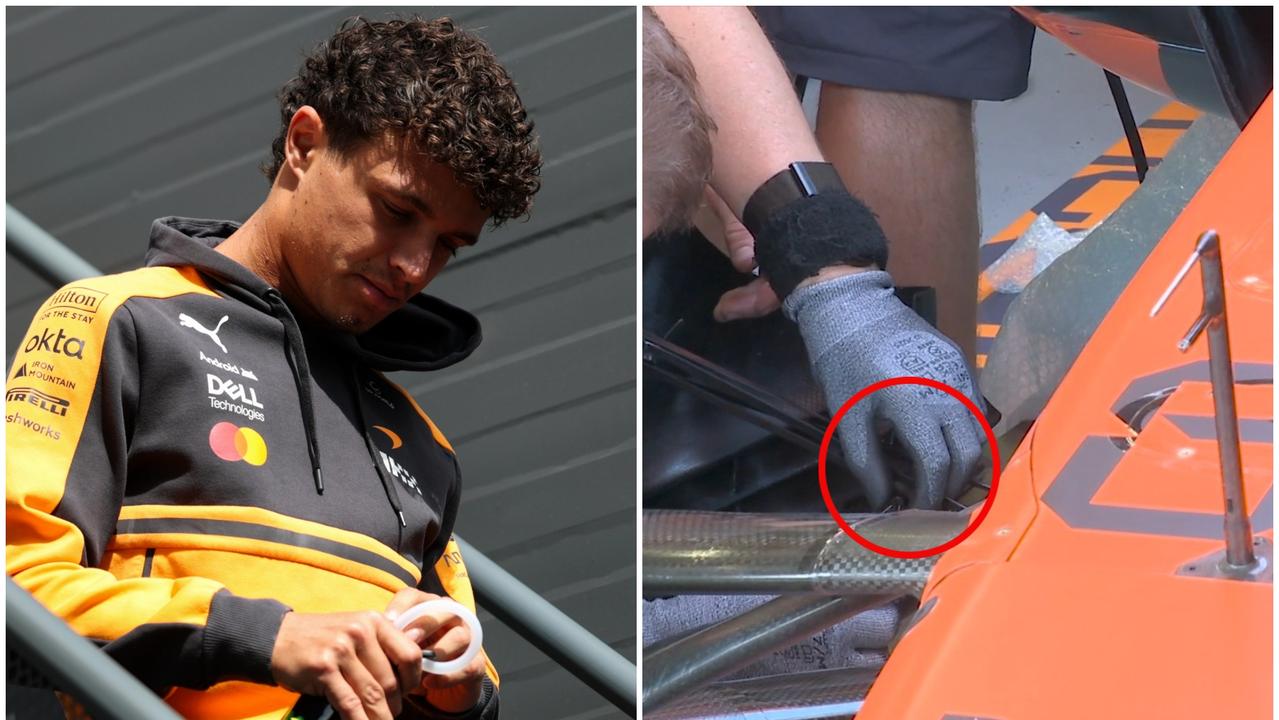
The new parts got off to an inauspicious start, however, when the team discovered weakness in the bargeboard area — the upright aero parts behind the front wheels but ahead of the radiator inlets.
Repairs kept both Oscar Piastri and Lando Norris garaged for most of the final part of FP1. When they re-emerged, the extent of repairs was the addition of some trusty cable ties to hold together the intricate, sculpted and undoubtedly extremely expensive bodywork.
A permanent solution will be worked on tonight.
Cable ties aside, the team is absolutely certain its upgrade is working as intended.
But the car was also miles off Mercedes’s pace.
“It’s clear we haven’t yet unlocked its full potential,” said chief technical officer Rob Marshall.
“The first session was slightly disrupted, and we are still in the process of dialling in both the chassis and the power unit to suit the unique demands of this circuit.
“We have a history of making strong progress from free practice into qualifying, and that remains our objective.”
Norris, though, was far less optimistic.
“We’re miles off,” he said. “We’re up there relative to [other teams], we’re in the position we expect to be in, but 1.5s off the pace — pretty pants.
“The car didn’t feel that bad. It’s a little knife in the heart when you see how far off you are.”
It’s deeply unlikely the 1.5s gap is representative, however.
Quite aside from McLaren and Mercedes sharing the same power unit — and McLaren tends to run in a lower power mode during practice — Norris abandoned what would have been his quickest lap, pitting after setting a purple first sector and a personal best second sector.
Had he matched that with an equal best final split, he would have been within 0.1s of Verstappen — not Mercedes pace, but about half the distance.
It’s a similar story for Piastri, who left around 0.3s on the table comparing his best sector times.
It’s a different circuit, but Monza makes similar low-drag demands of the cars to Baku, and there McLaren was only 0.18s short of an admittedly chaotic qualifying session.
Whatever the case, it’s clear we should expect a much closer competition for qualifying tonight.
2027 Aussie Grand Prix gets sprint race | 01:29
HAMILTON REPRIMANDED IN FIRST BAKU FLASHPOINT
Arvid Lindblad aside, drivers kept things generally tidy throughout the opening day of practice in Baku, but Liam Lawson and Lewis Hamilton came close to having an aeroplane accident around halfway through FP2.
Lawson had just exited turn 16 and had put his foot down for the long flat-out run to the finish line.
Hamilton had just completed a flying lap and was travelling slowly through the fast, blind series of corners between turn 18 and turn 20.
His Ferrari suddenly appeared in Lawson’s visor, and in an instant he was right on Hamilton’s gearbox.
The closing speed was a whopping 67km/h — 300km/h to 233km/h. Lawson had no choice but to back out and take evasive action — and vent about it on team radio.
Hamilton was summoned to the stewards afterwards and reprimanded for travelling slowly on the racing line contrary to instructions.
But don’t expect that to be the last flashpoint at this high-risk section of the circuit.
Even before the weekend, it was clear this would be a problematic part of the track, with race control warning drivers to stay well off the race line due to the potential for massive closing speeds due to battery usage.
But Hamilton, speaking before receiving his penalty, said it wasn’t enough.
“Basically, with the rules that the FIA gave us this year, when you come into the weekend, there’s no data or simulation to say, ‘Okay, when you come to the last corner and you go to full throttle and you have 500bhp (373kW) less than the car behind you on a lap, this is the gap you need to have before they get on your [tail].’ They don’t tell you the closing speed that you’re going to have.
“I was 4s ahead basically. I went into the last corner pushing. I could see him, but I thought the gap was enough. I got onto full throttle and then literally as we got into [turn] 18, the car just died, and he swallowed up the gap massively. That could happen to anyone.”
Hamilton suggested the sport come up with some special settings that help drivers access full electrical energy at this part of the track to avoid triggering these massive speed differences.
It’s a question worth pondering now given it won’t be the only track that creates similar problems.
The slalom between these corners is only a small part of this track but is representative of pretty much the entire Jeddah circuit that hosts the Saudi Arabian Grand Prix, for example.
But like almost every element of these hybrid engines, it’s easier said than done when there are already so many intricate rules governing how they’re used.
CARNAGE as Max takes on 100 drivers | 02:04
OCON GETS DEADLINE AS AUDI TAKES SEATS OFF THE TABLE
Off the track, there were too key pieces of driver market information revealed on Thursday in Baku.
The first came from Haas principal Ayao Komatsu, who attempted to argue that Esteban Ocon was still a chance to retain his seat despite the Frenchman telling reporters on Wednesday that he would “definitely” be a free agent next year.
“We haven’t made any decision yet,” he said, though he admitted that Haas had let the option in Ocon’s contract for a year’s extension lapse.
“We’ve done all the evaluations, so we’re just waiting to summarise our findings, have a discussion internally, have a chat with Gene [Haas, team boss], and then we’ll take the final decision.”
He said the decision would come within “the next couple of weeks”.
Ferrari-backed Formula 2 title contender Rafael Câmara is tipped to take Ocon’s seat, with some reports suggesting Ocon has already been told he won’t be driving for the team next year — which almost certainly means he won’t be driving in Formula 1 next year and perhaps ever again after 10 years in the sport.
Audi certainly won’t be an option, with team boss Mattia Binotto confirming nonchalantly in a press conference that both Nico Hülkenberg and Gabriel Bortoleto were signed up for 2027.
“We have no discussion about what’s the plan for the next season,” he said. “Our drivers were contracted, so we knew that it would have been no change.
“But on top of that, I think we are happy on the speed of them, so we never announced really what would happen next year because there was no necessity. We have a line-up which is confirmed and which we are happy with.”