
What is “good taste” anyway? Allow your favorite actor, musician, celebrity, or comedian to let you in on what they’re watching, reading, and consuming.
Photo-Illustration: by The Cut; Photos: Everett Collection, Heretic, The Guardian & JW Films, Retailers
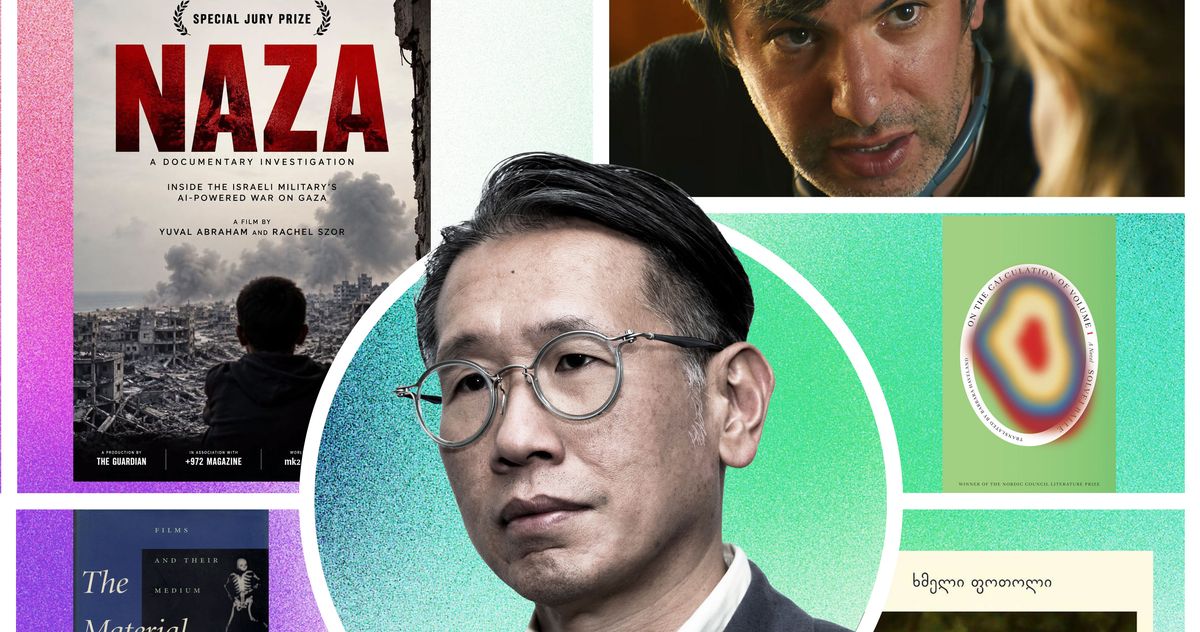
The 64th annual New York Film Festival begins this Friday, bringing together Letterboxd posters, culture critics, up-and-coming auteurs, and Hollywood movie stars at Lincoln Center. This year’s slate is a spectacular array: 119 films — 75 features and 44 shorts — from 46 countries around the world. The most anticipated include Luca Guadagnino’s buzzy new Sam Altman biopic Artificial and Nathan Fielder and Lance Oppenheim’s dizzying Elizabeth Holmes documentary You Can See Everything. There is also the damning war doc Naza, by No Other Land filmmakers Yuval Abraham and Rachel Szor, about the Israeli military’s mass killings of civilians in Gaza. (In retaliation for Naza, Israeli prime minister Benjamin Netanyahu has threatened to revoke Abraham and Szor’s citizenship.) Plus the festival has daring debuts from first-time directors, new experiments by veteran filmmakers, and so much more.
The man in charge is Dennis Lim, a revered (and quietly stylish) curator and critic who has served as the New York Film Festival’s artistic director since 2020. Prior, he was the film-programming director at Lincoln Center and a Village Voice editor. Ahead of the festival’s opening on Friday, I spoke to him about his NYFF recommendations, movie-watching habits, and more.
What does the process of selecting films for the festival look like for you?
It’s very much a job with seasons. In the first quarter of the year, I’m traveling to festivals and checking in with filmmakers, studios, and distributors. They’re also getting in touch about what they might have for the year. The three festivals I visit every year are Berlin, Cannes, and the restoration festival in Bologna, which is really important for our Revivals section. Beyond those, it varies. I try to travel to parts of the world I don’t often get to visit when the opportunity arises, and it’s useful to connect with colleagues in Asia, Latin America, and elsewhere.
Then there’s an intensely busy period that begins in April and goes until we finalize the program in mid-July. I work with programmers, some of whom are on staff at Film at Lincoln Center and some of whom are freelance. I also have advisers, most of whom are based elsewhere and involved in different kinds of programming, development labs, and things like that. They’re aware of projects earlier in their life cycle. Then there are months of logistics, scheduling, and figuring everything else out.
Do you watch all of the candidates multiple times before selecting them?
Not all, but increasingly, I feel like I do. Even without open submissions, we end up with well over a thousand features that we could potentially choose from. We’re trying to narrow that down to about 30 in the main slate, plus a few more in the other sections. It’s a lot of decision-making, so I do watch films more than once. As you know as a writer, when you’re on deadline, it’s always hard.
You’ve mentioned that some days you’ll spend upwards of 12 hours watching films. That seems like a real feat of endurance.
I can’t stress enough that this is abnormal and suboptimal. We should all be honest about it. You shouldn’t necessarily trust your judgment under those conditions. That’s why I leave time to come back to things. I’m getting increasingly comfortable with not knowing how I feel about something and allowing myself the time to figure it out.
Do you take notes?
More to stay away than to go back to. For notebooks recently, I’ve been using a Life Noble and a Rhodia Webnotepad. My go-to pen is a Pilot Acro ballpoint, and I also have been using a Caran d’Ache ballpoint, the most basic one.
What themes, either stylistically, in mood, or in topic, have emerged from this year’s slate?
I think the themes typically come after the fact. This festival has always had a pretty clear identity: It’s a festival that attempts to capture the year in cinema and make a case for cinema’s relevance today. This year, it’s been hard to miss that there’s a critical mass of films very directly, and urgently, engaged with the state of the world. For example, I saw Artificial a few months ago, and I feel like we’ve finally caught up to the level of alarm that a film like that presents in terms of how we’re talking about the potential horrors of AI.
One of my favorite films of the year is All of a Sudden, and I think of that in conjunction with Mike Leigh’s Tender Loving Care. These are films that deal with the increasingly difficult question of care in a precarious world. I also think of Lee Chang-dong’s Possible Love, which tries to contain so many of the contradictions around labor, class, and art-making. I think it’s a tremendously ambitious film. And then, obviously, there are the documentaries, like Naza.
Earlier this year, you wrote a review of Alexandre Koberidze’s Dry Leaf in The New York Review of Books praising its visual blur — it was filmed on a 20-year-old phone. Are there aesthetic interventions in this year’s slate that have struck you in the same way?
I don’t think there’s a film that’s such an aesthetic gamble this year. We have a section called Currents, which is where we showed Dry Leaf and where some of the more formally experimental work lives. Currents is interesting this year specifically because of its narrative films. There’s A Day in the Life of Jo by a young Greek filmmaker named Jacqueline Lentzou. Without giving any spoilers, there’s a mid-film shift that turns it into an entirely different kind of film. I think that disruptive gesture is really profound.
I think of that and Dan Sallitt’s film What Can Be Mentioned, which is incredibly precise in its tone. It has this micro-calibrated comedy of discomfort made with very minimal means. It’s interesting that we can show a film that’s much more modest in its approach but is doing something so precise. I’ll leave it at that. And there’s Carlos Reygadas’s High Jupiter, which we’re showing. He’s someone who has been pushing the language of cinema in interesting ways throughout his career. High Jupiter is a wildly ambitious attempt to engage with the metaphysical. It takes place across multiple realities and refuses to provide easy answers, or even many signposts for the viewer. It throws you from one confusing situation to another. This is a film that I’m really curious to see how people respond to because it’s premiering with us.
How does it feel to have one of your former students, Lance Oppenheim, premiere at the festival?
I’m very happy about it. I’ve always thought Lance was very talented and somebody who had a very clear sense of what he wanted to do very early on. I haven’t seen Primetime yet, though I’m excited to. The existence of You Can See Everything was conveyed to me in such secretive terms. The people at A24 just said Nathan Fielder was involved and that it was about Elizabeth Holmes. I didn’t know about Lance’s involvement until the screening.
Nathan’s work and persona and the interests he’s cultivated throughout his career are all present here. I think Lance’s presence as co-director is really key to the film. Given Lance’s background in documentary and the questions he’s asked in his own work about staging and reenactment, having him work with Nathan makes this a really fruitful and exciting collaboration. I think it’s an incredible film.
What’s the last big commercial film you watched?
I saw The Odyssey. It has its strengths.
Very polite.
I did see it in an outdoor cinema in Greece, so maybe that added to the experience. It seemed like the perfect setting to see The Odyssey.
In your off time — or the rare time you have for yourself, which hopefully is in a few weeks — do you know what you want to do? Are there exhibits you want to see, books you want to read, parks you want to walk in?
I usually try to find a few weeks in the summer to read as well, but things were complicated and chaotic this year because of all the late additions we had, including You Can See Everything, Naza, and Artificial. All of those came together in a way that required me to stay engaged until about a week ago. I’ve been reading these Scandinavian cycles. I got through Book IV of On the Calculation of Volume this summer. I’ve loved them. They’re really fun reads but also incredibly philosophical works. I also love Karl Ove Knausgård’s The Morning Star series, especially the last one, which I thought was the best. I think it was called The School of the Night. And I love Jon Fosse. There’s been something about Scandinavian literature that I’ve really connected with lately.
One of my favorite writers, Tom McCarthy, has a book coming out in a few weeks with New York Review Books. I also started reading Robert Musil’s The Man Without Qualities a few months ago. It had been on my shelf for a long time, and I found it much more enjoyable than I expected.
Do you read multiple books at one time?
Maybe I’ll have one fiction and one nonfiction book going but generally not.
You worked as a film critic at The Village Voice for many years. Who were some of your foundational influences as a critic?
I was lucky to work with Jim Hoberman. He was at the [Fjord] screening yesterday. That was my first job.
Going further back, I discovered Manny Farber’s Negative Space probably after I started writing, and that was important to me. Gilberto Perez’s The Material Ghost is a book I’ve really returned to. It’s a book of essays organized around the idea suggested by the title: cinema’s dual status as material but also as spectral, as ghostly. That’s the central idea running through the book. It’s quite personal and has some autobiographical material, but Perez was also a scholar, so there’s a scholarly dimension to it. I’d call it very accessible scholarly writing.
Working for the Voice and shaping the film section of an alternative newspaper — an idea that meant something back then — was important to me as a film programmer. What does it mean to provide alternatives to a commercial mainstream art form? What does it mean to look at the commercial offerings of that art form from an alternative perspective?
You also love art. I remember last year, when you wrote a NYFF diary for the New York Times, you were seeing the Jack Whitten exhibition at MoMA.
Incredible. I think the best art show I went to this year was in Venice. Not the Biennale, but the Prada Foundation had an Arthur Jafa and Richard Prince show. It was beautifully curated. The works were put together in a really exciting and mutually enriching way.
What music are you listening to?
I’ve actually been playing the Evil Does Not Exist soundtrack a lot — the Ichiko Aoba one. And D’Angelo. Those are probably the two records that are always out at my house.
Everyone also wants to know about your sense of fashion.
Okay, this is where I feel completely inarticulate. It’s a 15-day festival, so I feel like I have to be somewhat presentable. I did go to Tokyo last fall. I bought a couple of suits that I’ve barely worn, so I’ll probably wear them. One is an A.Presse double-breasted charcoal suit. I think I also got an Auralee blazer. And a designer named Philip Huang made a suit for me.
I met Phillip’s wife, who runs the label with him, when I was in Bangkok last year for a workshop at the Thai Film Archive. It’s an indigo-dyed suit, an interesting material, sort of a cotton satin, but it looks more like velvet.
I’ve also been getting messages from Keith Herron. I know his work, and it’s very film-inspired. But I don’t know if that’s going to happen, so maybe we should wait and see.
This interview has been edited and condensed for clarity.
Related
Lim taught at Harvard University’s Department of Art, Film, and Visual Studies intermittently from 2014 and 2023.