
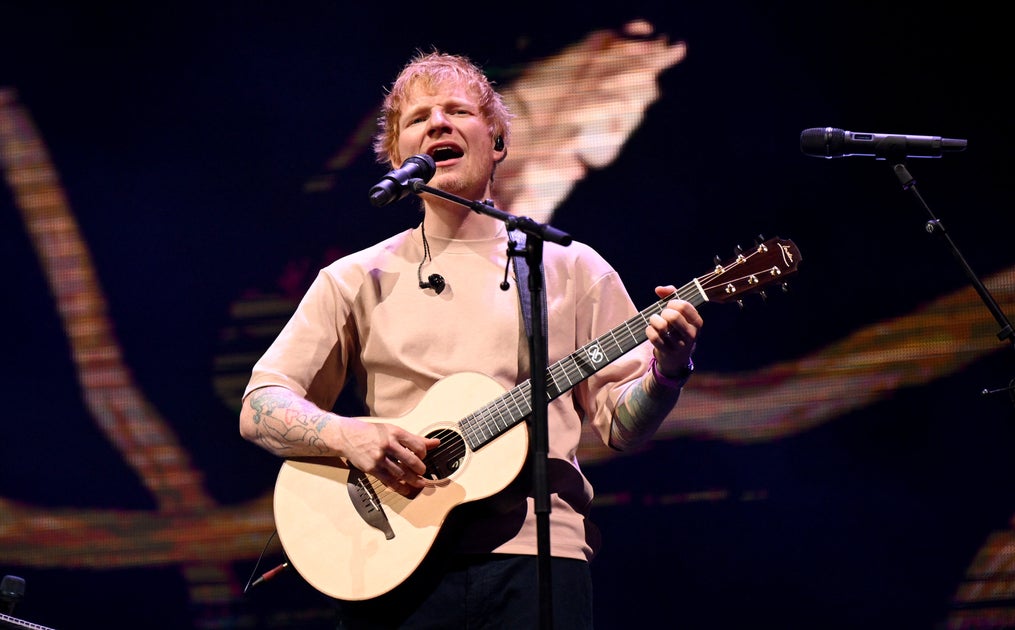
An apolitical approach may have worked for Ed Sheeran in the past. But as he faces one of the biggest controversies of his career, it seems clear that the days of being impartial are over.
Usually, when a celebrity makes any sort of political statement, the public response is rarely neutral. Some people either applaud, push back or question why one of their favorites has now chosen to wade into the world of politics. But when an artist faces consequences for speaking up and taking a stand — or, in Sheeran’s case, staying silent — the debate is even more contentious.
That’s what happened last week, when rapper Macklemore said he had been dropped from the remaining dates of Sheeran’s U.S. Loop Tour after making pro-Palestine remarks during one of the singer’s shows earlier this month.
According to Macklemore, one of the main reasons he wanted to join Sheeran on the road was to have the opportunity to stand “on stages and stadiums across America and say two words that are very near and dear to my heart: Free Palestine.”
“Wanting all humans to be treated equal should never be controversial,” Macklemore captioned an Instagram video of his speech. And yet, the controversy of the past week suggests otherwise.
Macklemore’s onstage comments drew criticism from fellow artist Pink and Jewish organizations like StopAntisemitism, which characterized his speech as “anti-Israel propaganda” and accused him of making a false claim about an Israeli “genocide.” But the situation escalated further after Macklemore alleged that the New England Patriots and Gillette Stadium owner Robert Kraft coordinated with other stadium owners to prevent him from performing at their venues.
“Last Monday, in the middle of all the media attention surrounding Pink and what I said at MetLife, Ed told me that Robert Kraft called him,” Macklemore said in a statement. “Ed told me that Kraft said I would not be allowed to perform in his stadium. Ed also told me that Kraft had rallied some of the other stadium owners and collectively they gave him an ultimatum: if Macklemore stays on the tour, you will not be allowed to play in our venues.”
Because of that, and despite their years-long friendship, Macklemore said he and Sheeran “had some difficult conversations” that ultimately left them on opposite sides: one choosing to speak out and the other choosing silence.
Macklemore has since announced a Free Palestine Tour, billed as “Macklemore and Friends,” featuring “artists who have shown up and used their stages to stand in solidarity with the Palestinian people, regardless of the consequences.” The three October shows, in Dublin, Paris and London, have been framed as a protest against the “power of billionaires that try to censor” artists like the “Same Love” rapper for bringing the Israel-Hamas war back into mainstream conversation.
Although Sheeran clarified that the decision to remove Macklemore from his tour was not his and respected the rapper for choosing to “shout for what he believes,” the singer made his own position clear, saying, “Those who come to my shows do not expect a political forum.”
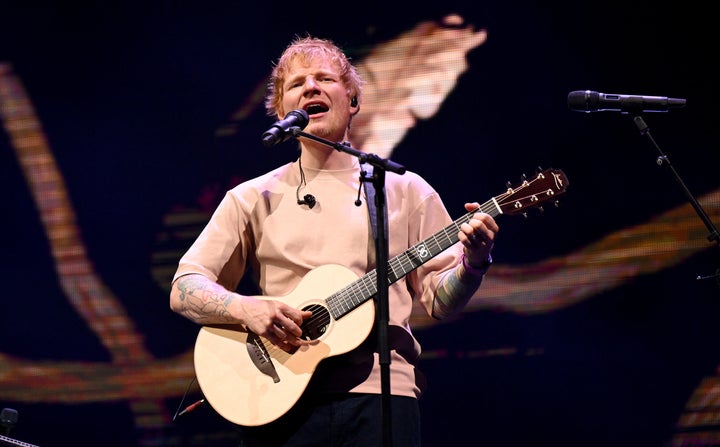
Paras Griffin via Getty Images
Ed Sheeran performs during iHeartRadio KISS108’s Jingle Ball 2025 at TD Garden on Dec. 14, 2025, in Boston, Massachusetts.
As Sheeran’s controversy shows, people expect artists to use their platforms to speak out when they have the chance.
For years, Sheeran’s “I don’t take sides” position has allowed him to keep his music and personal beliefs separate in the public eye, as Macklemore’s recent statement pointed out. But that impulse is hardly unique. Other artists have similarly sought to insulate their work from worldly issues (and drawn criticism for it), like the late Dolly Parton and Carrie Underwood, as if the divide between art and politics today is natural and not a product of cultural convention.
Still, when Sheeran resumed his tour last weekend in Philadelphia — without his four supporting acts who withdrew in solidarity with Macklemore and in protest of Kraft’s silencing campaign — the singer, who said he never set out to be an “activist musician,” felt compelled to address where he stands on the Israel-Gaza conflict after the backlash left him “in the middle of an important and passionate argument about freedom of speech and the most complex political issue on the planet.”
Perhaps the pushback against Sheeran would not have reached this point if it had not begun with powerful entities deciding what an artist should — and should not — be allowed to say on a public stage, particularly when speaking out against injustice.
There once was a time when staying silent offered public figures some form of protection from political controversy. Today, however, that silence seems to better serve the interests of those who have the most to gain financially from keeping certain voices out of the spotlight and the status quo intact.
That, in many ways, is the predicament Sheeran has found himself in. The criticism he faced from peers and others alike wasn’t necessarily a demand that he articulate his own views on what is happening to the people of Palestine after Macklemore’s remarks (though doing so initially might have helped quell some of the uproar). Rather, it was about the precedent he helped establish when given the chance to support a fellow artist’s beliefs and First Amendment rights — and what that choice suggested about whether politics belongs in a space of creative expression.
Music has always been shaped by the world around it, including issues concerning wars, genocide and humanitarian crises. Concerts simply give artists a more intimate way to connect with their audiences and, in some cases, speak about the causes that matter to them.
That appeared to be Macklemore’s goal while on Sheeran’s tour. The “Shape of You” singer, however, chose what seemed like the least disruptive course for himself and his fans, many of whom he said see his concerts as a “safe space” from divisive issues such as the urgent situation in Gaza. But as PinkPantheress once told The Guardian, “Neutrality,” particularly among artists, “shouldn’t be an option.”
The growing expectation that artists speak out on today’s political climate may also reflect how much more emotional and angst-ridden pop music has become over the past two decades, according to an analysis conducted for The Economist by the music data company Musixmatch.
Audiences actually want musicians to stand for something.
The data suggests that listeners, particularly younger ones who support artists using their platforms to make political statements, are gravitating toward music that matches their gloomy moods and gives voice to their pain, including, for some, the anguish of witnessing the horrific events in Gaza.
In that case, the uproar over Macklemore being booted off of Sheeran’s tour makes even more sense. We live in a time when audiences increasingly expect accountability from the artists they support. Perhaps, then, artists should be more willing to reckon with criticism when they choose not to speak up — and reconsider the outdated notion that their responsibility as public figures doesn’t include engaging with what’s happening in the world around them.
“Being apolitical during a genocide doesn’t work anymore,” Macklemore said recently. “People are asking artists to show up, educate themselves and be in community. To use the stage for more than entertainment. To push back when the call for a Free Palestine is met with attempts to silence it.”
Because for artists and celebrities alike, silence on such issues is no longer the absence of a statement. It is one.