
C — Bill Russell (1956-69)
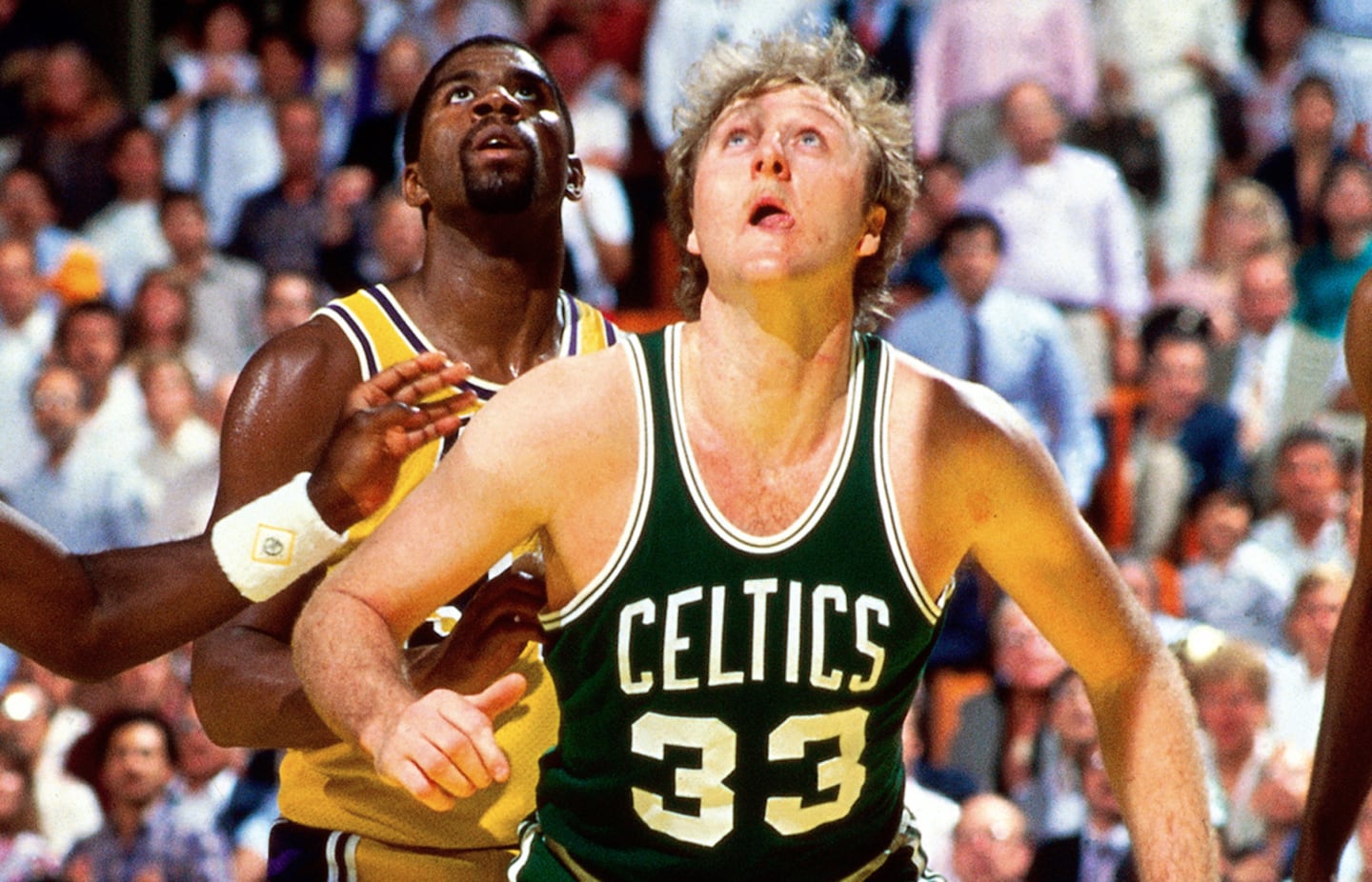
F — Larry Bird (1979-92)
F — Elgin Baylor (1958-72)
G — Magic Johnson (1979-91, 1996)
G — Stephen Curry (2009-present)
Sixth man — John Havlicek (1962-78)
Coach — Gregg Popovich (1996-2025)
C — David Robinson (1989-2003)
F — Tim Duncan (1997-2016)
F — Julius Erving (1976-87)
G — Kobe Bryant (1996-2016)
G — Jerry West (1960-74)
Sixth Man — Kevin McHale (1980-93)
Coach — Steve Kerr (2014-present)
Get Court Sense
Keep up with everything Celtics with news, commentary, and analysis from the Globe’s all-star team. Arrives twice weekly.
No argument here. Russell has stood the test of time. He is the greatest documented winner in North American team sport history. What’s important in this discussion is that he was an athlete far ahead of his time. As he told me to my face, “I could kick the rim.” His rebounding prowess has never been matched. He made the then-rarely seen blocked shot an art, and in contrast to so many modern players, he was able to turn many of his blocks into fast breaks. As Tom Heinsohn always said, Russell “popped” the ball rather than smashed it into the stands.
From 1955-69, his teams reached the finals 15 times, including two in college and the 1956 Olympics. Those teams won 14 times, and it would have been a clean sweep had he not been injured in the 1958 Finals. His Celtics teams won the NBA title 11 times during his 13 seasons as a player. Oh, and he was 21-0 in winner-take-all, somebody’s-going-home-tonight games.
The second-team selection was trickier. I very much wanted to honor the Bullets’ Wes Unseld (1968-81), who was Rookie of the Year and MVP in 1968-69, and who was a legendary outlet passer. But I simply couldn’t ignore the two-decade play of The Admiral, Robinson, an MVP with two rings and 10 selections to first-, second- or third-team All-NBA squads.
He was first-team All-Defense four times and a Defensive Player of the Year. He was a Dream Teamer and he did it all with class.
It’s a very close call.
One more thing: Special acknowledgment should be made for George Mikan (1948-56), the NBA’s first superstar “big.”
You could say that Bird’s numbers and hardware accumulation speak for themselves, but that is not the case. The record book tells you that Larry Bird had a combined regular-season and playoff total of 6,757 assists. What the numbers do not tell you is that Bird got more done with the ball in his hands less than anyone in basketball history. He never monopolized the ball. He simply had unmatched anticipation, superior court awareness, and, of course, a willingness to pass.
As for Baylor, time has done him no favors. You must understand that in terms of individual basketball offense, there was B.E. (Before Elgin) and A.E. (After Elgin). He brought us ways to put the ball in the basket we had never seen before. And how about this points-rebounds run from 1959-60 to 1962-63: 29.6/16.4, 34.8/19.8, 38.3/18.6, and 34.0/14.3. He had to be something special for me to pick him over Duncan. And he was.
Duncan, a.k.a. “The Big Fundamental,” has a case. He had five rings, three Finals MVPs, 15 All-Star Games, and 10 first-team All-NBA honors, among other accomplishments. But Baylor was a man of enormous influence in the game.
It kills me to leave out Bob Pettit (1954-65), but homage must be paid to eternal crowd favorite Dr. J.
Magic is an obvious pick. He had five rings, was MVP three times, and led the league in assists four times. And he oozed charisma. The tough call was his backcourt partner. Cousy played himself out with those unfortunate seven games for the Royals. It came down to Kobe, who was Michael 1A in talent and temperament; and Curry. I stuck with Curry because he is, without question, the most influential player of the 21st century. Every 8-year-old is out there hoisting threes. Curry is the greatest shooter of all time.
I need no apologies for picking West. He is, of course, The Logo, and a worthy one. Everyone respected West, and that even included Johnny Most, who called him “Gentleman Jerry.” John Stockton and Isiah Thomas were very tough omissions.
During his seven years coming off the bench (1962-69), Havlicek was the greatest guard-forward/offense-defense player ever. And he was always a finisher, averaging 32.2 minutes a game in that stretch. I think Magic would freak out playing with Havlicek.
McHale, a two-time Sixth Man Award winner, was the premier center-forward force coming off the bench in his time. His inside game has not been equaled. Hubie Brown once referred to McHale’s “bank vault of moves.”
For the record, the list of 12 players includes four No. 1 picks (Baylor, Magic, Robinson, and Duncan), two No. 2s (Russell, West), a 3 (McHale), a 6 (Bird), a 7 (Curry), a 9 (Havlicek), a 13 (Bryant), and an ABA expatriate (Erving).
Most of them move around, and that includes Red Auerbach, who began with the Washington Capitols and later coached in the Tri-Cities. Popovich is a complete outlier with San Antonio. And Kerr is still going strong in the Bay Area.
If only we could see these teams actually take the floor.
Bob Ryan can be reached at robert.ryan@globe.com.