
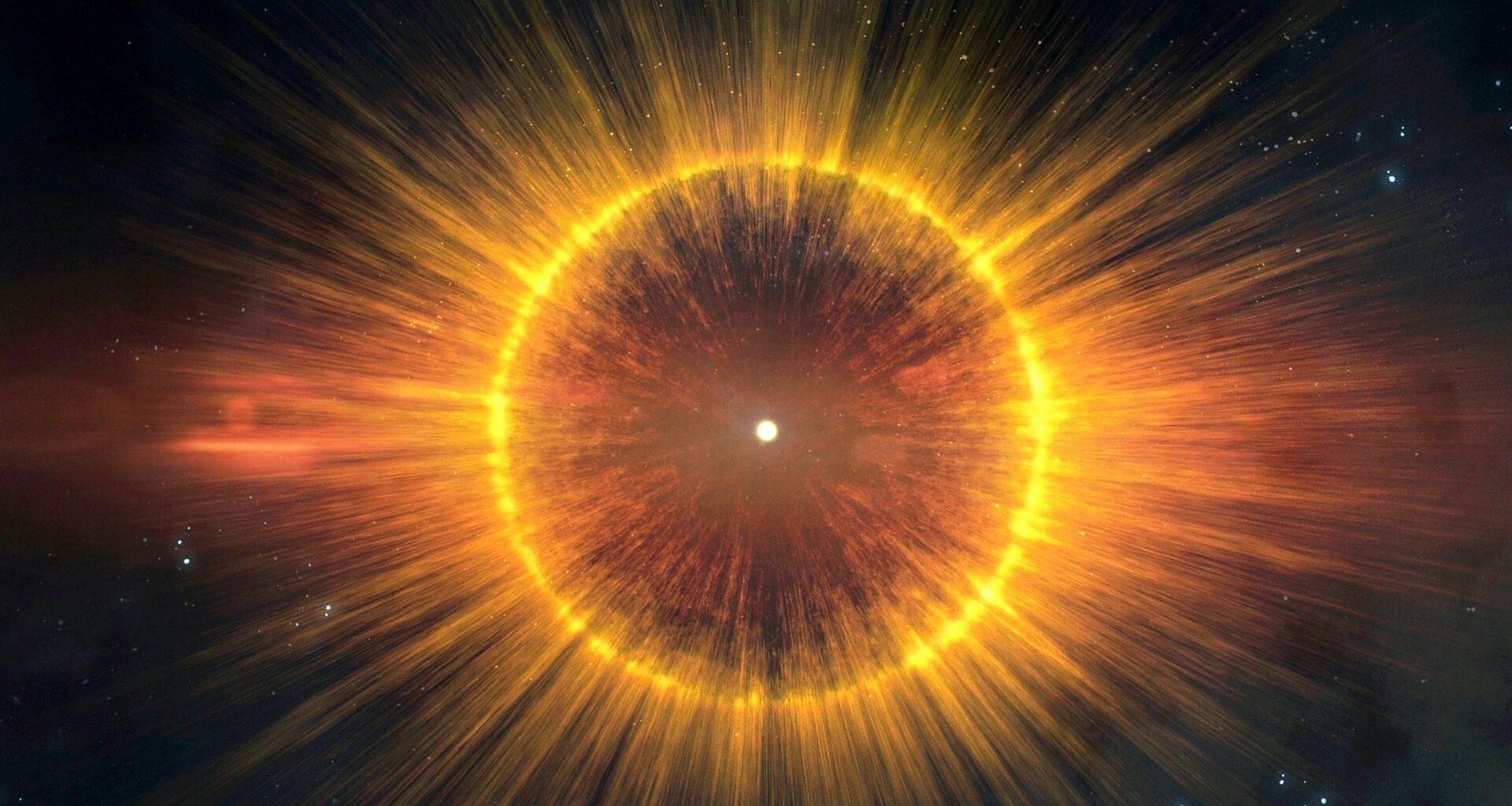
Tiny particles called neutrinos could help determine whether a dying massive star explodes as a supernova or collapses into a black hole.
When dying stars run out of fuel, they have two ways to go. They can blow apart as supernovae and leave small, dense neutron stars behind, or they can collapse into black holes.
New computer simulations suggest that tiny particles called neutrinos, which can switch from one type to another, push many of those stars toward collapse.
Mariam Gogilashvili, a postdoctoral researcher at the Niels Bohr Institute at the University of Copenhagen, led the study.
“We have long known that neutrinos can switch between different flavors. But we generally assumed that this had no effect on the outcome of the explosion itself,” Gogilashvili said.
“Our new research findings suggest that this flavor can tell us something about the star’s fate.”
The work is a set of computer models rather than a telescope observation, and it uses a simplified version of the neutrino physics.
Neutrinos carry energy that matters
Once a star at least eight times heavier than the Sun has used up its nuclear fuel, the iron core at its center collapses under its own gravity. The collapse sends a shock wave outward, but the shock stalls.
What happens next depends on neutrinos. They pass through matter so easily that they’re often nicknamed ghost particles.
A collapsing core releases enormous numbers of them, and they carry away about 99% of the energy freed up by the collapse.
If enough of that energy heats the gas behind the stalled shock, the shock restarts and the star explodes. If it doesn’t, the star keeps falling in and forms a black hole.
Neutrinos come in three types, which physicists call flavors. The electron type does most of the heating behind the shock.
Since a neutrino can change flavor as it travels, switching away from the electron type tends to mean less heat reaches the spot where the explosion needs it.
Testing different stellar fates
Physicists have known about flavor switching for years. Building it into a supernova simulation has been the hard part.
Irene Tamborra, a professor at the Niels Bohr Institute, heads its Particle Astrophysics group and was the study’s second author.
“Simulating the death of a massive star is something that is pretty much at the frontier of what we can do computationally at the moment,” said Irene Tamborra.
“That is because it is a problem involving a great deal of physics and it is extremely expensive computationally.”
So the pair built a simplified model. In it, the neutrinos mix evenly among the three flavors all at once, everywhere from a chosen depth outward.
The team tried four depths, from near the stalled shock to deep inside the newborn neutron star, because how far into a star the switching reaches is still uncertain.
They simulated 195 stars weighing between 9 and 120 times the mass of the Sun. Each star ran once without flavor switching and once at each of the four depths.
Every run followed a star for one to three seconds after its core bounced back. A star counted as exploding if its shock wave reached more than about 620 miles (1,000 kilometers) from the center.
Many exploding stars began to fail
Without flavor switching, 25.6% of the simulated stars failed to explode. That’s in line with earlier simulations that also treat stars as perfect spheres.
Adding the switch raised the failure rate at every depth. Even the shallowest version pushed it to 50.8%, and when the switching reached deep inside the newborn neutron star, 96.4% of the stars failed.
So at its mildest, the switch nearly doubled the failures. The deeper it reached, the fewer stars exploded.
In the simulations, stars between 16 and 30 times the mass of the Sun changed the most. Many that exploded in the original runs failed once flavor switching was added.
“It was a really exciting moment when we put all 195 simulations side by side and saw a whole range of stars flip from exploding to failing,” Gogilashvili said.
“Seeing such a clear pattern across so many stars told us that neutrino flavor conversion is something we simply cannot leave out when we try to understand how massive stars end their lives.”
Failed blasts may fill a gap
Astronomers spot fewer supernovae across the universe than their theories predict. The gap is known as the supernova rate problem, and more stars that collapse without a blast could help close it.
“Normally, we detect a supernova because the explosion shines very brightly. But if a star collapses directly into a black hole without a visible explosion, or is obscured by dust, it can effectively ‘disappear’ from our counts,” Gogilashvili explained.
“Our results therefore suggest that there is a mechanism that could make such ‘failed supernovae’ more likely.”
The 16-to-30 range lines up with a second puzzle. Among the stars identified as the sources of one kind of supernova, big red stars in that mass range don’t show up.
The authors suggest flavor switching could help explain those missing red supergiants.
“This could therefore not only give us better tools to predict a dying star’s fate, but it may also help explain why observations do not always match theoretical predictions,” Tamborra added.
Explosions decide what gets left behind
The switch also changed the stars that did explode. In the simulations, their leftover neutron stars came out lighter than in the runs without it.
That’s closer to what astronomers measure. Observed neutron stars cluster around 1.2 to 1.4 times the mass of the Sun, while the runs without flavor switching kept producing heavier ones.
Which stars explode matters for more than black holes and neutron stars. Supernovae scatter elements made inside stars across space, and traces of ancient supernovae have turned up frozen in Antarctic ice.
“When we study how massive stars live and die, we are also investigating the origins of many of the elements that make up the universe and ourselves,” Tamborra said. “In this way, questions about dying stars are linked to questions about our own origins.”
The exact numbers are still rough
The authors wrote that their exact figures should be treated with caution. At the two deepest settings, failures ran high enough to seem at odds with observations.
Those observations suggest that somewhere between 5% and 50% of collapsing stars don’t produce a visible explosion.
Their models also treat each star as a perfect sphere, and they flip the neutrino flavors instantly instead of letting the switching unfold over time and space.
They leave out a sloshing motion of the stalled shock that tends to help stars explode, especially the most compact ones, so the simulations may lean toward failure. The results could shift with a different set of starting stars, too.
Still, the authors found that the rise in failures holds up against the same stars run without the switch. What’s missing is a precise count.
To get one, researchers will need detailed descriptions of flavor switching, ones that track where and when it happens, built into supernova simulations as they run.
That’s what it will take to learn how many dying stars really skip the explosion.
The full study was published in the journal Physical Review D.
—–
Like what you read? Subscribe to our newsletter for engaging articles, exclusive content, and the latest updates.
Check us out on EarthSnap, a free app brought to you by Eric Ralls and Earth.com.
—–