
KeysQuestions4Explore4
Sandia’s Z Machine is the most powerful X-ray source on Earth, and the lab wants to build one 10 times bigger — with no published cost, no site, and no timeline, which means whatever this thing costs, it’s going to be a very large number.
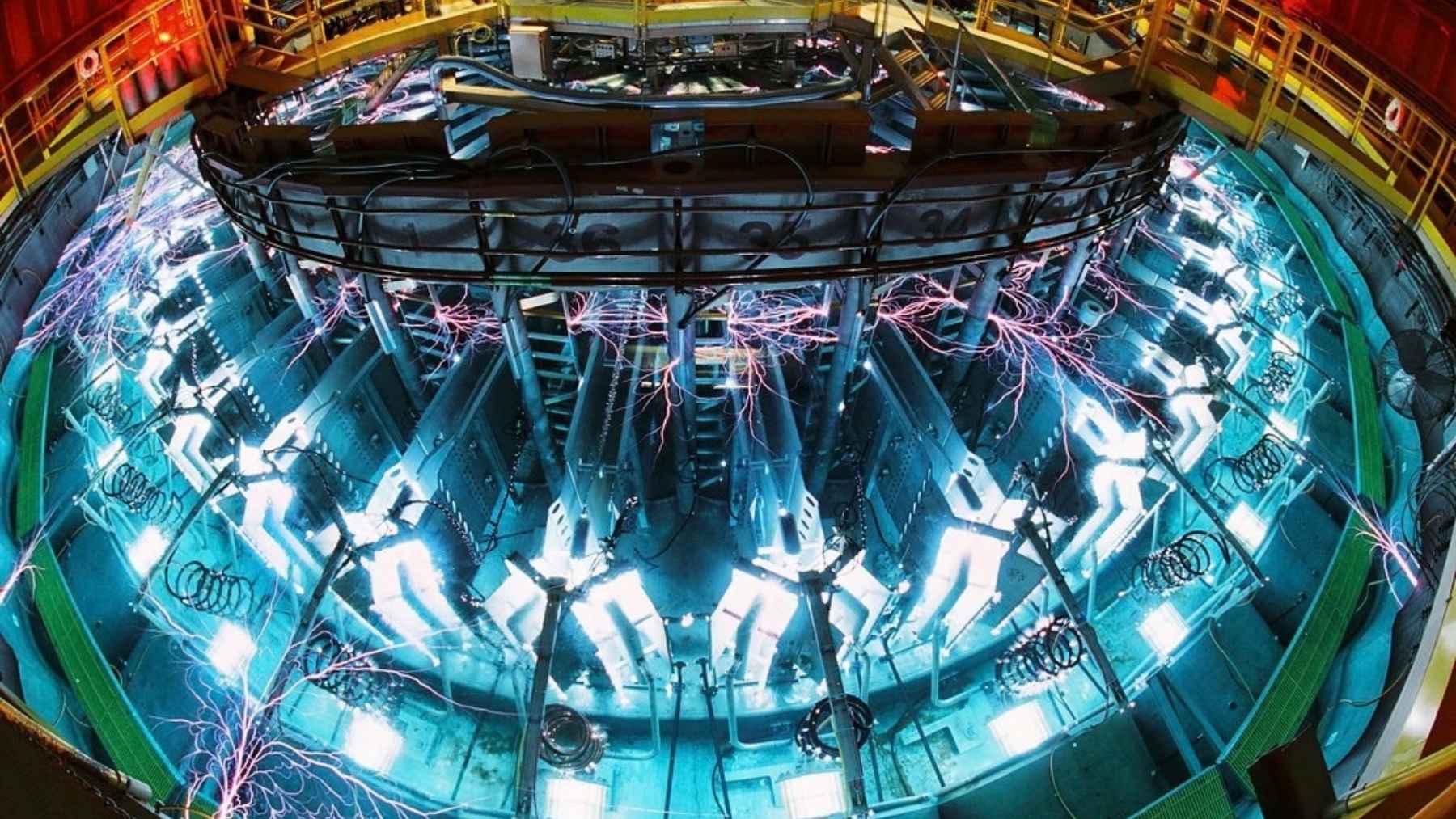
Every single shot delivers over 1,000 times the electricity of a lightning bolt in 20,000 times less time, concentrated onto a target the size of a spool of thread — and the shockwave rattles the Sandia Mountains next door.
This isn’t abstract physics: it’s the machine the US government uses to keep its nuclear weapons working without actually detonating them, and a successor would reshape how America maintains its entire nuclear stockpile for decades.
If Congress ends up funding this, you’re looking at one of the most expensive and consequential science projects in the country — and right now, almost nobody outside Albuquerque is paying attention.
Ask The Box →
Ask The Box:
SummarizeContextWhat does it mean?Related
Sin categoría
A 281-ton boring machine has sat at the bottom of a pit under a New Hampshire bridge all summer with a 570-foot train assembled behind it, waiting on the plant that feeds it clay slurry, and the crew filled the ground in front of it with concrete on purpose so it starts against one solid wall
2 weeks
Sin categoría
EG / An Australian park crew carried nearly 400 tons of material a kilometer through forest, pushed 30,000 bricks in by wheelbarrow, and laid every one of them in red light, because the tenants of the old railway bore go dark the moment a white beam hits the ceiling.
1 month
Sin categoría
A box the size of a school bus held iron ore and molten electrolyte at 1,600 degrees in a Massachusetts industrial park until the metal separated itself out and pooled at the bottom, and a ton of it came off the tap with no coal, no hydrogen and no water anywhere in the building
1 month
Sin categoría
A 65-foot American drone boat just fired two Joint Air-to-Ground Missiles off Hawaii, the first time a Saildrone hull has launched a weapon — six months from the Lockheed deal to live fire, targeting from USS Theodore Roosevelt’s strike group
1 month
AI-generated summary from reviews, comparisons and articles by AutoNotion
Local TV news doesn’t usually get anywhere near nuclear weapons science. Albuquerque’s KOB 4 covers weather, traffic and the Balloon Fiesta, pretty much like every local station in the country. But on September 18, the station aired a look inside one of the strangest machines the US government owns, because Sandia National Laboratories has started talking publicly about building a version roughly 10 times bigger.
The machine is called Z, and Sandia calls it the most powerful pulsed-power machine and X-ray source on Earth. It fires around 200 times a year, and every shot slams the building hard enough that Greg Rochau, the director of the Z Machine Center, told KOB it “creates a mini little earthquake” around the facility. The station reported the tremor shows up in the Sandia Mountains next door.
You’d think that’d be enough machine for anybody.
Apparently not. Sandia is pitching a successor to the National Nuclear Security Administration, the agency that oversees the nuclear weapons complex, and if the NNSA likes the concept, Congress would have to come up with the money. Nobody’s published a cost estimate. I couldn’t find a site or a timeline either, which tells you how early this is.
So what is the Z machine?
Z’s basically an enormous bank of capacitors wrapped around a very small target. A capacitor is a gadget that soaks up electric charge and can dump the whole load at once, and Z has 2,160 of them, arranged in 36 groups called Marx banks. Charged to their standard 85 kilovolts, they hold 20 megajoules of electrical energy between them, or 23 if operators push the charge higher.
That sounds apocalyptic and really isn’t. Do some rough math and 20 megajoules works out to about the chemical energy in a day or two of food, and Sandia notes that each shot pulls roughly the electricity needed to keep 100 homes lit for a few minutes. Your power company presumably doesn’t even notice.
Z gets its violence from timing. A Marx bank charges its capacitors slowly, side by side, then discharges them in a chain that stacks their voltages into one pulse, and Z fires all 36 banks toward the center at once. The stored energy leaves in roughly 100 nanoseconds. That’s 100 billionths of a second, and squeezing it through a window that short can push the peak electrical power to 80 terawatts while driving about 26 million amps into the target.
If terawatts don’t mean much to you, Sandia’s own walkthrough of the hardware offers a better comparison: each shot packs over 1,000 times a lightning bolt’s electricity and moves 20,000 times faster.
Autonoción Newsletter
No spam. Unsubscribe anytime. Privacy policy (opens in new window)
All of it converges on a target no bigger than a spool of thread, sitting in a vacuum chamber 10 feet across and 20 feet tall. The usual target is a set of hundreds of tungsten wires, each one finer than a human hair. The current vaporizes the wires into plasma, the magnetic field slams that plasma inward, and the crash throws off an X-ray flash that peaks at 350 terawatts.
Current per shot
26 million amps
Over 1,000 times a lightning bolt’s electricity, per Sandia.
Release time
~100 nanoseconds
Up to 20-plus megajoules from 2,160 capacitors, peaking at 80 terawatts.
Firing rate
~200 shots a year
Each one shakes the ground around the Albuquerque facility.
TARGET
Proposed successor
~10x bigger
Concept stage, under NNSA review. Congress would have to fund it.
Every shot registers in the mountains
So where does the mini earthquake come from? There’s a set of components with the wonderfully honest name of self-break water switches doing part of the work, and they pass the pulse by blasting it through a channel of water between two electrodes. Sandia’s documentation says plainly that these switches produce much of the mechanical shock when the machine fires. Z partly runs by exploding water on purpose, which I find weirdly delightful for a national security asset.
The shaking’s also why the machine gets rebuilt in miniature every time it fires. At the center of the chamber sit five nested stainless steel cones, about 10 tons of metal that carry the pulse through the vacuum, and they’re refurbished after every single shot. Around 200 shots a year means around 200 rebuilds a year.
What are all those shots for? Densities and pressures up near what you’d find in the sun’s core, according to Chris Seagle, Sandia’s senior manager of material physics. Some of that work is fusion: more than 70 shots on Z’s MagLIF program have crushed a metal tube less than half an inch tall onto its fusion fuel hard enough to reach thermonuclear conditions, in the same broad Z-pinch family that Seattle’s Zap Energy is working in at a much smaller scale.
The rest is weapons. Z creates radiation environments similar to a nuclear detonation, which lets researchers test how materials and components hold up without setting off an actual bomb, and Sandia’s completely upfront that this has been the job since its pulsed-power program started in the 1960s.
Sandia wants one 10 times bigger
For all that capability, Sandia says Z can’t reach every condition its national security mission calls for. Seagle told KOB those extreme densities exist in the sun’s core and inside weapon systems, and the current machine can’t generate all of them. Rochau’s explanation was blunter: the lab’s squeezed about everything it can out of the current footprint.
Albuquerque, weirdly, keeps collecting this kind of hardware. Pacific Fusion is assembling its own pulsed-power machine across town, a private one built from 150 truck-sized modules aimed at a single target, so the city now hosts the government’s biggest machine of this kind and a private one that’s still going up.
The successor, though, is still a pitch, and pitches die in Washington all the time, so I wouldn’t pencil in a groundbreaking. Sandia is presenting the concept to the NNSA, the NNSA would be the one asking Congress for money, and KOB aired its look inside the facility on September 18, 2026. Until something moves, Z keeps charging its 2,160 capacitors and shaking Albuquerque a couple hundred times a year.