
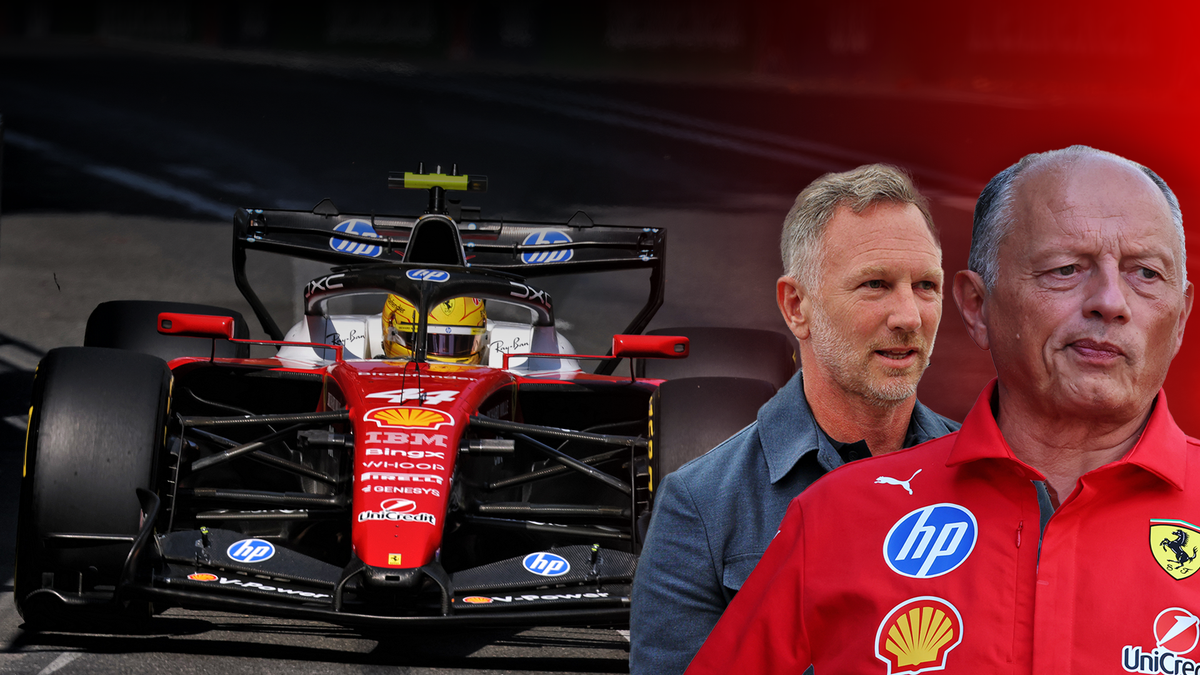
There’s fresh speculation hanging over Ferrari and its team principal Fred Vasseur – but what’s really behind the rumours linking Christian Horner to the team?
The trigger for the speculation was an interview Horner did with The Times, as he declared Ferrari “the biggest brand in Formula 1”, and “the dream” destination, but a “sleeping giant”.
Most significant was Horner indicating he was willing to drop a previous red line to any F1 comeback for one team: “[There is] only one team for which I would accept non-participation in ownership.”
The strong implication being that one team was Ferrari, enough for some to wonder if the door is open, and that Horner may be setting sights on a move there. But sources have made clear to The Race that that is not quite the case.
Context is important. That interview took place before the Italian Grand Prix in early September – (When rumours began to swirl again about Vasseur’s future at the team.) It was done as a promotional piece for the book Horner is releasing next month and arranged through its publisher, rather than by Horner.
This isn’t believed to be Horner publicly throwing his hat into the ring.
While Horner has long had regular contact with Ferrari chairman John Elkann – who visited his house in the summer of 2022 to offer him the team principal job prior to it going to Vasseur – there have been no discussions about a role at Maranello.
Furthermore, reservations that Horner has long had about taking on that job at Ferrari – which are why he rejected Elkann’s offer four years ago – remain in place.
What Horner would want
From Horner’s perspective, while he would theoretically accept a role at Ferrari without necessarily needing to have a team shareholding, there are important elements of control that are still understood to be critical.
At Red Bull, for example, Horner did not have any equity in the team. But as team CEO, he had control over everything – and he was central to many of the key decisions made by the racing division of the energy drinks giant.
He influenced driver decisions, staff hirings, was involved in sponsorship deals across Red Bull and Racing Bulls, and was central in signing off approval for major investment projects including Red Bull Powertrains, and a new windtunnel, that he felt were needed to keep the team pushing forward.
Such a high level of control was, in his head, essential if Red Bull was going to achieve success in F1.
But the scale of his influence ultimately proved to be a factor in his downfall. Red Bull’s Austrian management pushed back against fears that the squad was becoming ‘Horner Racing’.
Horner has always been of the mindset that there is only one way that he can achieve success in F1, and that is by being in complete charge.
Success in his eyes cannot be achieved if every call he makes, big or small, has to be approved by another level of management above him.
This is why Horner was both CEO and team principal at Red Bull Racing.
Would Ferrari give him what he wants?
Getting into such a position of authority at Ferrari would require a totally different approach from Elkann and CEO Benedetto Vigna.
The pair have stuck to a rigid management structure through recent years – with team principals Mattia Binotto (2019-22) and Vasseur (2023-present) having nowhere near the level of control in the operation that Horner had at Red Bull.
So even if Elkann and Vigna came to the conclusion that Horner was someone they would be interested in, they would have to totally revise the way that Ferrari is run if they wanted to move it forward.
Horner would want to have a level of authority that has not existed at Ferrari perhaps since the Jean Todt days that helped drive success in the Michael Schumacher era in the late-1990s and early-2000s.
But change at Ferrari goes beyond Elkann and Vigna handing full control to someone like Horner. There are also questions about whether the Ferrari operation in Maranello would be open to such a different way of doing things.
As F1’s most historic team, Ferrari has built up its own culture over many decades and that has led to a fair degree of internal politics that can sometimes be hard to keep under control.
Vasseur has been open in the past that there were challenges for him to deal with in the early days.
This included getting staff to not be afraid to stick their head above the parapet and take risks, rather than constantly be in fear of having fingers pointed at them so acting in a way of self-preservation.
There were also frustrations early on about how readily information seemed to leak out to Italian media from staff at Maranello. This, Vasseur felt, was simply helping the opposition gain knowledge.
The media pressure put on Ferrari and its staff is like no other in F1 – with every move scrutinised and what is being reported having an impact inside the factory walls. This is something Vasseur has tried to isolate staff from as much as possible.
One thing that cannot be predicted in advance, though – and could be decisive in Horner concluding whether Ferrari would work underneath him if an offer came – is whether there would be a willingness inside Ferrari to accept sweeping change.
If Horner went to Ferrari then he would almost certainly surround himself with allies who he felt were needed to move the team forward, which could ruffle some feathers with incumbent staff.
The risk then of resistance to change is that this would create factions inside Maranello that would limit any progress being made.
So while Horner may be willing to take on a role at Maranello without shareholding, there is still a lot that would need to change for him to believe it is a project that could work in the way he would want it to.
There was an interesting line in The Times interview where Horner said that he was aware he was both “the cure and the problem” for any team that wanted him, as he suggested that egos would ultimately have to be put aside.
“There comes a point in time where a team’s competitiveness outweighs other egotistical stuff,” Horner said.
Pressure on Vasseur
Horner’s comments have certainly stirred up the rumours in the paddock, and only added to the heat that Vasseur is facing.
Vasseur’s leadership was put under the spotlight after the Italian GP when Lewis Hamilton suggested that the buck stopped with Vasseur when it came to making changes at Ferrari that he felt were necessary to move it forward.
Some Italian media interpreted Hamilton’s messaging as a call for fresh blood at the top. Hamilton took to social media to clarify that this was not the case.
He said that he has “never asked for anyone on my team to be replaced”.
On top of this, there have been whispers floating around the paddock for several races now that Ferrari has already settled on a plan to wait until the end of the season before making a change.
After last weekend’s Azerbaijan GP, when The Race asked him about the impact of the rumours on him and Ferrari, Vasseur confessed that “we are not working in the perfect serenity” and labelled it a “frustrating situation” as “50% of the questions” are about his future.
Vasseur is not in denial that speculation is out there over his future, but it is something he has endured throughout his tenure at Ferrari.
There have been repeated stories in the past that his job was under threat, and he knows it comes with the territory of being Ferrari team principal.
The last time the noise got as intense as this, in the middle of 2025, Ferrari responded by handing Vasseur a new multi-year contract.
Vasseur knows the speculation is not going to go away, but he is also aware that there is little he can do to shut the speculation down other than help Ferrari deliver better results on track.
When The Race asked him if he’s willing to fight on despite the growing questions, Vasseur said: “For sure. Motorsport is my life, it’s my business. I’m trying to do my best. For sure. I’m there to do my job. I have the best job in the world. But, it is like it is. We have still seven races to go, and I will push until the last corner.”
And crucially, he said “it is not in my hands” when The Race asked about the mounting rumours.
Instead, the ball right now is very much in the court of Elkann and Vigna. They know what Vasseur can do, they can see the results on track, and they are sure to have a pretty good idea of where Horner’s red lines are now.
It is up to them to decide what path they think is best to get Ferrari back to the front in F1.