
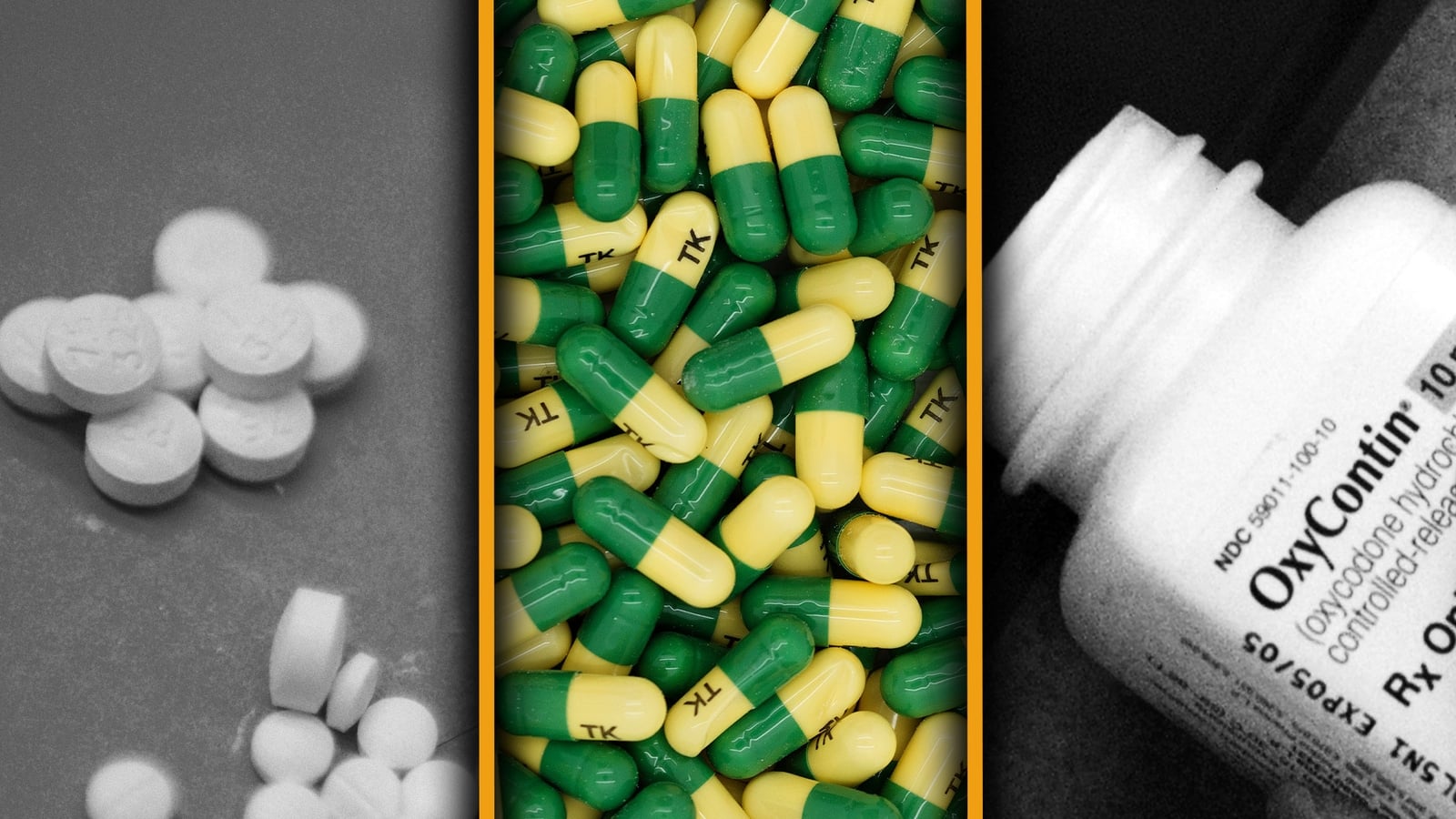
The estimated consumption of opioid pain medication under the General Medical Services scheme increased by more than 10% between 2018 and 2025, according to a new RTÉ Investigates analysis of HSE data.
Approximately 1.5 million people, or around 30% of the population, are eligible for the General Medical Services (GMS) scheme, the country’s main community drug scheme.
Between 2018 and 2025, the State spent €316m on opioid prescriptions across the GMS and two other community drug schemes: the Long Term Illness (LTI) scheme and the Drugs Payment Scheme (DPS). Most of this expenditure, €271m, was through the GMS.
Data released to RTÉ Investigates under Freedom Of Information shows that more than 17m opioid prescriptions were recorded under the three schemes during this period. Of these, 15m were recorded under the GMS.
The annual number of opioid prescriptions across the three schemes increased by 18% between 2018 and 2025. On average, more than two million prescriptions were recorded each year.
Analysis
Prescription opioid use has come into sharp focus in recent decades because of the US opioid epidemic, which has been the subject of several high-profile television series, books and podcasts.
While Ireland has not experienced problems on the same scale, the use of prescription opioids under the main community drug scheme has increased in recent years.
RTÉ Investigates obtained prescribing data from the HSE’s Primary Care Reimbursement Service, which manages payments under the three schemes.
The aggregated data covers prescription opioids including oxycodone, codeine, fentanyl, morphine and tramadol. It includes information on costs, patient numbers and prescribing across the HSE’s 32 former Local Health Office areas (LHOs).
Some low-dose codeine products included in the data can also be bought over the counter. However, the figures relate only to prescriptions processed under the three public schemes and do not include over-the-counter purchases or private prescriptions. They also exclude drugs classified separately for the treatment of drug dependence, including methadone.
To compare opioid consumption over time and between LHOs, RTÉ Investigates converted the quantities recorded in the data into a standard unit of measurement known as a Defined Daily Dose (DDD).
The World Health Organization defines a DDD as “the assumed average maintenance dose per day for a drug used for its main indication in adults”.
RTÉ Investigates also calculated the number of DDDs recorded under the GMS relative to the number of people eligible for the scheme.
The analysis found that the national annual rate increased from more than 15,400 DDDs per 1,000 GMS-eligible people in 2018 to just over 17,200 in 2025, an increase of approximately 12%.
The map below shows the average annual rate for each of the 32 LHOs between 2018 and 2025.
We need your consent to load this flourish contentWe use flourish to manage extra content that can set cookies on your device and collect data about your activity. Please review their details and accept them to load the content.Manage Preferences
Over the eight years, Cork North Lee recorded the highest average annual rate, at more than 20,800 DDDs per 1,000 GMS-eligible people. Wexford followed at 20,303, and Cork South Lee at 19,543.
Clare, Cavan-Monaghan and Galway recorded the lowest average annual rates, each with approximately 13,000 DDDs per 1,000 GMS-eligible people.
We need your consent to load this flourish contentWe use flourish to manage extra content that can set cookies on your device and collect data about your activity. Please review their details and accept them to load the content.Manage Preferences
The chart above shows how the increase in use was felt much more strongly in certain LHOs than others.
Dublin South-West recorded the largest increase, with the rate rising by 30%. This was followed by Laois-Offaly, at 29%, and Carlow-Kilkenny, at 25%.
‘A significant public health concern’
In response to queries from RTÉ Investigates, the HSE said its current guidance for acute non-cancer, post-operative pain recommends prescribing opioids for no more than four days.
It added that before treatment begins, the clinician and patient should agree “a treatment strategy including treatment duration and treatment goals.”
Separately, the Department of Health said the community drug schemes reduce the cost of approved prescriptions and that there had been a “significant focus” in recent years on improving access to healthcare services.
It also said a new National Drugs Strategy, which is being finalised, recognises the misuse of prescription medicines as a significant public health concern.
Irish addresses listed in US Purdue Pharma claims
Much of the attention in the US opioid crisis has centred on Purdue Pharma, the maker of OxyContin, a prolonged-release formulation of oxycodone.
The company, formerly owned by members of the Sackler family, filed for bankruptcy in New York in 2019 while facing thousands of claims over its manufacture and marketing of opioid products, including OxyContin. The claims were brought by individuals, families and public authorities.
Purdue Pharma ceased operations earlier this year. Knoa Pharma, a new public benefit company owned by a non-profit foundation, began operating in its place, with a stated mission to address harms caused by the opioid crisis.
Among the allegations made against Purdue Pharma were that it had downplayed the risk of addiction associated with OxyContin and similar products and had aggressively marketed these drugs to doctors.
A document in the US bankruptcy proceedings, filed by lawyers representing the claimants, stated that approximately 122,000 individuals and families had submitted personal-injury claims as part of the bankruptcy.
This represented, according to the filing, “only a small portion of the people who were hurt by Purdue”.
The document, submitted in 2020, also said five claimants provided Irish addresses on their claim forms.
Hundreds seek treatment for prescription opioid problems in Ireland each year
Meanwhile, data supplied to RTÉ Investigates by the Health Research Board (HRB) shows that hundreds of drug treatment cases relating to prescription opioids are recorded in Ireland each year.
Between 2018 and 2025, oxycodone was recorded as the “main problem” in 145 treatment cases and as an “additional problem” in 190 cases, according to the HRB.
During the same period, codeine was recorded as the main problem in 1,589 treatment cases and as an additional problem in 1,140 cases.
Tramadol was recorded as the main problem in 284 cases and as an additional problem in 339 cases.
‘It was pure bliss’
RTÉ Investigates recently spoke to a woman who received treatment for an addiction to OxyContin. We have changed her name and withheld certain details to protect her privacy.
The woman, whom we will call Sarah, is in her 40s and has three children. She described how, before her problems with the medication, she led a fairly conventional middle-class life in a provincial town, where she worked in a respected profession.
Sarah said she had previously experienced problems with alcohol but had been in recovery for approximately seven years before she was first prescribed OxyContin.
By 2019, she had developed a chronic pain condition that required surgery.
Sarah said she was given OxyContin in hospital to treat her pain.
She told RTÉ Investigates that she had no previous knowledge of the drug and was unaware of the scale of the problems associated with OxyContin in the US.
“I can still remember the first time they gave it to me,” she recalled. “It was a pure feeling of bliss because the pain obviously left, but also because of how it made me feel.”
“The only thing I was told was that it was used for people who had cancer. So, I knew it was very strong.”
After leaving hospital, Sarah continued to be prescribed OxyContin to manage her chronic pain. Initially, these prescriptions were provided under the GMS scheme.
She said she soon became heavily dependent on the drug.
According to Sarah, prolonged opioid use dramatically lowered her pain tolerance, leaving her feeling that she needed the drug to relieve even relatively minor pain.
‘It was like watching our mother die on the couch’
Sarah said that when she expressed concern about her reliance on the medication, she was told that she could not be considered an addict because the medication had been prescribed.
She began to require increasing amounts of the drug to function.
In addition to prescriptions obtained under the GMS, Sarah said she obtained OxyContin from a pain specialist, private walk-in GPs and, on occasion, through online medical consultations. She also attended several different pharmacies.
But her health continued to deteriorate.
“I could barely walk. I used a crutch to walk,” she said. “I was physically, mentally, emotionally just broken.”
One of her children once remarked, “It was like watching our mother die on the couch.”
After prolonged periods of sick leave, Sarah eventually left her job on medical grounds. She lived in fear that she would lose custody of one of her younger children if she disclosed the extent of her addiction.
“In the end, I was using against my will,” she said. “I knew I was completely addicted. I could find no way out.”
‘Baby steps’ out of addiction
The full extent of Sarah’s addiction eventually became evident after a pharmacist discovered that she had been obtaining multiple prescriptions and raised concerns with her GP.
What followed was a particularly difficult period involving attempted reductions in her medication, withdrawal, hospital treatment and an eventual overdose.
Sarah said that concern for her children ultimately became a turning point.
“Something in me clicked,” she said. “I wanted to live for my kids.”
She sought help through a non-residential addiction programme, although several services initially declined to accept her while opioids remained in her system.
“I eventually found a place that took a risk on me, and they let me in,” she said.
Sarah underwent repeated detoxifications and attended frequent recovery meetings.
She gradually became more physically active and learned to manage her pain through exercise, massage and other non-opioid approaches.
“The more exercise I was doing, and the more the opiates were out of my system, the more my body started to build up a pain threshold again,” she said.
Sarah said she has now been drug-free and in recovery for two years.
In recent years, she has been studying to become an addiction counsellor so that she can help others who have had similar experiences.
As part of her training, she gained practical experience with Cuan Mhuire, an addiction charity she credits with playing an instrumental role in her recovery.
The recovery process, she said, “was like baby steps back to becoming human again”.