
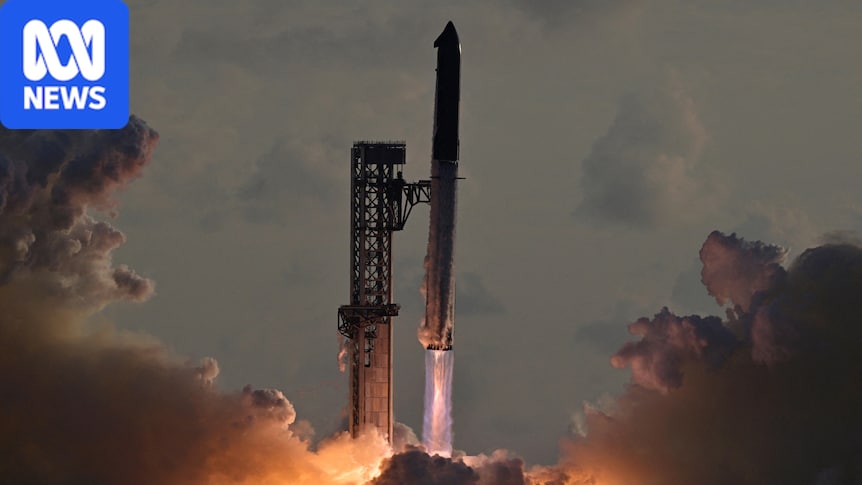
SpaceX has launched its enormous Starship into orbit for the first time, deploying Starlink satellites before returning to Earth early due to an engine issue.
The spacecraft almost didn’t achieve the long-desired goal in its Monday launch, after one of its three engines shut down too soon.
The mission was scheduled to last 10 hours, but was reduced to three hours after the engine problem, and the rocket later re-entered the atmosphere and conducted a controlled and fiery landing in the Pacific Ocean.
The snag with its engine initially led SpaceX spokesperson Dan Huot to announce on the company’s livestream of the mission that the craft would be unable to reach orbit.
But Mission Control reversed course minutes later after an update from engineers confirmed that the craft could still attempt an engine firing that would boost it into orbit, which Starship successfully did minutes later.
SpaceX recovers rocket off Christmas Island
“Starship is orbital,” Mission Control announced to cheers.
Founder Elon Musk’s showpiece rocket — the biggest and most powerful ever built — carried 26 of the latest and most advanced Starlink satellites to join the 11,000 older models already providing internet service.
It was Starship’s 14th full-scale launch from Texas’ southern tip in three years.
The earlier test flights ventured no farther than the Indian Ocean halfway around the world, often crashing in flames and briefly skimming space.
This time, SpaceX had hoped the Starship would circle the globe from an altitude of 275 kilometres — not just once but six times over almost 10 hours, ending with a Pacific splashdown near Chile.
The reusable rocket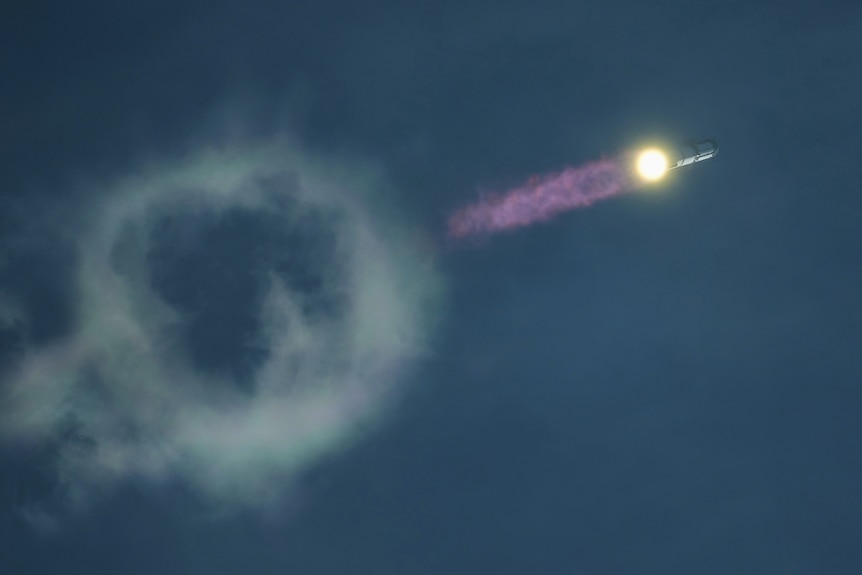
SpaceX’s mega rocket Starship making the test flight from Starbase, Texas, on Monday. (AP: Eric Gay)
The Starship deployed 26 next-generation Starlink satellites while in orbit at an altitude 269 kilometres above the Earth’s surface.
The 124-metre rocket was designed from the start to be fully reusable, a key to lowering launch costs, and built to launch SpaceX’s Starlink satellites and for future NASA missions to the moon.
If the spacecraft breaks apart over land and rains debris onto people, “our popularity would diminish very rapidly”, Mr Musk said at a business summit earlier this month.
Photos show impact of SpaceX rocket that slammed into Moon
“That’s why we’re being extremely cautious here.”
SpaceX is pressing hard to certify Starship for orbital flight, a vital step toward moon and Mars travel.
Mr Musk originally developed Starship for Mars, intending to launch scores of them with the red planet’s first settlers.
For now, he plans to focus on the moon and use Starship to haul satellites into orbit by the truckload — phasing out the company’s frailer Falcon 9 rocket within several years.
NASA’s Artemis IV mission, slated for no sooner than 2028, would have astronauts landing on the moon in either Jeff Bezos’ Blue Moon or Mr Musk’s Starship, whichever is ready first.
AP