

September 29, 2026 — 11:00am
Save
You have reached your maximum number of saved items.
Remove items from your saved list to add more.
AAA
Soon after she was diagnosed with a rare muscle disease, Amanda Bennetts started noticing a change in the content she was being served in her social media feed.
“I started seeing these really bizarre ads on SoundCloud and Instagram,” says the conceptual artist from Queensland’s Sunshine Coast. “One was for a funeral home; it was just an image of a white coffin. It was this constant assault whenever I wanted to see my friends’ Instagram posts.”
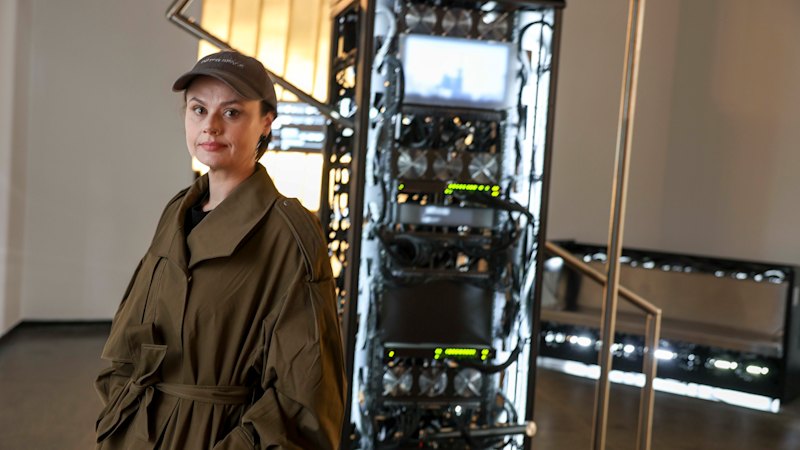
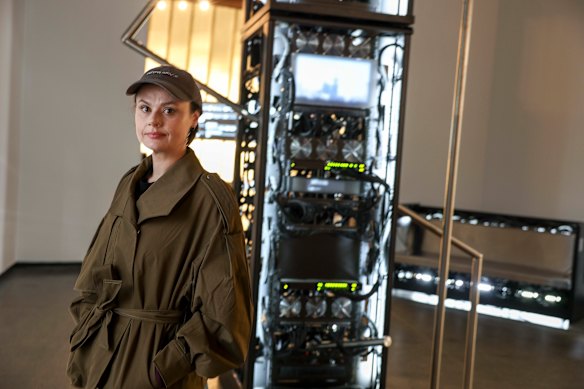 Woman v machine: Amanda Bennetts and her sculptural work Axis Mundi at the Australian Centre for Contemporary Art.Eddie Jim
Bennetts has lived with multiple sclerosis since she was 22; she is 40 now. When initially diagnosed, in a time before targeted ads, “I withdrew, became depressed”. Were she getting that same diagnosis as a 22-year-old now and seeing the ads she’s recently been served, she says, “that’d be absolutely terrifying”.
Four years ago, she received a second diagnosis of dermatomyositis, a disease that attacks the muscles and skin and is linked with a vastly increased risk of cancer. Though living with MS had developed her resilience, getting those ads, and the implicit suggestion that her time might soon be up, was not welcome as she struggled to understand a little-known condition.
“I had never heard of the disease, and at times I couldn’t walk and I was having to deal with my body changing, and instead of just asking my doctor questions or dealing with it in a mentally healthy way I was being assaulted with these ads,” Bennetts says. “These algorithms and this AI was telling me relentlessly that I’m really unwell when I could have just been dealing with it in my own time with my doctor.”
Axis Mundi, an artwork that features in the New26 survey show at the Australian Centre for Contemporary Art, is Bennetts’ response to the uncomfortable realisation that her most vulnerable moments were being tapped into and monetised by invisible forces. In some ways, it’s her stab at revenge.
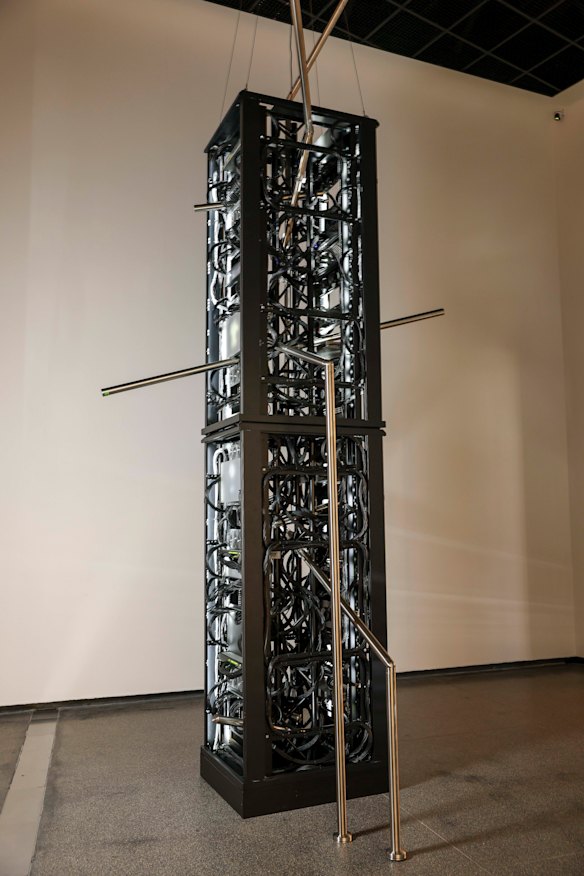 The work comprises two data towers stacked vertically, pierced with stainless steel handrails in what Bennetts jokingly calls an act of revenge.Eddie Jim
A large sculptural piece, it comprises two server racks, stacked one on top of the other rather than side by side as they usually are in data centres, their normal habitat. There are network switches, cooling fans, blanking plates, around five kilometres of cable, and eight screens.
“They’re all veiled behind acrylic,” she says of the monitors that flicker with the vague impression of images. “I wanted to make it really obscure because we’re just so glued to our screens without thinking of what infrastructure is driving them. And I think this veil or invisibility is what tech CEOs particularly hide behind.”
The whole tower is pierced at multiple points by stainless-steel handrails, “an assistive technology” on which Bennetts has increasingly had to rely. She likens their presence in the work to the arrows piercing the body of Saint Sebastian in religious paintings from the Renaissance.
“I wanted it to be violent,” she says. “By trying to pierce it, the steel wounds it.”
‘I wanted it to be violent. By trying to pierce it, the steel wounds it.’
Amanda Bennetts
Bennetts is unequivocal when I ask if she’d be happy to have the piece in her own home, an old Queenslander.
“Oh, absolutely not. It’s just so brutal looking, not pleasing at all. I wanted it to feel uncomfortable to look at and imposing. I definitely don’t shy away from art that is uncomfortable.”
The piece takes its title from a Latin phrase used to describe the connection between heaven, Earth and the underworld. The concept is present in many religions and cultures, and has symbolic parallels in the way we understand and relate to man-made structures such as skyscrapers, as well as natural ones such as mountains. And, Bennetts suggests, there’s something of the way tech bros have co-opted the imagery of the mountain as a challenge to be conquered at play here, too.
She calls the piece “a techno-fascist monument”, and says she can’t imagine anyone wanting to buy it. “It would be great if an institution would buy it because I think it’s super timely, but technology art also dates quickly, aesthetically.”
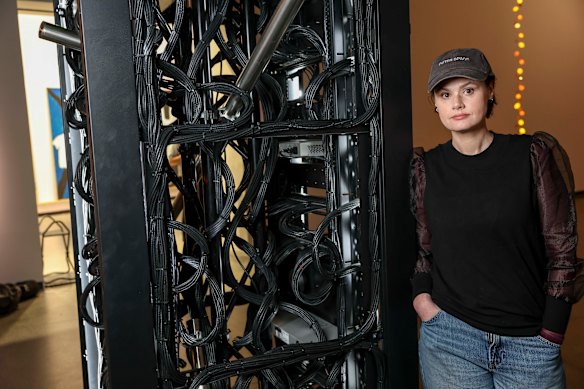 Bennetts calls her work a “techno-fascist monument”.Eddie Jim
There’s a rage against the machine element to this work, but Bennetts says her own view of technologies is “on the fence”. Data can be helpful in tracking and predicting how her body will behave – though in an earlier art-science project she realised technology is much better at doing that en masse than it is for an individual – “but what’s happening at the moment is pretty scary as far as the way it’s changed how we socialise and interact with people, how people are addicted to their phones”.
Mostly, though, she wants to draw attention to the enormous shift that’s under way in our relationship with technology and data.
Editor’s pick
Substitute the word “algorithm” for “God”, she says, and the sentence generally holds.
“We put so much mysticism on technology, all the things that we can’t see, and when you’ve just been diagnosed with a very serious disease and you get an ad for a coffin or a funeral home it acts as a rupture or a puncture. You can’t help but think, ‘Well, it knows something’.
“It’s not the case, though. It’s just picking up your searches and your worries and following you around everywhere.”
New26 is at the Australian Centre for Contemporary Art, 111 Sturt Street, South Melbourne, until November 22.
The Booklist is a weekly newsletter for book lovers from Jason Steger. Get it delivered every Friday.
Save
You have reached your maximum number of saved items.
Remove items from your saved list to add more.
From our partners