
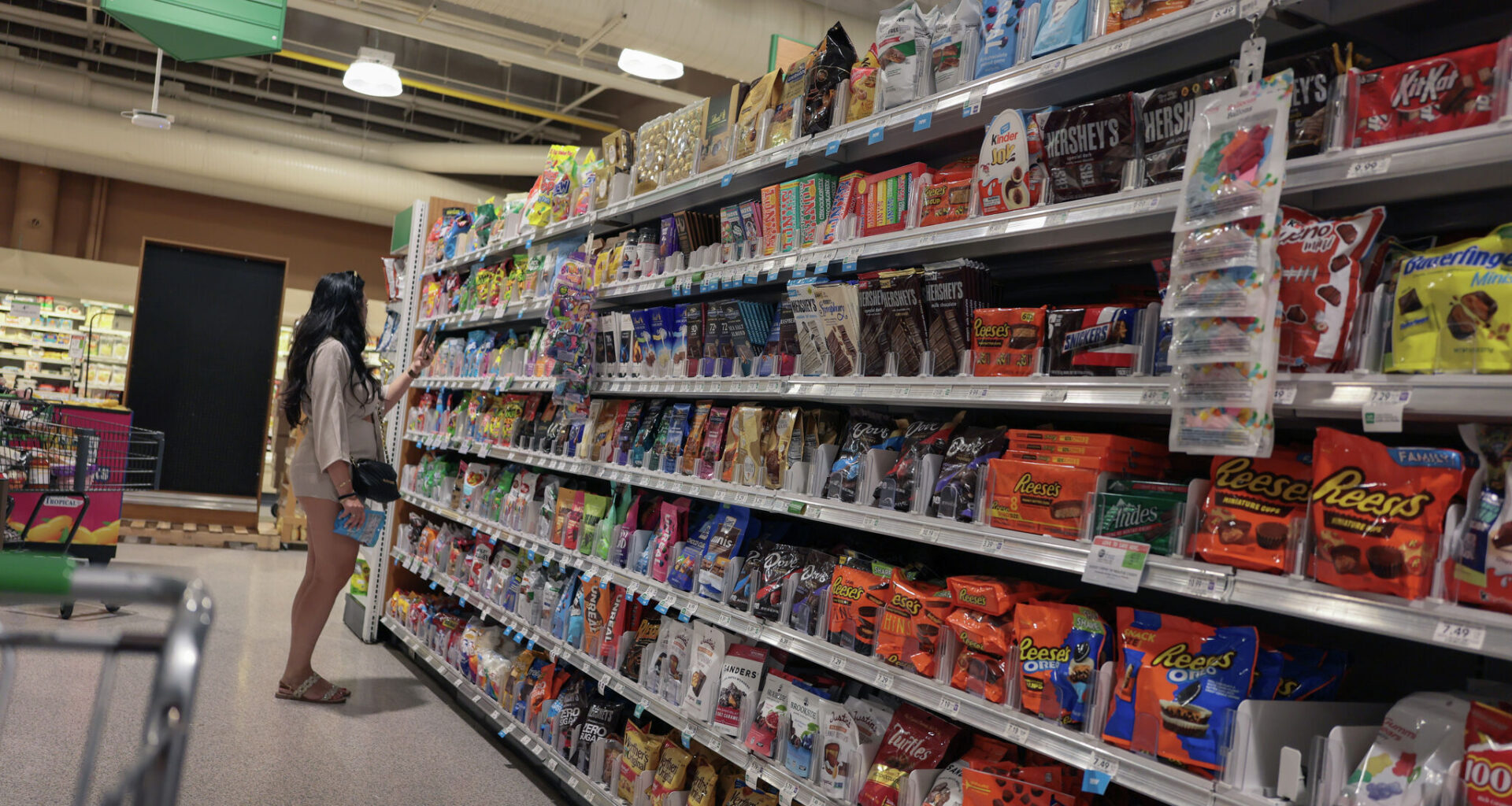
Bags of candy are displayed on a store shelf in Miami in April. A small UCSF study found that participants who cut almost all ultra-processed foods from their diets experienced a significant drop in depression symptoms.
Joe Raedle/Getty Images
A small UCSF study found striking drops in depression symptoms among people who dramatically changed their diet to cut out almost all ultra-processed foods.
The results do not suggest a panacea for depression — no one is going to tell people who are depressed to stop eating potato chips if they want to feel better. But they do highlight the close tie between diet and mood, and imply that what people eat could be a target for treatment of depression, which is a widespread and in some cases intractable problem.
“It opens the door to a new field of inquiry for depression research,” said Dr. Andrew Krystal, a UCSF psychiatrist and senior author of the study. “We attack things with expensive, high-tech solutions, like medications, which is a good thing. But diet has been neglected.”
Article continues below this ad
Depression affects nearly one in five adults in the United States, according to the Centers for Disease Control and Prevention. Though treatments exist that can help many people manage the disorder, some cases are more difficult. And the condition is so widespread that many people go without care simply because there aren’t enough providers to see them.
That’s why finding new therapies for depression and other mood disorders is so important, say experts in mental health.
Scientists have long been aware of the tie between diet, the gut and mood orders like depression. Studies have found correlations between the Mediterranean diet, for example, and lower rates of depression and anxiety.
Indeed, the vagus nerve, a major neural connector between the brain and the body, has masses of connections to the gut. “So truly what’s happening in the gut has direct effects on neural pathways,” said Dalia Perelman, a research dietitian at Stanford.
And most people are aware to some degree of how their diet can affect the way they feel: Who hasn’t been “hangry” before? Or felt the crash after a heavy meal? Delicious foods can even have an uplifting effect.
Article continues below this ad
Untangling the role that diet plays in mental health is challenging, though, because food interacts with all parts of the body. And the effect goes both ways — what people eat affects how they feel, and how they feel affects what they eat.
Ultra-processed foods could be causing harm to mental health through a variety of mechanisms — perhaps their high fat and sugar content causes certain hormones to be released that can affect mood. Or they may contain additives that are causing consequences in the brain.
“The brain is so sensitive to the impact of diet,” said Maryam Makowski, a medical nutrition scientist at Stanford. “There are a couple of studies that showed if you eat processed food that is high in sugar and fat today, you will feel worse two days later. But you can also feel changes in days or even hours.”
Dr. Nyasha Chagwedera, first author of the UCSF study, said ultra-processed foods may be causing damage to the gut that is then having more widespread effects.
“This gut damage can create low-grade, chronic inflammation throughout the body that either directly causes depression or makes people more vulnerable to it,” said Chagwedera. “In other words, junky processing may harm your gut in ways that ripple up to your brain.”
Article continues below this ad
Ultra-processed foods, which are generally laboratory-engineered to be more palatable and last longer, aren’t inherently bad. But scientists can’t say exactly how they may be affecting the body and mind. The new study out of UCSF, published last week in the journal JAMA Psychiatry, is among the first to demonstrate that removing those foods can result in a quantifiable reduction in depression symptoms.
The study included just 20 participants, many of whom were recruited from the waiting list for UCSF’s depression clinic. All of the participants were depressed, most also had an anxiety disorder, and all were overweight and had at least one metabolic disorder.
The participants were coached to remove almost all ultra-processed foods from their diets. All of the participants spent four weeks on their regular diet and four weeks on the diet low on processed foods, and the scientists compared their depression symptoms during both time spans.
The main goal of the trial was simply to see if it was possible for participants to make major changes to their diet. During the trial, participants managed to reduce their ultra-processed food intake by 85%, and their depression dropped significantly during the weeks they cut those foods.
“Reducing the amount of ultra-processed food in our diet can be challenging, because it’s highly palatable, cheap, and convenient,” Chagwedera said. Since she’s shown that it’s possible to get people to change their diet, Chagwedera is now planning a follow-up study with more participants.
Article continues below this ad
Perelman and other scientists noted that it’s not easy for many people to make major diet changes, especially when it means cutting out foods that are engineered to be tasty and habit-forming — and even more so when people are already depressed and not feeling motivated.
But they added that major changes might not be necessary, and even small shifts in a diet could improve people’s mental health. Diet could be one intervention, and a relatively cost-effective and adaptable one, that helps people before they seek care or while they’re waiting for more help.
“I’ve learned that baby steps, just very slowly changing the diet, is the best way to do it,” Perelman said. “You’re building success because you’re like, ‘Yay, I added an apple a day or a yogurt a day.’ Instead of ‘Wow, I’m still eating fast food,’ let’s focus on the positive and keep the momentum going.”
“I just don’t want people to keep thinking all or nothing about food. It’s not that ultra-processed foods are all bad and they cause depression — it’s more nuanced than that,” she said. “A diet that once in a while includes an ice cream sandwich is fantastic.”
Article continues below this ad