
 Over a dozen native white ibis were killed, injured or displaced at a property managed by a global company in 2024. What happened next has been linked to a $9.1 million funding dispute.
Fri 2 October 2026 at 12:06 am UTC


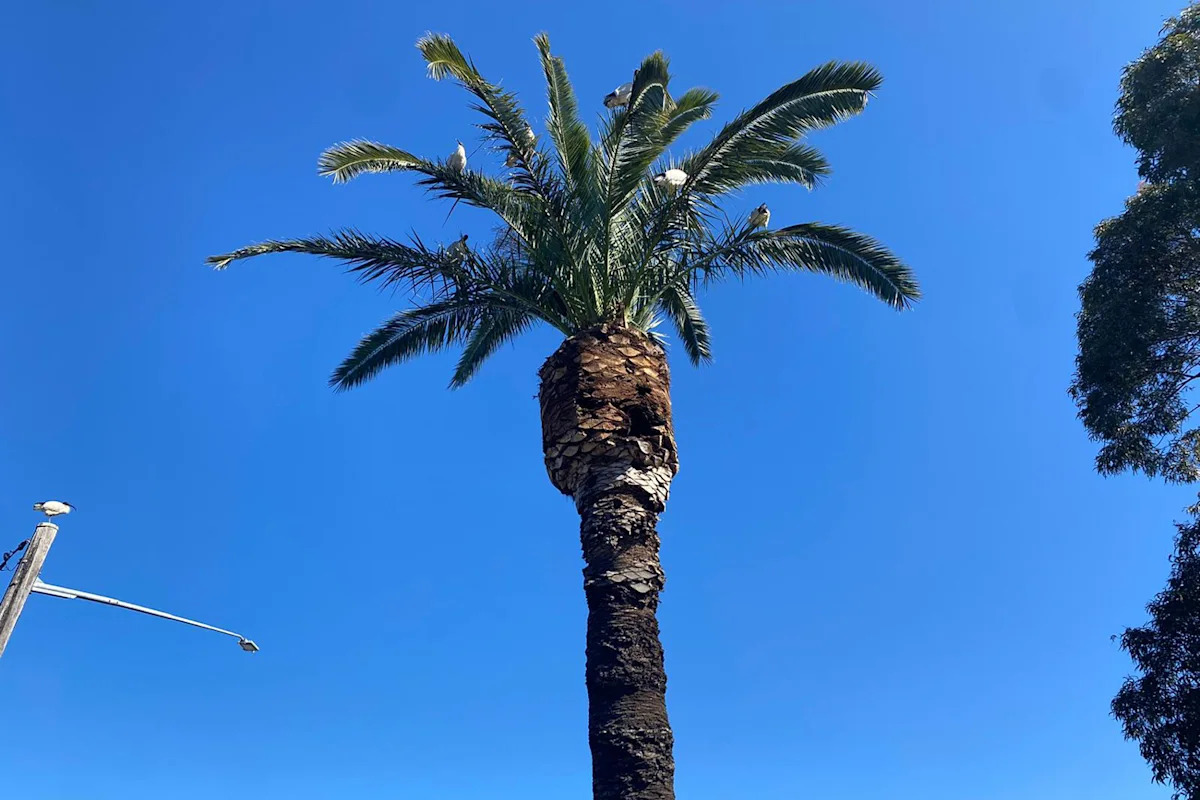
Ibis were nesting in these palm trees at the ESR-managed Chullora Business Park before contractors trimmed their branches. Source: Supplied
A two-year investigation into the “massacring” of ibis at an Australian business park has failed due to a “misunderstanding”, highlighting the shortcomings of authorities in NSW to investigate allegations of wildlife crime.
The outcome is not surprising to the Sydney-based rescue volunteers who painstakingly photographed the scene and then cleaned up the blood, body parts, and feathers.
The investigation into the white was sparked on August 2, 2024, when wildlife volunteers received multiple calls about a “critical rescue” at the ESR-managed Chullora Corporate Park.

Photos and video taken that day show a nightmarish scene:
Decapitated birds.
Blood strewn across the car park.
Abandoned nests full of eggs lying in the gutter.

Multiple ibis were found dead at the ESR-managed Chullora Business Park, west of Sydney. Source: Supplied
In 2024, rescuers raised doubts that anyone would face consequences, so Yahoo News resolved to monitor the incident to examine how well NSW animal cruelty laws were working.
The case was investigated by RSPCA NSW’s Inspectorate as a potential breach of the Prevention of Cruelty to Animals Act (POCTAA).
It, along with the Animal Welfare League NSW (AWL), has been granted Approved Charitable Organisation (ACO) status by the NSW Government, giving it the authority to investigate and prosecute.
But this enforcement system is “failing” because of underfunding, according to politicians, rescuers, and many within the charity itself.
RSPCA employees have admitted to Yahoo that budget shortfalls are impacting the Inspectorate’s ability to investigate alleged crimes, including the “ibis massacre”.
“It’s frustrating,” said one inspector, who did not have permission to speak publicly on the matter.

Three decapitated ibis were discovered by wildlife rescuers. Source: Supplied
RSPCA reveals why ibis investigation ended
RSPCA’s decision to lead the investigation was made when the charity was flush with cash after receiving $20.5 million from the NSW government during the 2023/2024 financial year.
But on November 4, around two months after the Ibis incident, the RSPCA faced a bombshell — it would receive just $11.376 million for 2024/2025.
The amount was $9.1 million less — roughly a 50 per cent drop — on the previous year.

Funding has fluctuated between 2022 and 2026. Image: Getty, Source: RSPCA/NSW Government
Running the Inspectorate was set to cost $23.129 million, and so it had to find an additional $11.753 million in funds.
The situation didn’t improve in 2025/2026 when it lowered its forecast to spend $18.637 million and received $9.856 million.
RSPCA reveals two problems that ended the investigation
Over the next two years, RSPCA tightened its belt and reduced its workforce from around 60 inspectors to mid-30s.
During this time, Yahoo requested updates from the charity about the ibis, but it declined to comment because the matter was still under investigation.
Behind the scenes, the Inspectorate was facing multiple hurdles, including issues in finding those responsible and dwindling staff.
Then, in September 2026, the investigation abruptly ended, and RSPCA agreed to talk.
Its Chief Inspector, Scott Meyers, still wouldn’t discuss specifics, but he confirmed two key things:
The investigation was complicated.
Like many real estate managers, global firm ESR had used third-party contractors to carry out work, making it hard to identify those responsible.
“The company was interviewed, and they provided information about contractors,” Meyers said.
“Then people that had initially spoken to us went MIA, and that’s when it became difficult.”
Roughly 18 months after it began, RSPCA’s lawyers determined that its Inspectorate could not establish charges under POCTAA.
The investigation ended due to human error.
It was now February 2026, and only six months remained before the statute of limitations ended.
But crucially, lawyers believed there was a second option to pursue the matter.
Ibis are native birds — which means they are protected by both POCTAA and the Biodiversity Act — so they suggested handing the case to the NSW Department of Environment (DCCEEW).
What happened next silently brought the investigation to a close.
At the time, Meyers was overseeing multiple cases, and he admits there was a “communication breakdown” when he attempted to refer the matter over to DCCEEW by phone.
“I determined that I made the referral when I spoke to them, but when they came back saying they hadn’t received anything, I sent an email to them,” he said.
The error was only revealed after Yahoo asked both RSPCA and later DCCEEW for an update.
At face value, this “miscommunication” was a human error. But on closer inspection, it was driven by an Inspectorate struggling with heavy workloads.
Privately, RSPCA sources say even long-term cases “can fall through the cracks”.
State unable to investigate potential offences
DCCEEW noted the Chullora incident “involved multiple potential offences against both animal cruelty and wildlife crime legislation”.
However, even if the case had been handed over earlier, it may have struggled to investigate what were now historic alleged offences.
But DCCEEW’s hands were completely tied in September because more than two years had passed since the incident.
“Unfortunately, as the statutory limitation period has expired, no enforcement action is possible, and no further investigation will be undertaken,” a DCCEEW spokesperson told Yahoo.

In some instances, eggs were found smashed on the ground, in others, they were placed in gutters while still in the nest. Source: Supplied
Real estate company silent after investigation
The exact details that led to ibis being killed at the Chullora Corporate Park will likely never be known.
RSPCA has declined to provide specific details of the case. And DCCEEW never investigated.
Meanwhile, ESR — a company incorporated in the Cayman Islands and listed in Hong Kong, with a subsidiary in Australia — has been silent on the matter.
ESR declined to be interviewed immediately after the incident, but in a statement issued through a PR company, claimed it was investigating and taking the allegations “very seriously”.
It has not responded to subsequent requests from Yahoo for an update, and there is no public record of the outcome of its inquiry.
RSPCA struggling to enforce animal protections
The event at Chullora Corporate Park was just one incident.
RSPCA’s contact centre receives around 100,000 calls a year, of which 30,000 are cruelty complaints.
This is generally whittled down to roughly 20,000 cases, and in recent years it’s been slashed further to 10,000 due to dwindling capacity.
Each member of its Inspectorate team often handles 10 to 15 cases at any given time, and insiders within the organisation confess that this is affecting performance.
Often, they travel long distances to investigate alleged POCTAA breaches because funding uncertainties have left RSPCA with vacant positions in Albury, Bathurst or Orange.

Small pieces of flesh and blotches of blood were found in the car park. Source: Supplied
Much of the central and southwest of the state remains unmanned because the charity doesn’t want applicants to quit their jobs, move to regional areas, and then be let go if the budget takes a hit.
Within RSPCA, there are concerns that failures by its Inspectorate could lead to reputational damage.
RSPCA lowers expectations of Inspectorate
For the 2026/2027 financial year, RSPCA has lowered expectations and proposed spending $15 million on the Inspectorate.
It has requested $9.8 million from the government and proposes to spend $5.2 million from charitable funds.
What this would mean for animal welfare enforcement is unclear.
Looking at the white ibis alone, the species faces an onslaught of environmental threats, and advocates argue its protection is more important than ever.
It’s survived inland drought and habitat loss by moving towards the coast and settling in Sydney, where it scavenges for scraps and is affectionately known as the “bin chicken”.
But this year, the federal government warned it has a “very high” susceptibility to H5 avian influenza, which was detected in Australia in June.
It is considered at risk of severe drought, intensified by climate change, as well as habitat destruction and alteration, which also concern experts.
Government claims animal welfare wins
The Minns Government maintains the 2023/2024 funding boost of $20.5 million was intended as a one-off “grant”.
And when that blip is taken out of the mix, NSW Primary Industries Minister Tara Moriarty maintains funding has actually risen “significantly”.

Agriculture Minister Tara Moriarty and Animal Justice Party MLC Emma Hurst disagree on whether RSPCA funding is adequate. Source: AAP
Money for the Inspectorate comes from both her department (DPIRD) and the Office of Local Government.
In 2022/2023, the two ACOs received around $3.1 million ($2.924 million went to RSPCA), but only $499,000 came from DPIRD. Last year, after Moriarty took over the portfolio, it increased to almost $13 million.
“During these years, the NSW government has also provided funding to the RSPCA in regard to non-compliance matters covering animal shelters and capital assets,” Moriarty told Yahoo.
Funding situation described as absurd
The Shooters, Fishers and Farmers Party MLC Mark Basniak and Animal Justice Party’s Emma Hurst often have polar-opposite views on animal welfare.
But after leading an inquiry into the enforcement of POCTAA, they both agreed on one thing — the current model was “failing”.
During the inquiry, RSPCA CEO Steve Coleman confirmed discussions had taken place about ceasing its enforcement role, although no decision had been reached.
Speaking of funding fluctuations, he said, “The uncertainty and the disruption are not sustainable”.
Basniak, the inquiry’s chair, told Yahoo this week that if the government continues to use third parties, like RSPCA and AWL, to enforce animal welfare laws, they should be fully funded.
Speaking before parliament in June, he called the situation “absurd”, adding that the NSW Police would not be asked, “to run a raffle to pay for a criminal investigation”.

In 2024, rescuers documented the nests dumped on the ground at the business park, but they had little faith anyone would be held to account. Source: Supplied
Hurst, the inquiry’s deputy chair, wants to see an independent office of animal welfare either policing or overseeing fully-funded ACOs.
“The government has outsourced the policing of serious criminal offences to charities and then drastically underfunded and under-resourced them to do this work,” she told Yahoo.
“The question isn’t simply whether the RSPCA has failed in individual cases. It is why successive governments have built an animal protection system where failure is almost inevitable.
Why transparency matters
For the wildlife rescuers, there was a glimmer of hope after the ibis massacre when eight juveniles were rescued from the ground.
All were taken to RSPCA’s Sydney veterinary clinic.
But for two years, the charity refused to disclose to Yahoo what happened to them, because the wider incident was under investigation.
This frustrated rescuers, who wanted confirmation on what happened to the birds. They argued that the investigation and the euthanasia should be separate matters in terms of transparency.
In September 2026, RSPCA confirmed all were euthanised.
Two because of health complications — plastic ingestion and a fractured leg — and the others because the charity believed no carer would take them.
In Australia, almost all wildlife rescue and care is conducted by volunteers, and at the time, RSPCA explained it did not have access to trained wildlife carers.
It maintains rescue non-profit WIRES advised that no vet clinic or organisation had capacity to take the ibis, and this informed the decision.
WIRES responded, saying its staff are not in a position to advise on euthanasia.
While carers from the smaller Sydney Wildlife Rescue have privately told Yahoo they were available.
Both Hurst and Basniak argue that if RSPCA is fully funded and has the same investigative powers as government agencies, then it should be required to provide the same level of transparency.
You can also follow us on Facebook, Instagram, TikTok, X and YouTube.