
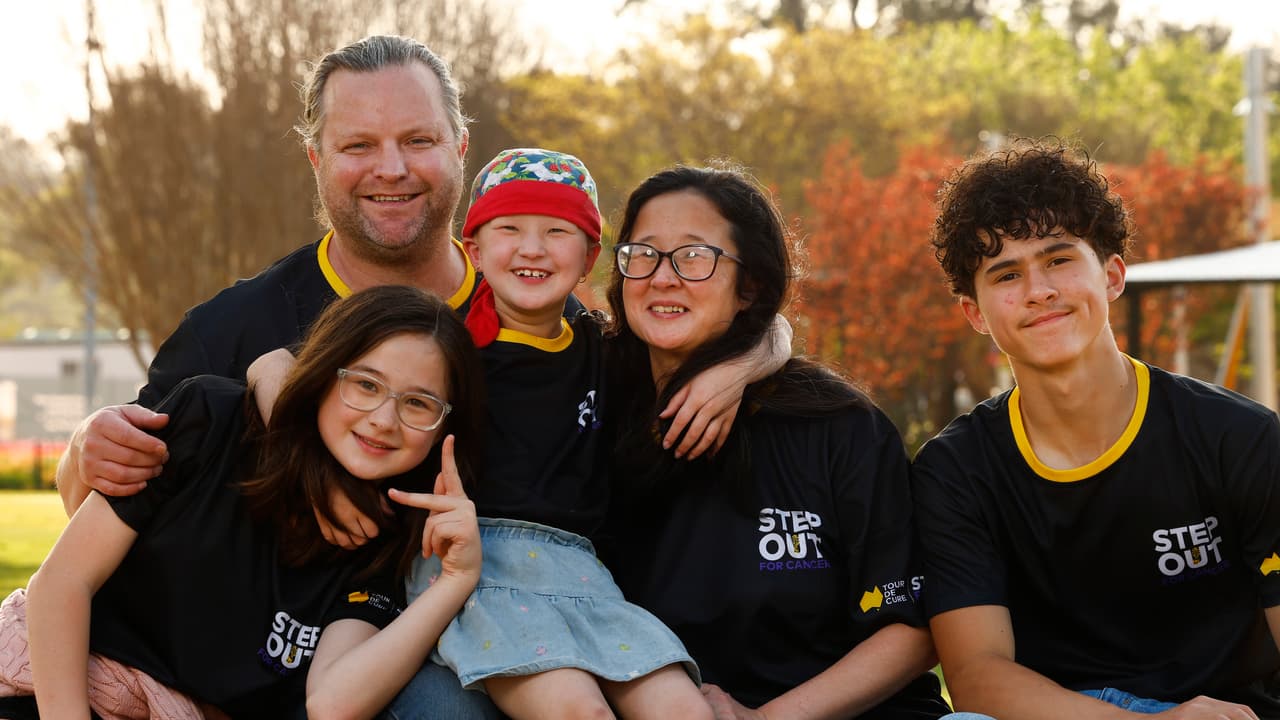
To Chrissie Fitzpatrick, her daughter Zara is the “meaning of brave”.
Her “smart, resilient” nine-year-old daughter still bears the marks of a health battle which nearly claimed her life, at the same age other children were learning to walk and talk.
Fitzpatrick and her husband Ryan initially dismissed their third and youngest child’s gripes when she began complaining of a sore leg in 2019, aged two.
“She used to say her leg was sore a lot of the time; we were just thinking it was growing pains,” Fitzpatrick says. “But then over about a week, for a few days she wasn’t weight-bearing (on the leg) very much at all, and she had a really high fever.”
The Fitzpatricks took their toddler to hospital, where Zara’s pain was initially diagnosed as a suspected bone infection. But after spending a week there, the family returned for her to have more tests at the request of clinicians.
“At first they thought it was a broken femur and a bone infection, because she had all the symptoms,” Fitzpatrick says.
“She had a fever, wasn’t weight-bearing and she was really pale. They did her bloods, they were looking to see what it could be, and they looked and said, ‘Oh, it looks like it’s leukaemia’.”
Zara was diagnosed with acute myeloid leukaemia, an aggressive form of blood cancer where the cells in her bone marrow – which create red and white blood cells and platelets – multiply uncontrollably, leaving no space for healthy blood cells.
Fitzpatrick says she struggled to wrap her head around what her daughter was facing.
“In some ways it feels so long ago, but otherwise it feels like it was only yesterday,” she says. “Walking out of the doctor’s office, I couldn’t even pronounce (the disease name), like ‘What was that?’ Everything just came crashing down.
“Zara was a surprise pregnancy, we already had a boy and a girl. I wouldn’t say I felt guilty, but when she got sick, part of you always blames yourself, like, ‘Is it something I did, or maybe because she wasn’t planned.’ It’s fine now, I realise it’s not my fault or anyone’s but it’s something that goes through your head.”
The family of five’s lives changed rapidly. Zara was moved into Sydney Children’s Hospital to begin four brutal rounds of chemotherapy. She was too young to understand what was happening, so her parents swapped between staying in the hospital for three to four nights each with their little girl, and working and caring for their other children, Sophie and Rory, then aged four and eight.
“Zara spent a lot of time in isolation; she was so little and didn’t understand … we were just taking it day-by-day, week-by-week, it’s all we could do,” her mum says.
“She went into remission after the first round, but they do the full four just to be sure it’s gone. The hardest period was where she was in the same room for like three weeks in isolation after treatment. She went a little stir crazy I think. You can imagine being cooped up in a room for three weeks, even though she didn’t feel well, she was ready to get out of there.”
The toll of treatment on Zara was something the Fitzpatricks couldn’t ignore, with the latter stages of chemotherapy leaving her skin a sunburnt red and swelling her eyes tight shut.
“I’m not sure I knew the meaning of brave until I watched her go through that. Brave isn’t enough of a word, but that’s the best word I’d use,” Fitzpatrick says.
“There were days where I look back and don’t know how we got through it. Those days, they were just really, really hard.
“We know of families who have lost their child … but we just had to focus on the positive and that she would get through it, when there are children that don’t.”
Zara found comfort in playing with her older siblings, whose visits to her hospital bed “lit her up”, and was allowed to return home to spend Christmas with her family in between rounds of chemo.
“The girls are very close, so Sophie used to like coming to the hospital and visiting ‘Bubby’ – she calls Zara ‘Bubby’ – she’d come and see her, and play with her, and I think that cheered (Zara) up a lot,” Fitzpatrick says.
“But we also had a good support network around us – our family, my in-laws – who helped keep things normal for our other kids. The hospital staff and all the doctors were amazing.
“Zara slept a lot so the nurses would offer to keep an eye on her so I could duck out, grab a coffee and take a moment for myself.
“But also the other parents with kids in the ward. They knew what it was like, to have someone who knows exactly how you’re feeling.
“I became friends with one whose son had the same type of cancer as Zara … he was diagnosed just before us so I would often ask (his mum) questions and find out what to expect; it was so good to have that support. And if we have appointments together, we try and catch up, all of us.”
Despite treatment’s challenges, in early 2020, Zara finished all four cycles and was allowed to go home.
“For the first two years it was hard, every little thing I would freak out about, reaching out to her specialists or GPs,” Fitzpatrick says. “But as time has gone on, we’ve been able to watch and see how she goes, and she’s doing really well.”
Zara, to this day, remains cancer-free. She has grown into an energetic, happy nine-year-old who loves reading and watching YouTube, with her months spent in hospital now all but forgotten.
“She remembers being sick. I don’t think she remembers it actually but she’s seen the photos and knows she was very sick,” her mum says. “We’ve told her she had cancer when she was very little, but we don’t speak about it a lot as it’s something she still can’t quite understand. But as she gets older, we will talk about it more.”
The impact of her battle still affects Zara every day. Now in Year 4 at school, she is much smaller than her peers, and recently developed alopecia, losing much of her hair.
But the gutsy girl has again bounced back, taking her differences in her stride by wearing colourful head scarves with pride.
“You do have some dark thoughts at the time when it’s hard, but for her to come out the other side, it was a blessing,” Fitzpatrick says.
“She’s very resilient, she’s kind of just accepted that she doesn’t have any hair. She’s seen photos of herself where she didn’t have any, so I don’t know whether it’s just because of that.
“(Other kids) can be kind of curious. We did have an incident at school where a boy tried to take her scarf off her head. It made her upset but he was spoken to and hasn’t done it again.
“But she’s good, she doesn’t (let anything slow her down), she’s full steam ahead.”
But while Zara’s battle has been won, 20 Australian children are diagnosed with cancer each week.
The Fitzpatricks hope other children and families won’t have to fight as hard as they did against the disease, and are taking part in Tour de Cure’s Step Out For Cancer fundraising push this month, where participants walk, run or move to fundraise for children’s cancer.
“(Childhood cancer) needs more funding, better funding for research so they can find better treatments, kinder treatments, as all treatments are designed for adults,” Fitzpatrick says.
“Until you’re in that space, ignorance is bliss. You don’t think about it if it doesn’t affect you, where the funding is coming from, who is doing the research behind the scenes. But it feels very rewarding to (advocate and fundraise).”
Zara is an ambassador for Step Out for Cancer 2026, a fun-filled, family event dedicated to fighting childhood cancer on Sunday, October 11.
Find tickets at stepoutforcancer.com.au
Originally published as Sydney mum’s warning after toddler’s sore leg turned out to be aggressive leukaemia