
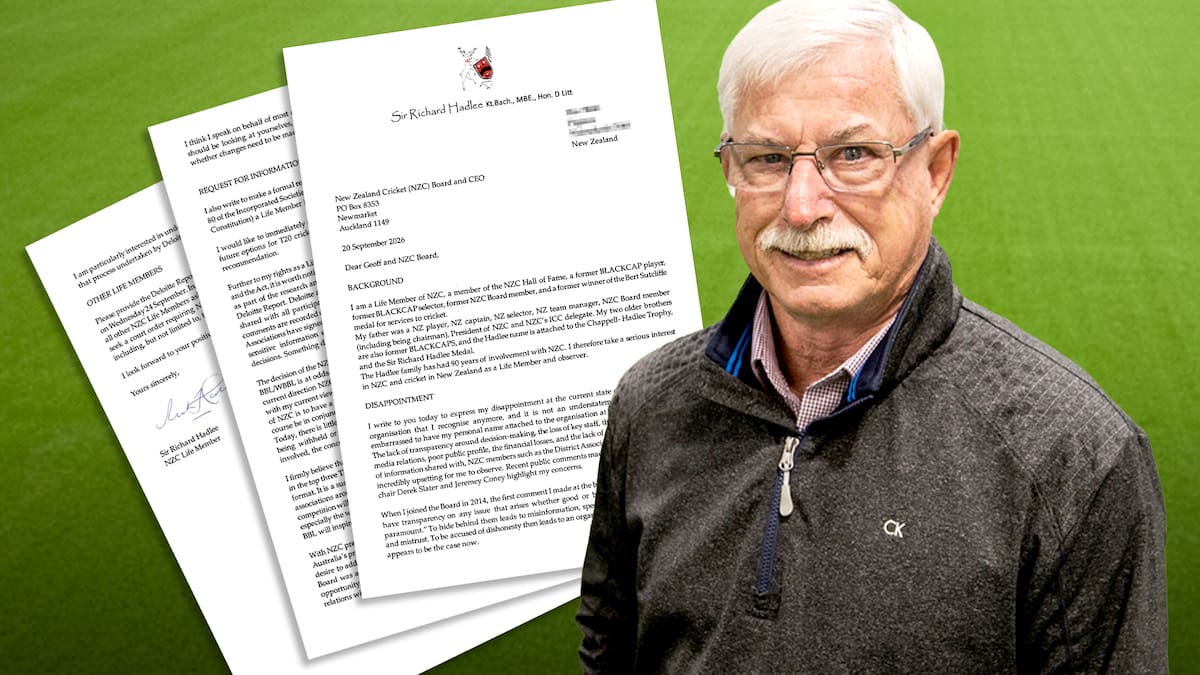
“It is not an organisation that I recognise any more, and it is not an understatement to say that I am embarrassed to have my personal name attached to the organisation at present.
“The lack of transparency around decision-making, the loss of key staff, the poor staff morale, poor media relations, poor public profile, the financial losses, and the lack of respect shown to, and lack of information shared with, NZC members such as the District Associations and life members, is incredibly upsetting for me to observe.”
NZ Cricket has today responded to the letter, with Allott defending the organisation and painting an optimistic picture of the sport’s future, while Hadlee reiterated to the Herald that he wanted to see the board step aside.
Hadlee said some people might ask whether his concerns were justified. “My answer is unequivocally yes.”
An NZC spokesman said: “The chair has confirmed that no board member has indicated that they will be standing down”.
Sir Richard Hadlee appeals, successfully, during his 9-52 haul against Australia in Brisbane in 1985 and (inset) at the NZ Cricket Awards in March 2026. Photos / Photosport
Hadlee’s letter follows a turbulent year for NZ Cricket in which its former chief executive Scott Weenink was effectively forced out of the role, amid a political power play over the future format of New Zealand’s T20 domestic competition.
Morale at the organisation has fallen, and it announced last month a preliminary $7.3 million loss for the July 31 financial year, a material change from the budgeted forecast deficit of $1.8m.
Hadlee, 75, played 86 tests and 115 one-day internationals for New Zealand, holding the world record at one stage for test wickets. He was the first player to take 400 test wickets, finishing his career with 431.
The Hadlee family is cricketing royalty in New Zealand – Richard’s father Walter and older brothers Barry and Dayle also played for New Zealand. The family name is attached to the Chappell-Hadlee trophy – regularly contested between the Blacks Caps and Australia for one-day and T20 internationals. The Sir Richard Hadlee medal is also awarded each year to the New Zealand men’s cricketer of the year.
Hadlee is also a former NZC board member and said in his letter that when he became a director in 2014, his first comment at the board meeting was the need to be transparent “on any issue that arises whether good or bad. To front-foot any issue is paramount.”
In his letter, Hadlee reiterated his 2014 belief that hiding behind any issue would lead to misinformation, speculation, confusion, uncertainty and mistrust.
“To be accused of dishonesty then leads to an organisation lacking credibility, which appears to be the case now.
“I think I speak on behalf of most of the cricket community in New Zealand when I say that you should be looking at yourselves and your performances as CEO and governors and consider whether changes need to be made to lead NZC into the future.”
NZ Cricket chief executive Geoff Allott. Photo / Photosport
‘Something does not sound right with this report’
Hadlee also used the letter to formally request, as an NZC life member, a clean and unredacted copy of the recent Deloitte Report that assessed options for T20 cricket in New Zealand, along with NZC management’s supporting recommendation.
The spotlight has been on the NZC board after it opted for the privately run NZ20 competition – now scheduled to start in the summer of 2027/28 – rather than having a men’s team in Australia’s Big Bash League (BBL) and a women’s team in the corresponding WBBL.
Hadlee wrote in his letter that he was interviewed for the Deloitte Report.
“Deloitte and NZC management indicated at the time that their report would be shared with all participants in its preparation, including myself,” Hadlee wrote.
“I have no idea whether my comments were recorded correctly in the report, if in fact mentioned at all. I also note that Major Associations have signed non-disclosure agreements, [suggesting] the contents of the report [have] some sensitive information especially relating to Deloitte’s recommendations rationale and NZC decisions.
“Something does not sound right with this report.”
He said the NZC board’s decision to support the NZ20 proposal over the BBL/WBBL option was at odds with feedback he had given Deloitte and NZC management.
“… indeed the current direction NZC is taking in supporting the proposed NZ20 league still stands in conflict with my current view that the best option for NZC to secure the financial and operational future of NZC is to have a New Zealand team, or teams, participate in the BBL/WBBL. This could of course be in conjunction with a privatised league in New Zealand.”
Hadlee said the BBL was in the top three leagues in the world, with many superstars. “It is a successful and proven concept that will deliver much needed funding to all cricket associations around the country.”
Do you know more? Please email Shayne Currie – shayne.currie@nzherald.co.nz
Hadlee, whose storied career included taking 9-52 in an innings against Australia in Brisbane in 1985, said: “The transtasman rivalry will create a lot of interest and the competition will better the players’ skillsets and ability to compete better on the international stage especially the women’s game and grow our overall game at different levels. To have teams in the BBL will inspire younger players to aim big.”
The NZ Cricket board – chair Diana Puketapu-Lyndon (front) and (from left) deputy chair Kevin Malloy, Mike Devonshire, Alison Shanks, Bill Birnie, Roger Twose, and Anna Campbell. Photo montage / Phil Welch
He said NZC rejected Cricket Australia’s proposal to be involved in the BBL/WBBL “with little or no discussion”.
“I suspect our refusal to be part of the BBL will sour relations with CA at a time when we should be building relationships.”
Hadlee asserted there was “little or no information” about the NZ20 concept, which he believed “means any information is being withheld or NZ20 is having issues that need explaining, especially with those people involved, the concept, the format, financials etc.”
He was keen to understand “the findings, analysis and conclusions arising from that process undertaken by Deloitte and NZC management”.
NZ Cricket’s board comprises chair Diana Puketapu-Lyndon, deputy chair Kevin Malloy, and directors Bill Birnie, Anna Campbell, Mike Devonshire, Alison Shanks and Roger Twose.
NZ Cricket responds
The Herald approached NZ Cricket at 2pm on Friday, and at 2.44pm, Allott distributed the Hadlee letter to the chief executives of the country’s major cricketing associations.
Allott wrote in an accompanying email that Hadlee was “one of the greatest players our country has produced”.
“He has put his name to his concerns and raised them with us directly, which we respect and take seriously.
“Earlier this week, after I returned from my ICC meetings in Dubai, I went and sat down with Sir Richard at his home to discuss his concerns. Sir Richard is a hero of mine and someone I look up to immensely, and I wanted the opportunity to speak face to face.
“It was an open and honest conversation. It’s been a challenging year for NZC, and I acknowledged that. There has been much change, the cricket landscape is evolving rapidly, and NZC is being challenged to adapt.
“I took him through the progress with NZ20 and its incredible potential to transform cricket in this country from grassroots to the elite. I also explained the confidential nature of the Deloitte process, listened to his concerns, and I’ve agreed to increase our communication and engagement moving forward. We don’t agree on everything, and that’s okay. They’re genuine differences of opinion from people who care deeply about the game.”
Sir Richard Hadlee. Photo / Photosport
Allott’s email did not specifically address Hadlee’s suggestion that he and the board consider their futures. Nor did it indicate the Deloitte report would be released.
NZC has also not responded to specific questions from the Herald and says that beyond Allott’s email to the associations, there would be no further comment.
In his email, Allott said he was optimistic about the future of the sport.
“I’ve made it a real priority to get out into the network and listen. I’ve met every major association chair and CEO, many DA [district association] and club leaders, I’ve attended the NZC Community Cricket Hui, the High Performance forum and the Umpires and Match Referees forum.
“What I’m hearing is that our network is keen to move on from this challenging period and work together collaboratively to push the game forward.
“We’re lucky we have so many people who care deeply about cricket in this country, and while we’re not always going to agree on everything, I believe the network is aligned on moving forward together in the same direction.”
Hadlee comments further
Hadlee released a further media statement this afternoon.
“Over many decades, I have had a deep connection with cricket in New Zealand, both personally and through my family’s involvement in the game,” he said.
“As I outlined in my letter, the Hadlee family has had almost 90 years of involvement with New Zealand cricket, including as players, selectors, administrators and supporters of the game. It is from that perspective that I wrote to the CEO and board.
“My concerns are about governance, transparency, accountability and the future direction of cricket in New Zealand. Those concerns have developed over an extended period and are based on a series of events and decisions that, when viewed collectively, do not paint a positive picture of the current state of the organisation.
“I remain disappointed by the lack of transparency surrounding significant decisions that have been made by the board.”
Sir Richard Hadlee snares the wicket of Allan Border at the Basin Reserve in February 1986 – it was his 300th test wicket. Photo / Paul Estcourt
In particular, he believed the Deloitte report should be made available to those who participated in it.
“My view is simple. The longer the report remains unavailable to key stakeholders, the greater the speculation regarding its findings, recommendations and the decision-making process that followed. Transparency builds trust. A lack of transparency creates uncertainty, misinformation, speculation and mistrust. That was my view when I served on the board, and it remains my view today.
“Over the past 12 months there have been a number of developments that have raised concerns for me and many others across the cricket community.
“These include changes in board composition, the departure of key senior executives and staff, concerns regarding staff morale, concerns expressed by commercial partners and sponsors, and the treatment of key people within the organisation. Individually, some of these matters may be explained. Collectively, however, they warrant serious reflection by the board and leadership of the organisation.”
He confirmed he had discussed matters directly with Allott.
“Those discussions were constructive and I appreciated the opportunity to have them. However, I continue to hold the views expressed in my letter and remain disappointed that the Deloitte report has not been released more broadly.”
He wanted to see two things happen: the report should be released and the “current board should step aside and reapply through a genuinely independent appointment process, not one run by the MAs”.
“Such a process would allow members of the cricket community to have confidence that the board has been renewed and appointed through a transparent and independent mechanism.”
Hadlee also said he was not alone in holding his concerns. “A number of highly respected people within the New Zealand cricket network have expressed similar views, including former NZC president Lesley Murdoch, former New Zealand captain, Hall of Fame member, On The Front Foot podcaster Jeremy Coney, former New Zealand Cricket CEO Justin Vaughan, other life members and many individuals throughout the wider cricket community.
“Their concerns may not be identical to mine, but they reflect a growing unease about the direction and governance of the organisation.”
He wanted to make clear that his concerns came from “a deep love of cricket and a desire to see the game thrive”.
“New Zealand cricket has achieved extraordinary things over many years and has been served by many outstanding people. I want to see the sport continue to prosper, strengthen its relationships throughout the cricket community, and regain the confidence of its stakeholders.
“Good governance depends on accountability, transparency and trust. In my view, those principles need to be restored and strengthened if NZC is to move forward successfully.”
A turbulent year
Hadlee’s letter follows a turbulent year for NZ Cricket.
Chief executive Scott Weenink resigned in December last year and officially left the organisation in late January. That followed a widely reported political power struggle over the future shape of the domestic game.
NZ Cricket chair Diana Puketapu-Lyndon (left) and former chief executive Scott Weenink. Illustration / Oliver Rusden; photos / AFP, Photosport
Weenink was effectively chased from the role after a falling out with NZC’s six major associations (Northern Districts, Auckland, Central Districts, Wellington, Canterbury and Otago) and the New Zealand Cricket Players Association, specifically over their push and support for the breakout, private franchise T20 competition.
A subsequent, savage internal NZC staff survey, leaked to the NZ Herald, took aim at the board.
A summary accompanying the staff survey said: “A significant portion of staff believe Scott was not supported by the board and was effectively forced out due to external pressure from parts of the network (major associations, cricket players association, NZ20 stakeholders). Many comments explicitly state he ‘did not want to resign’ and was ‘left with no alternative’.”
There were dozens of individual comments in the survey, many of them disparaging of the board. Some staff were said to be “in tears”, “visibly upset” and “deeply unsettled”.
“There have been no actions from the board to give me confidence in the organisation’s direction in the short to medium term. I am fully supportive of the SLT [senior leadership team] but am very disappointed in a weak board,” said one staff member.
The Herald put these concerns and claims to Puketapu-Lyndon in March. She said at the time: “We’re not comfortable discussing documents that were never intended for public discourse and will therefore decline to elaborate on your questions regarding staff surveys or private correspondence”.
The Herald subsequently revealed that the board had hired a forensic investigator to try to find out who had leaked the material, as well as other documents.
According to sources, some staff believed the move was a “witch hunt” – it is understood the investigation did not find any evidence that pinpointed a leaker or leakers.
The Herald then revealed in June that NZ Cricket’s top public relations leader had terminated his contract with a pointed, parting shot at the sport’s governing board, saying he has lost confidence in its integrity.
Richard Boock told staff in that email that “stepping away” had been “one of the hardest decisions I’ve had to make”. It was a “sad” decision and “a wrench to have to leave”, he wrote.
“I have enormous respect and admiration for you all; the dedication, the expertise, and the genuine care you bring to your roles every single day. It’s been a privilege to work alongside you.”
But he also went on to outline his view of the board.
“As you’re aware, I’ve deliberately avoided describing the reason for my departure as being ‘not aligned’ with the board, because I think this sounds like a disagreement over policy or strategy.
“My concern is simpler and more fundamental: I’ve lost confidence in the board’s integrity.
“At the end of the day, trust is everything.”
Former NZ Cricket public affairs manager Richard Boock, inset, had been with the organisation for the past 13 years.
NZ20 saga
The saga over the future summer T20 competition caused tumult within NZC, and even among board members.
In late March, the board announced the NZ20 competition, featuring privately owned teams, would replace the Super Smash competition.
NZC board member and former Black Caps cricketer Dion Nash resigned from the NZC board hours after that decision was announced.
Former New Zealand Cricket board member Dion Nash. Photo / NZME
NZ20 was originally due to start in the 2026/27 summer, but it has been pushed back a year.
As well as Weenink, Nash and Boock leaving NZ Cricket, chief strategy and financial officer Ben Kay also departed the organisation.
District associations
The Post reported on September 17 that grassroots district cricket associations wanted access to the Deloitte Report.
“Our interest in it is to be able to form a view as to whether the rules or constitution of NZ Cricket has been followed in terms of how they make decisions and for what reasons,” Northland Cricket chair Derek Slatter told the newspaper.
“The constitution, as does ours and that of the major associations, all say the same thing really, which is that the professional game is a means towards supporting the grassroots game.”
He said at one stage a NZC board member had told him that the BBL had never been an option.
“So if it had never been an option, why did they spend what was probably between $500,000 and $1 million on a Deloitte report? Things like that don’t fill you with confidence.”
Editor-at-large Shayne Currie is one of New Zealand’s most experienced senior journalists and media leaders. He has held executive and senior editorial roles at NZME, including managing editor, NZ Herald editor and Herald on Sunday editor and has a small shareholding in NZME.