
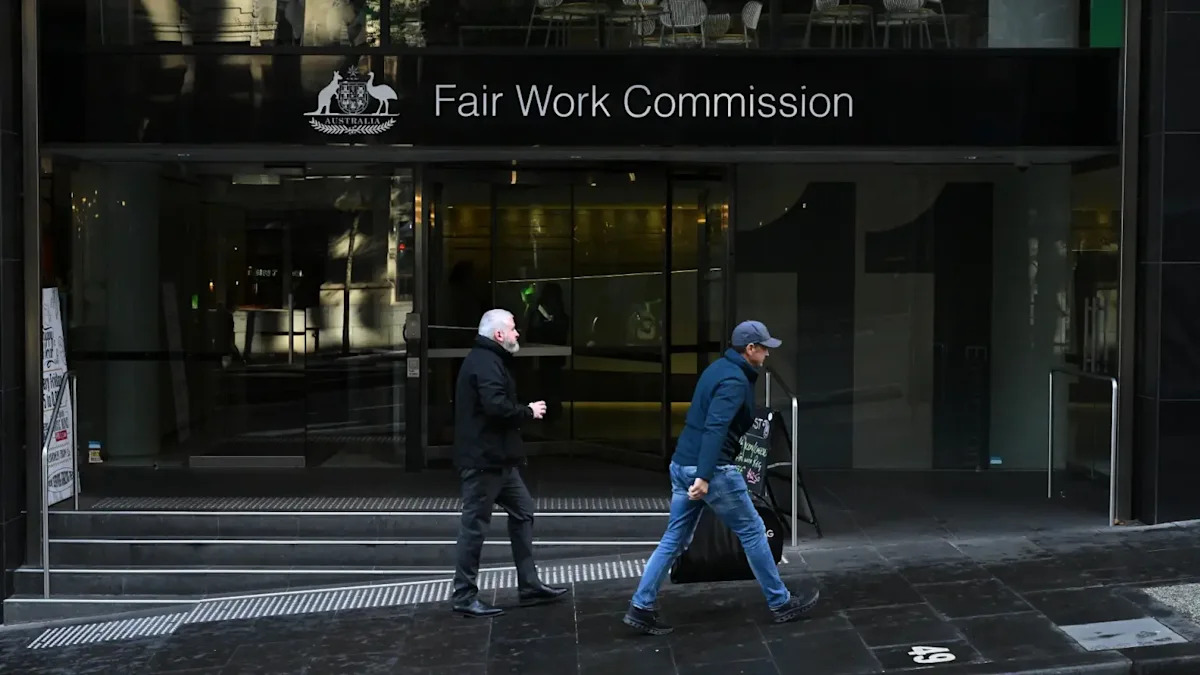
The Fair Work Commission’s changes to AI use will be put in place from October 20 as claims reach record numbers. Between July 2025 and July 2026, 44,039 claims were lodged, which the commission believes were driven by a growth of Australians using artificial intelligence for legal advice.
Barrister Ian Neil says the changes will, broadly speaking, require parties to disclose the use of AI, as well as explain how any generative AI tools were used in their case.
“There will also be new requirements of verification, where the party using AI will have to personally check all of the facts, the evidence, the legislation, the cases, the quotes, and so on,” he told Yahoo Finance.
RELATED
It’s a big change being introduced by the commission, but Neil said authorities aren’t intended to preclude the use of AI in claims made by workers against their employer.
“But it will be a real burden for many people who, without legal assistance, are relying on AI.”
Employer associations had called for changes, arguing there was now “virtually no downside to having a crack” – something that was laid bare in a recent Woolworths worker case thrown out by the Commission after a worker complained he was told by a co-worker “in rude terms” to cover “the cleft of his bottom [which] was protruding from his trousers”.
The lightning rod case highlighted the deluge of weak complaints filed with the government body.
“The commission is, to put it bluntly, swamped by claims. There’s been a 70 per cent increase over the last three years, which is extraordinary,” Neil told Yahoo Finance.
“There’s really no doubt that comes down to the use of AI.”
 Ian Neil advises Australians to not blindly trust AI with legal matters. · Ian Neil
This was seen in the Fair Work Commission’s research itself, where a survey found that 40 per cent of respondents said they had used AI to prepare their case.
“It is thought by members of the commission that that is going to increase very substantially over the next year or so,” Neil added.
But it is “too early to tell” whether this new change will have an effect on the number of claims submitted in total, or just the use of AI itself.
“Although it’s hard to think that it won’t,” he said. “Because the requirements really, at the bottom of what they do, are requiring people who use AI to check things themselves.
“It transfers the responsibility for doing that checking away from the commission and back on the parties themselves.”
‘Made up’ detail in worker claims
The Fair Work Commission has previously warned Australians that materials created with AI can be incorrect or simply “made up”.
“There have been an increasing number of well-publicised cases in which the commission has been critical of parties who have used AI, and even awarded costs against them,” Neil says.
“AI has caused them to behave, or conduct litigation, in ways that are unreasonable, because they are based on legal propositions that are unsustainable.
“It has a sycophantic quality, where it tends to agree with people and be encouraging, very upbeat. It’s programmed to do that. Of course, what that does is encourage people to make claims that may not always be soundly based.”
Sacked Aldi worker forced to pay $1,230
He points to a recent case where a sacked Aldi store assistant was forced to pay $1,230 toward the supermarket’s legal costs by the commission.
“It was said by the commission that it was unsustainable; there were serious, unavoidable problems in the way of his success,” Neil said.
“The commission kept pointing this out to him, saying his case was hopeless, but he kept on going because he was encouraged to do so by the AI that he was using.”
The Aldi case demonstrates the risks associated with using AI in cases presented to Fair Work.
For those intending to file a claim in the future, he encouraged people to take a close look at the commission’s new requirements to make sure they can comply.
“There’s no way out of that. If you don’t comply with them, the consequences can be quite serious.
“The document they produce can be disregarded altogether, or can be given less weight than it would otherwise be given. You could also be exposed to cost orders.
“There are all sorts of risks.”
Get the latest Yahoo Finance news – follow us on Facebook, LinkedIn and Instagram.